When people think of the fall of al-Andalus, they often picture a single dramatic moment — the surrender of Granada in 1492, or the mass expulsion of the Moriscos between 1609 and 1614. The reality was far more complex. Migration from Iberia to North Africa was not a single exodus but a centuries-long movement of scholars, merchants, soldiers, Sufis and families across a Mediterranean that, for much of its history, joined rather than divided the peoples on either side.
The lands that today form Algeria, Morocco and Tunisia each received Andalusi migrants in significant numbers, but the political circumstances, patterns of settlement and long-term legacies differed considerably from one to the next. Understanding those differences matters, because the story of al-Andalus in North Africa is too often told as a single narrative when it was, in practice, three broad but distinct experiences shaped by geography, empire and local society.
A connected world before the crisis
Before the thirteenth century, migration between Iberia and North Africa was not principally “flight from Spain”. Under the Almoravids and especially the Almohads, the western Mediterranean formed an unusually integrated political and cultural zone. Scholars, Sufis and administrators moved in both directions across the sea, part of the much older patterns of movement between the two shores described in Míkel de Epalza’s study of Andalusi and Morisco migration. Such circuits make little sense if projected backwards through the borders of modern nation-states.
The career of the twelfth-century Sufi master Abu Madyan illustrates the depth of these connections. Born near Seville, he moved to Fez, travelled eastwards for pilgrimage and later settled in Béjaïa. He died near Tlemcen and was buried at al-‘Ubbad, where his tomb became an important devotional landmark. His life linked Andalusi spirituality, eastern pilgrimage and North African devotional culture long before the great expulsions.
The thirteenth century: the first ruptures
The Christian conquests of Córdoba, Valencia and Seville in the thirteenth century sharply reduced Muslim-ruled Iberia to the Nasrid kingdom of Granada, producing the first major waves of refugees. Historian Michel Abitbol notes that Muslims from the conquered regions looked naturally towards Fez, Tlemcen and Tunis — cities where scholarly and commercial ties already existed — and that the later Granadan movement followed precedents established by people leaving Córdoba and Seville.
Morocco, with the shortest sea crossing, received particularly intense traffic through the Straits. Fez and northern Morocco already maintained longstanding scholarly and commercial links to al-Andalus, connections also reflected in UNESCO’s account of the historic medina of Tétouan. Tlemcen, with its proximity to Iberia and its network of ports such as Honaine, was a natural terminus for western Mediterranean movement. Ifriqiya, centred broadly on present-day Tunisia, though farther from Iberia, belonged to the same scholarly-commercial sphere.
1492 and the Morisco crisis
The fall of Granada in 1492 changed both the scale and the psychology of the movement. Although the capitulation arrangements initially guaranteed Muslims religious protections, those guarantees did not last. From 1499, coercive conversion campaigns in Granada increasingly violated the terms of the settlement, and in 1502 the Crown required Muslims in Castile to convert to Christianity or leave. Substantial numbers emigrated to the Maghreb during this period. Their motives were varied: fear of Christian rule and religious assimilation, loss of political status, confiscation of property, commercial opportunities across the Mediterranean, family ties already established in North Africa — and, eventually, direct compulsion.
By the early sixteenth century, Muslims in Castile and later the Crown of Aragon had been forced into formal Christianity. The people and their descendants subsequently labelled Moriscos — legally Christians or “New Christians” regardless of their actual religious beliefs — became an increasingly suspect population. The Spanish Inquisition, a Catholic tribunal established to investigate heresy among baptised Christians, constructed a broad category of Islamic “heresy” around Morisco cultural practices: Arabic language, dress, foodways, family customs and suspected Islamic observance could all be construed as evidence of apostasy or disloyalty.
The final expulsions: 1609–1614
The definitive expulsion under Philip III proceeded region by region from 1609 to 1614. From the surviving documentation, historians estimate that about 275,000 Moriscos were expelled, while broader estimates rise above 300,000 when clandestine departures and deaths associated with the exile are included. The majority were displaced towards North Africa, but country-by-country allocation remains much less certain than the overall figure, and people often moved again after their initial landing.
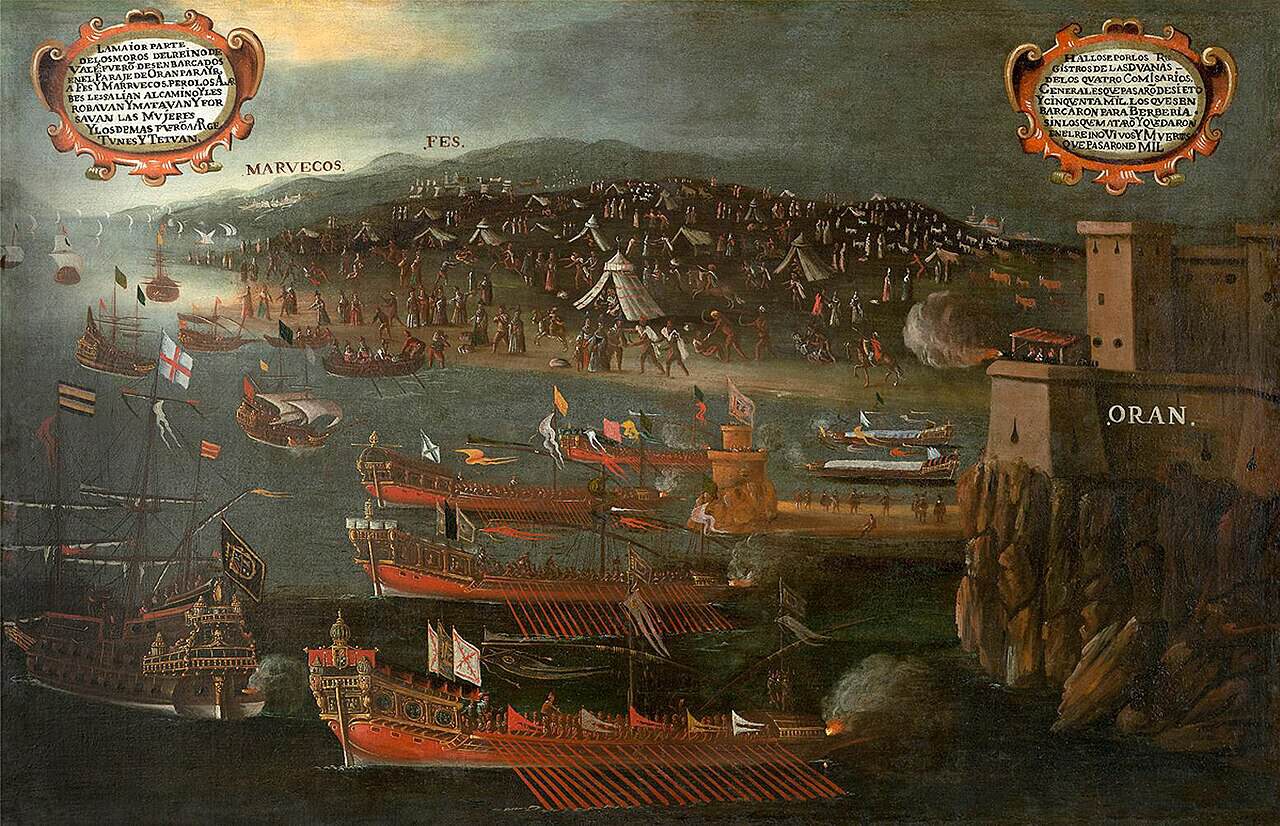
Routes were more varied than a simple Spain-to-North-Africa arrow suggests. Valencian deportees were sent in very large numbers towards Spanish-held Oran and neighbouring parts of the western Algerian coast. Aragonese routes were more varied: some departed through Los Alfaques on the Ebro delta, while others travelled overland through France before eventually reaching Muslim territories. French archival research documents the passage of Moriscos through Languedoc. The Hornacheros of Extremadura followed a well-documented itinerary through Seville, Ceuta and Tétouan to Salé. Others travelled through or around Spanish North African presidios (fortified enclaves).
Three destinations, three stories
The three Maghrebi destinations shared a civilisation, a legal tradition and a maritime space, but the political setting of migration differed substantially — and so did its outcomes.
Algeria: refuge and frontier
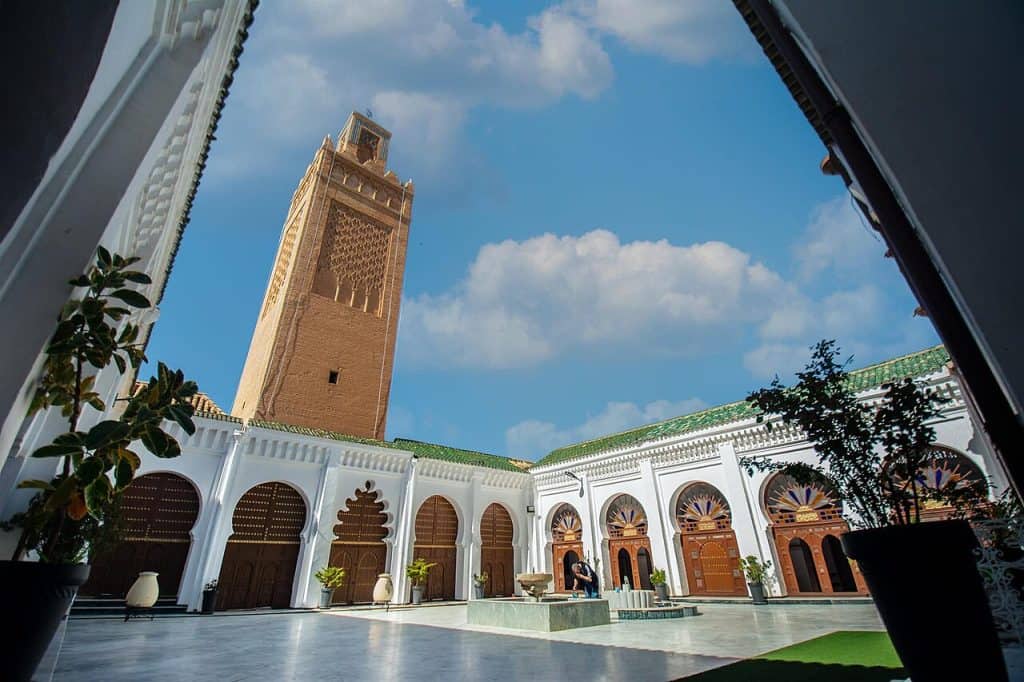
Algeria’s experience was distinctive because the country sat at the intersection of two forces: it was both a destination for displaced Andalusi communities and a strategic frontline in the Ottoman–Spanish struggle for the western Mediterranean. Spanish presidios at Mers el-Kébir and Oran lay beside territories receiving expelled Moriscos, while Ottoman-linked Algiers — developing after 1516–18 into Spain’s principal North African antagonist — simultaneously offered refuge and recruited newcomers into its expanding maritime economy.
This produced not a single “Andalusian colony” but several distinct reception zones:
Tlemcen and western Algeria had the longest Andalusi connections, stretching back to the thirteenth century. Western Algeria also bore the brunt of the earliest Valencian deportations. Beginning in October 1609, about 116,000 people were landed through Spanish-held Oran and directed towards surrounding Algerian territory within roughly two months. As Oran became overwhelmed, ships began landing deportees directly near Cape Falcon and Arzew. Tlemcen and Mostaganem were important destinations, but the sources do not allow all of these arrivals to be assigned to Tlemcen itself.
Conditions on arrival could be catastrophic. Contemporary accounts describe robbery, attacks and deaths from exhaustion and hunger. The same sources also caution, however, that some Christian accounts may have exaggerated the number killed, while Maghrebi sources record local religious figures and authorities later condemning attacks on the newcomers and helping them reach safer towns.
Nedroma, Trara and Honaine in the far west reveal an even longer history. Algeria’s UNESCO tentative-list dossier for Nedroma and the Trara presents Nedroma as a medieval crossroads linking Europe and Africa and identifies Andalusi influence as an important layer in the region’s cultural and architectural history.
Algiers is the best-documented Algerian centre, thanks partly to the Topography of Algiers, traditionally attributed to Diego de Haedo but now closely associated with the testimony of the Christian captive Antonio de Sosa, who observed the city during 1577–81. The account depicts Algiers as a multilingual, cosmopolitan port and explicitly connects increased immigration after the fall of Granada with the expansion of maritime activity. It is especially valuable as a contemporary Christian captive’s description of the city, although its adversarial and polemical perspective requires critical reading.
Studies of Algiers sharia court registers further corroborates a substantial Andalusi presence from 1492 through the final expulsions, with migrants initially retaining social distinctiveness and integrating more fully as prospects of return disappeared.
Cherchell provides one of the clearest examples of an older coastal town being revitalised and architecturally reshaped by Andalusi newcomers. Research on Cherchell’s religious architecture attributes much of the Ottoman-period town’s character to post-Granada settlement, linking the arrivals to the maritime activities of the Barbarossa period.
Blida illustrates the inland dimension. Its sixteenth-century development is traditionally linked to the local saint Sidi Ahmad al-Kabir, a group of Andalusi settlers from the Valencia region and the support of Khayr al-Din in Algiers. A study of Blida in the Encyclopédie berbère dates the establishment of the town for these settlers to 1535. Its development brought together several social components rather than an exclusively Andalusi population — a recurring pattern across Algerian settlement.
For Algiers in particular, the Andalusi case is best understood not through a modern state-refugee model but as a refugee movement embedded in an early-modern maritime frontier. Iberian Muslims represented both a religious constituency and a strategic resource: they knew coastlines, languages, ports and political conditions. Algerian scholarship describes the maritime role of Algiers in helping Iberian Muslims cross to North Africa, while contemporary accounts also connect increased immigration with maritime activity. The term “rescue”, however, requires qualification — not every crossing was an organised humanitarian operation. Some people emigrated independently, some paid for passage, some moved through France, and some were caught within commercial and corsair networks in which rescue, warfare, ransom and profit overlapped.
Morocco: autonomy and the Hornacheros
Morocco had the shortest and most habitual route from Iberia, and it was not under Ottoman rule — a distinction that shaped the entire character of Morisco settlement there.
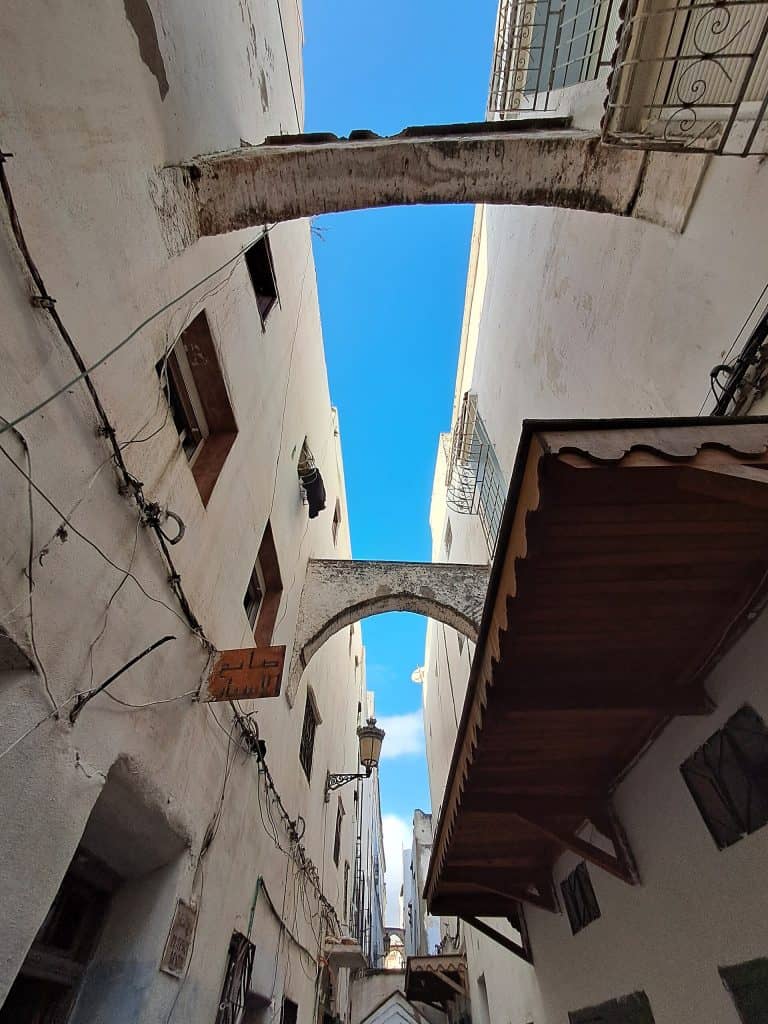
Tétouan is the clearest monumental case. UNESCO states that the city served as an important connection between Morocco and al-Andalus and was rebuilt by Andalusi refugees after the Christian reconquest. Its art, architecture and urban fabric display particularly strong Andalusi influence. UNESCO consequently describes the medina as an exceptional synthesis of Moroccan and Andalusi cultural traditions.
The Hornacheros of Salé offer a remarkably different model. These Moriscos came from Hornachos in Extremadura, where Arabic reportedly remained unusually strong and where prosperous families had accumulated experience in transport and commerce. A detailed study reconstructs their route from Hornachos through Seville, Ceuta and Tétouan to Salé, where about 1,500 families are associated in the sources with the initial settlement. Wealthy members reportedly negotiated the removal of arms and property. They rebuilt and occupied the kasbah (citadel) opposite old Salé, in the area from which modern Rabat developed.
What makes the Hornachero case extraordinary is the degree of political autonomy they achieved. Exploiting Sa‘dian dynastic weakness, the Bou Regreg communities acquired considerable self-governance, with their own governing diwan (council). Corsairing, captive-taking and diplomacy with European powers made Salé–Rabat not merely a refuge but a political experiment produced by diaspora conditions. Jurists such as Ibn ‘Ashir became involved in disputes over authority, legitimacy and relations with neighbouring powers. Their experience demonstrates that diaspora communities could retain a collective political identity for decades — Hornacheros, later-arriving Moriscos and native Saletines did not immediately fuse into a single population.
This Moroccan example also illustrates why “integration” should not be equated with instant assimilation. Moriscos could share Islam with local communities and still be perceived as culturally foreign: shared religion eased legal incorporation, but pronunciation, clothing, Iberian languages, marriage patterns, occupational networks and memories of Spain marked them off from long-established Maghrebi populations.
Tunisia: planned settlement and Ottoman patronage
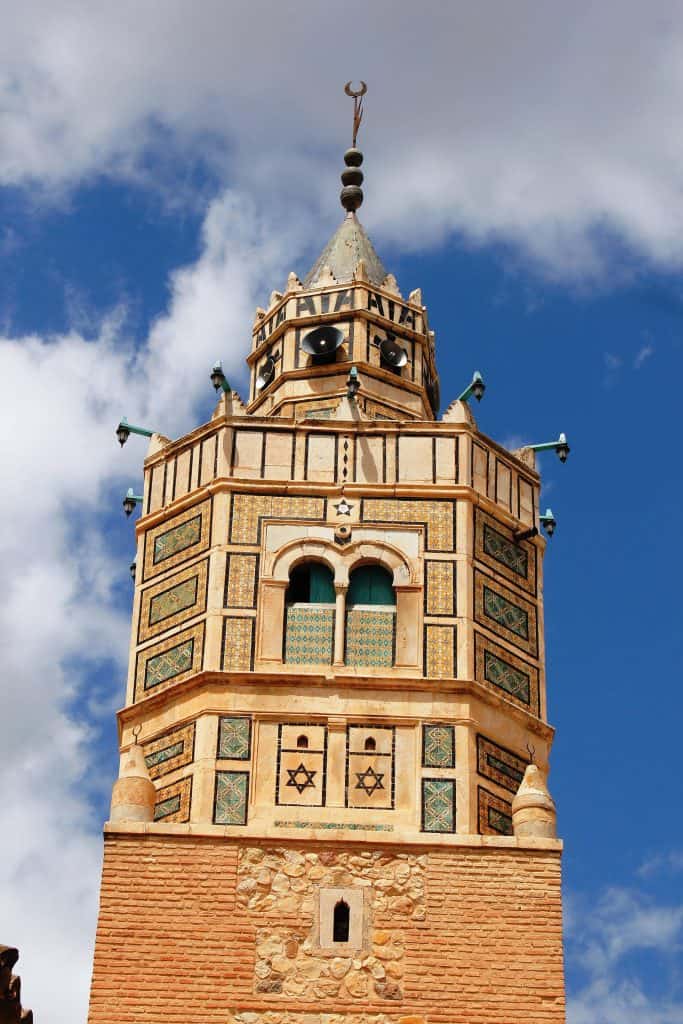
Tunisia, under Ottoman rule, appears to have received one of the most concentrated post-1609 populations and provides unusually strong evidence for deliberate, elite-sponsored refugee integration.
Testour is the outstanding case. Research identifies it as one of the largest Morisco centres of early-seventeenth-century Tunisia. A first settlement tradition is associated with 1610, followed by another substantial wave around 1613; the city developed Andalusi and Tagarin quarters — the latter associated especially with migrants from the former Crown of Aragon — a large mosque, a central square and an unusually regular street network. A visitor in 1634 described Testour as heavily populated by Andalusis, Tagarins and Catalans.
Testour’s significance was both urban and rural. Its Moriscos created an intensive agricultural hinterland using orchards, irrigation works, norias (waterwheels), basins and channels. Yet the same specialist study warns explicitly against claiming that they invented irrigated agriculture in Tunisia — Ifriqiya had a sophisticated hydraulic history of its own. What changed was the combination, intensification and spatial organisation of techniques in new Morisco settlements.
Tunisia also provides particularly clear evidence of elite sponsorship and organised settlement. The Sufi notable Abu al-Ghayth al-Qashshash played an important role in supporting the newcomers, while Uthman Dey and the provincial authorities facilitated their reception and geographical settlement. Tunisian historian Houssem Eddine Chachia’s study of Morisco settlement policy also cautions against attributing the entire resettlement programme personally to Uthman Dey, who died in 1610. The evidence instead points to a broader Ottoman provincial policy involving settlement planning, privileges and cooperation with Morisco leaders. Authorities appear to have perceived the migrants as people whose manpower, capital and specialised skills could strengthen the province.
Technical skills mattered. David James’s study of an Andalusi artillery manual notes that the 1609 expulsion brought architects, military specialists and skilled craftsmen to Tunis, contributing to what he describes as a modest technological flowering. The point is not that Tunisia lacked craftsmen beforehand, but that a sudden concentration of displaced specialists could introduce techniques, stylistic repertoires and occupational connections at unusual density.
Cultural legacies across the Maghreb
The Andalusi contribution to Maghrebi culture is genuine — but it should not be reduced to a story of “Spain exporting civilisation to North Africa”. The Maghreb and al-Andalus had exchanged people, technologies, legal learning and artistic forms for centuries before the expulsions. Maliki law, irrigation technology, courtyard architecture and Sufi institutions already had deep Maghrebi histories. Migration often intensified, recombined or localised these traditions rather than introducing them from scratch.
The most analytically useful way to describe Andalusi influence is as selective transfer followed by recombination: migrants arrived with skills and memories formed in Iberia, but those practices were reshaped by Maghrebi institutions and by interaction with existing Arab- and Amazigh-speaking populations, Ottoman institutions and elites, and other local groups.
Architecture
Architecture shows hybridity rather than transplantation. UNESCO’s description of Tétouan explicitly calls its heritage a synthesis in which Andalusi influence is exceptionally visible but sits alongside wider Maghrebi-Islamic urban practice. At Testour, rectangular street patterns, tiled roofing and details of mosque architecture evoked Iberian towns, yet courtyard houses, mosques, hammams (bathhouses) and souks (markets) also belonged firmly to wider Maghrebi tradition. In Cherchell, Andalusi influence developed within a town with a far older North African history.
Music
Music is one of the most celebrated legacies — and one of the most vulnerable to oversimplification. Medieval Andalusi poetic-musical forms migrated to the Maghreb, and several historically distinct traditions developed across the region. Dwight Reynolds describes the musical culture of medieval al-Andalus as having relocated and flourished in North Africa.
In Algeria, research emphasises that “Andalusi music” is itself an umbrella label, and that the twentieth-century Algerian revival transformed performance, transcription, association life, concert practice and conceptions of the repertoire. Modern san‘a in Algiers, gharnati associated especially with Tlemcen, malouf in Constantine and related traditions are best understood as living North African traditions with Andalusi genealogies — not audio fossils preserved unchanged since the fall of Granada. The Moroccan Andalusi art-music complex and the Tunisian maluf belong to the same wider family — historically rooted in al-Andalus but extensively transformed in North Africa.
Agriculture
The association between Andalusi settlers and intensive agriculture is strong across the Maghreb — Blida and the Mitidja plain in Algeria, orchards and irrigated land around Testour in Tunisia, and orchards and irrigated cultivation in parts of Morocco. Yet in each case, specialist scholarship cautions against claiming that refugees “introduced irrigation” or “invented” techniques that North Africa already possessed. Research on Testour’s Andalusi landscape explicitly recognises older Ifriqiyan hydraulic knowledge while identifying significant Morisco intensification.
Law and Sufism
Maliki jurisprudence already dominated much of the western Islamic world, so Andalusi refugees did not bring an alien legal school. What they brought were additional scholars, manuscripts, scholarly genealogies and particular Iberian experiences of minority life, conversion and persecution. In Morocco, existing Maghrebi jurists — rather than an autonomous Morisco legal system — mediated the newcomers’ political and communal problems. In Algeria, migrants entered an already Maliki legal environment; Algiers sharia court registers show how property, marriage and inheritance were negotiated through existing institutions. In Tunisia, Sufi patrons and Ottoman authorities facilitated incorporation through networks of patronage, privileges and neighbourhood rather than any modern concept of asylum.
Sufism itself demonstrates the depth of pre-expulsion exchange. Abu Madyan’s twelfth-century trajectory connected Andalusi origins with Fez, eastern pilgrimage, Béjaia and Tlemcen. In seventeenth-century Tunisia, Abu al-Ghayth al-Qashshash’s patronage shows established Sufi authority acting as a bridge for uprooted Moriscos. It is more accurate to speak of Andalusi migrants entering and strengthening trans-Maghribi spiritual networks than of distinct “Morisco Sufi orders” spreading wholesale from Spain.
Integration, identity and what the sources can tell us
Across the Maghreb, the question of what happened to the Andalusis after they arrived has no single answer.
In Algeria, sharia court registers trace a gradual process of incorporation: al-Andalusi (“the Andalusi”) survived as a family or origin label, but descendants increasingly entered existing urban and rural populations through intermarriage, property ownership and participation in neighbourhood life. Records point towards gradual incorporation rather than the persistence of a permanently separate legal community.
In Morocco, the Hornachero experience shows that diaspora communities could retain collective political identity for decades — but also that cultural friction between newcomers and established populations was real. Later Moriscos could be criticised or looked down upon for Spanish dress, language and manners, while the wealthier Hornacheros guarded their political privilege.
In Tunisia, the visibility of planned Morisco settlements such as Testour gives the impression of unusually concentrated communities, but even there, incorporation into broader Tunisian society proceeded over generations. Research into their settlement and social integration shows both organised reception and continuing processes of religious, social and economic incorporation.
An important corrective across all three countries concerns language. The assumption that Moriscos were uniformly Arabic-speaking is misleading. Linguistic experience varied greatly by region and period. The Hornacheros seem to have preserved considerable Arabic competence, whereas other groups reached Morocco with conspicuous Spanish language and customs. A 2025 study based on judicial records from around 150 localities found that Arabic-speaking monolingualism was clearly a minority condition among Valencian Moriscos on the eve of expulsion. Some Muslim refugees arriving in North Africa therefore had to acquire or strengthen spoken Arabic even while reclaiming an Islamic public identity.
Why this history matters
The deepest conclusion of the evidence is that Andalusi culture did not simply travel in one direction, from Iberia to North Africa. From the Muslim conquest of Iberia onwards, al-Andalus and the Maghreb shaped one another through centuries of migration, political union, scholarship and trade; later Christian expansion and the Morisco expulsions violently redirected and concentrated those connections.
Each country’s distinctive place in the story came from its own geography and political circumstances. Algeria’s came from Tlemcen’s old Andalusi ties and, later, from Algiers’s position at the heart of the Ottoman–Spanish frontier. Morocco’s came from the Straits, the Andalusi rebuilding and development of Tétouan, and the exceptional political autonomy that emerged at Salé–Rabat. Tunisia’s came from concentrated seventeenth-century resettlement backed by Ottoman provincial institutions.
Modern claims about direct, unchanged descent from medieval al-Andalus need to be distinguished from what the sources can actually demonstrate. A town can authentically preserve Andalusi architectural forms without most of its current residents being demonstrably descended from 1609 refugees. A family can maintain a credible Andalusi origin tradition even when archival proof disappears after several generations. And a musical repertoire can possess real Andalusi roots while having undergone centuries of North African innovation.
What endured was not a frozen transplant of Iberian culture, but Andalusi memories, skills and identities reshaped within North African societies — becoming, over time, part of the broader fabric of Maghrebi civilisation.