Long before the geometric mosaics of North Africa became internationally celebrated, craftsmen in the mountains of present-day Algeria were creating remarkable decorations from glazed ceramic tiles. Stars, crosses and interlocking shapes adorned the floors and walls of palatial buildings, their surfaces reflecting shades of green, white and violet—some shimmering with metallic lustre.
The most important surviving evidence comes from Qal’at Bani Hammad (the Citadel of the Banu Hammad), an 11th-century fortified city in the Hodna Mountains. Archaeological excavations there have uncovered some of the earliest surviving examples of geometric ceramic mosaic in the western Islamic world, including cross-and-star compositions identified as the oldest preserved examples of their kind. These discoveries place Algeria firmly within the early history of zellij (geometric ceramic mosaic), the tradition associated with the great architecture of the Maghreb and al-Andalus (medieval Muslim Iberia).
They also open a largely overlooked chapter of Algerian artistic history—one that finds later expressions in the medieval madrasas (Islamic schools) of Tlemcen, the Ottoman palaces of Algiers, and the living craft traditions of North Africa today.
What is zellij?
The word zellij (also spelled zellige) comes from an Arabic term meaning “small polished stone.” In practice, it refers to a distinctive tradition of geometric mosaic made from individually shaped pieces of glazed terracotta. Each piece—cut or moulded to a precise geometric template—locks together with hundreds of others to produce intricate patterns of stars, rosettes and interlacing bands. In its classical form, the pieces are hand-cut from larger tiles that have already been glazed and fired (heated in a special oven called a kiln). The finished surfaces can cover entire walls, floors, fountains and minarets.
The tradition is most closely associated today with Morocco, where the craft city of Fez has sustained a renowned zellij industry for centuries. But the history of ceramic mosaic in the Maghreb is older and wider than any single country. Fragments recovered from archaeological sites across North Africa and al-Andalus suggest that the technique evolved gradually—drawing on eastern Islamic precedents, regional ceramic expertise and increasingly sophisticated geometric design—before crystallising into the refined art form visitors admire in the palaces of Tlemcen, Fez and Granada.
Although the archaeological importance of Qal’at Bani Hammad has long been recognised by specialists, its contribution to the wider history of ceramic mosaic is less familiar to international audiences. The evidence that survives there tells a compelling chapter.
A fortified city in the mountains
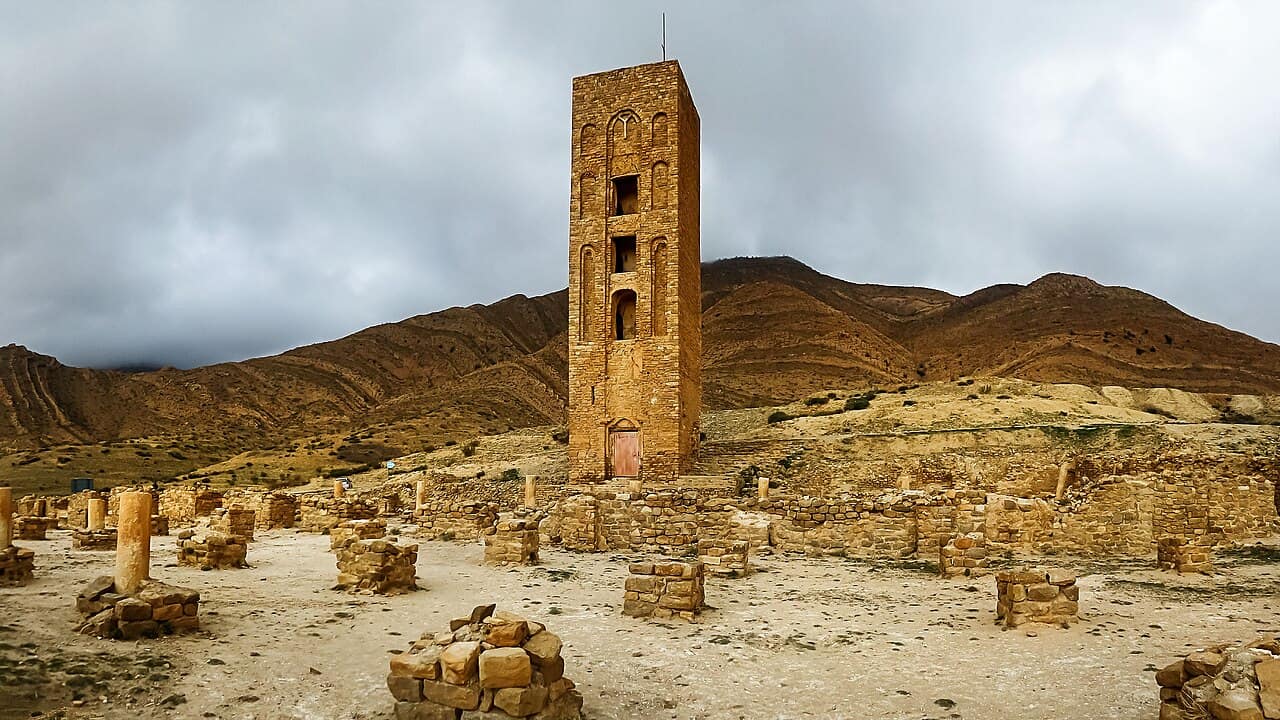
In 1007 CE, Hammad ibn Buluggin—a Sanhaja Amazigh prince whose family ruled much of the central Maghreb—founded a new capital on a plateau in the Hodna Mountains, roughly 200 kilometres south-east of present-day Algiers. Qal’at Bani Hammad grew rapidly into one of the most important cities in North Africa, a commercial and intellectual hub whose markets, mosques and palaces drew travellers and scholars from across the Islamic world.
The 11th-century geographer al-Bakri described a thriving centre of commerce attracting caravans from across the Maghreb and beyond. At its height the Hammadid capital boasted a great congregational mosque, elaborate palaces and fortifications stretching across the mountain landscape. The largest palace—the Qasr al-Bahr (Lake Palace)—featured a vast ornamental basin surrounded by decorated halls and pavilions.
The city’s pre-eminence was relatively short-lived. Threatened by Hilalian Arab incursions in the 11th century, the Hammadid court relocated to Béjaia on the Mediterranean coast around 1090. The former capital subsequently declined and was devastated during the Almohad conquest of 1152. By the time the French archaeologist Paul Blanchet surveyed the site in 1897, it was a vast field of crumbling walls and scattered debris.
Yet beneath the rubble lay extraordinary treasures—among them, some of the earliest ceramic mosaics known from the medieval western Islamic world.
What the archaeologists found
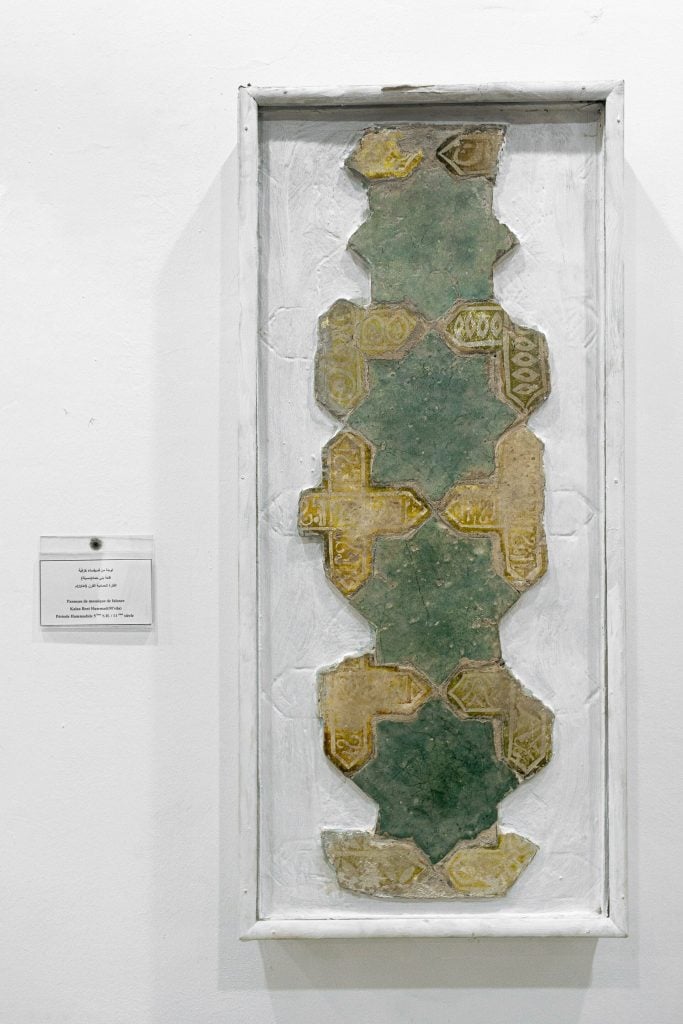
Archaeological investigation of Qal’at Bani Hammad began in the late 19th century, followed by important excavations conducted by Léon de Beylié and Georges Marçais in 1908. Further campaigns under the French archaeologist Lucien Golvin in the 1950s and early 1960s considerably expanded knowledge of the city’s palaces and decoration. Later investigations by the Algerian archaeologist Rachid Bourouiba also contributed to the understanding of the site. Excavations uncovered numerous ceramic fragments—glazed tiles shaped into geometric forms and arranged as mosaic panels on floors and wall surfaces.
The range of shapes was striking: eight-pointed stars, elongated hexagons, crosses, lozenges and narrow filler pieces designed to interlock in repeating patterns. Many were coated in lead-based glazes, sometimes opacified with tin, producing colours ranging from green and blue to yellow and white. Some tiles bore a distinctive metallic sheen—a technique known as lustre, in which a thin film containing metallic compounds was applied to the glazed surface and fired a second time in a reducing kiln to produce an iridescent finish.
Georges Marçais, writing decades earlier, had already noted the exceptional quality of ceramic work at the site. The subsequent Golvin excavations confirmed and greatly expanded the picture. Fragments recovered from the Qasr al-Bahr and the Qasr al-Manar (Lighthouse Palace) revealed that ceramic mosaics were used extensively on floors and walls—not merely as ornamental borders, but as a major architectural surface treatment.
One important distinction separates these Hammadid mosaics from the mature zellij tradition practised in later centuries in Fez or Meknes. The Hammadid tiles appear to have been purpose-shaped from raw clay before firing—each piece moulded or cut to its geometric template while still soft, then glazed and fired. The later cut-tile technique, by contrast, involves glazing and firing large square tiles first, then chipping them into shape from the back with a sharp hammer (menqash, a tile-cutting hammer). Whether this earlier method contributed directly to the development of later cut-tile zellij, or represents a related tradition within a broader history of ceramic mosaic, has not been conclusively established.
What is not in doubt is the sophistication of the results. Many of the surviving fragments are now held in the Musée National des Antiquités et des Arts Islamiques in Algiers and the Musée du Louvre in Paris, where they testify to a ceramic art of remarkable ambition and skill.
Made in Algeria?
For a long time, it was unclear whether some of the Hammadid glazed ceramics had been produced locally or imported from more established ceramic centres further east. The question mattered: if the mosaics were made on site, it would mean that the Hammadid court sustained skilled ceramic workshops capable of producing lustre-decorated tiles—a technically demanding achievement.
Recent scientific work has strengthened the case for local production. A 2018 study by Brahmi and Hamiane, using techniques including X-ray fluorescence analysis, examined the chemical composition of architectural ceramics from the site, providing important data on their materials and glazes. More decisively, a 2026 study by Djellid, Salinas and Pradell—published in the Journal of Archaeological Science: Reports—applied advanced microscopic and chemical techniques to a wider range of Hammadid glazed ceramics. Their analysis, incorporating kiln equipment discovered during a 2024 survey, identified a substantial group consistent with local manufacture, including lustre-decorated tiles. Other fragments appeared to have been imported from centres including Egypt and al-Andalus.
Taken together, these findings point to a local ceramic industry of considerable sophistication. The Hammadid workshops were not merely assembling imported tiles; they appear to have been manufacturing complex glazed and lustred ceramics. The presence of imported wares also reveals a ceramic industry connected to wider Mediterranean trade. This positions Qal’at Bani Hammad not just as a site where ceramic mosaic was used, but as a place where it was made—an important early production centre in the western Islamic world.
Roots in an older tradition
The Hammadid mosaics did not emerge from nothing. By the 11th century, the broader Maghreb had already accumulated generations of experience with architectural ceramics.
The Aghlabid and Fatimid courts of Ifriqiya (a historical region centred on present-day Tunisia) had been producing and importing sophisticated glazed ceramics from at least the ninth century. At Raqqada, the Aghlabid palatial complex near Kairouan, archaeologists have recovered richly decorated glazed pottery. The nearby Great Mosque of Kairouan preserves earlier examples of lustre tiles imported from Mesopotamia. The Fatimid capital of Sabra al-Mansuriyya, founded in 947 CE, has also yielded significant ceramic finds, including evidence of local lustre production by the late tenth and early eleventh centuries. These discoveries attest to the circulation of luxury ceramics and specialist knowledge across the Mediterranean, as well as the development of local craftsmanship.
Closer to the Hammadid heartland, the Rustamid imamate had governed much of the central Maghreb from its capital at Tahert (near modern-day Tiaret) during the eighth and ninth centuries. A 2023 archaeological study identified evidence of a local workshop producing glazed pottery at Tahert during the ninth century, including kiln equipment and manufacturing waste. The findings place Tahert among the earliest archaeologically documented centres of glazed pottery production in North Africa. Although these ceramics differed from the architectural mosaics later produced at Qal’at Bani Hammad, they demonstrate that sophisticated ceramic knowledge was already established in the central Maghreb approximately two centuries earlier.
The Hammadid achievement, then, is best understood not as an isolated invention but as a creative synthesis. The dynasty’s craftsmen drew on a well-established regional tradition of glazed ceramics, applied it to architectural surfaces with considerable ambition and geometric complexity, and—as the archaeometric evidence now suggests—produced sophisticated glazed ceramics, including lustre-decorated tiles, locally. What emerged was something distinctive: a ceramic mosaic tradition of a scale and sophistication that ranks among the earliest securely documented in the western Islamic world.
A tradition that endured
The fall of the Hammadid capital did not extinguish the ceramic arts in Algeria. As political power shifted, ceramic decoration continued to develop—most visibly in later centuries in the western city of Tlemcen, which became a major centre of Islamic art and learning under the Zayyanid dynasty (1235–1556 CE).
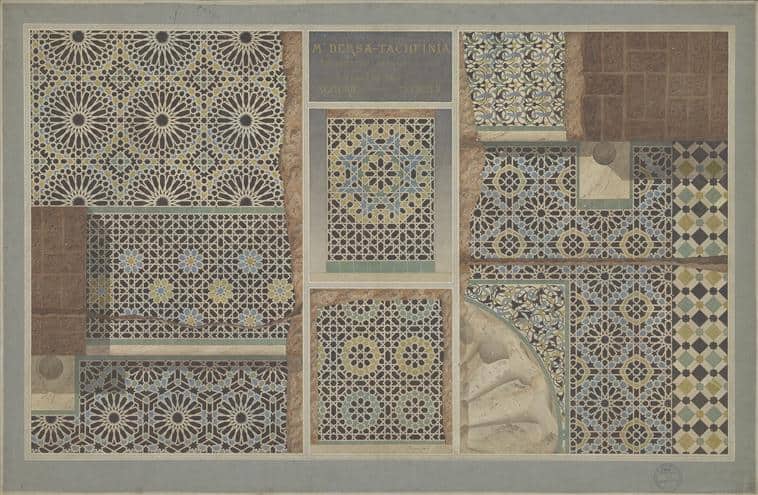
The Zayyanids, and the rival Marinid dynasty that periodically seized control of the city, invested heavily in monumental architecture. Tlemcen’s great complexes—including the mosque and mausoleum of Sidi Boumediene, the Tashfiniya Madrasa and the Mechouar Palace—were decorated with polychrome ceramic tilework of considerable refinement. Among the most celebrated was the Tashfiniya Madrasa, whose elaborate zellij panels were documented by the 19th-century French artist and architectural recorder Edmond Duthoit. The building was demolished during French colonial redevelopment in 1876, despite efforts to preserve it. Duthoit’s drawings and the surviving fragments remain important records of what was once there.
At the Sidi Boumediene complex, whose mosque was built in 1339 under the Marinid sultan Abu al-Hasan, visitors can still see ceramic mosaic adorning the monumental entrance and minaret. The geometric and floral patterns bear a recognisable kinship with contemporary work in Fez and Meknes—hardly surprising, given the close political and artistic connections between cities under Marinid patronage.
Ceramic decoration remained prominent into the Ottoman period, although its techniques and visual styles evolved. After 1516, the Ottoman governors of Algiers commissioned palatial residences whose interiors were lavished with ceramic decoration. Among the finest surviving examples is Dar Mustapha Pacha, a palace in the Casbah of Algiers built between 1798 and 1800. Historical accounts estimate that its interiors contain more than half a million faience (glazed earthenware) tiles, many reflecting the decorative traditions of European ceramic workshops. Unlike the individually shaped mosaics associated with medieval zellij, these painted tiles illustrate another chapter in Algeria’s ceramic history—one shaped by trade, changing tastes and connections across the Mediterranean. Nearby, Dar Aziza and Dar Khedaoudj el-Amia preserve further examples of Ottoman-era tilework, drawing on Maghrebi, Anatolian and European decorative traditions.
Taken together, these sites reveal successive chapters of ceramic artistry in Algeria, from the 11th-century Hammadid workshops to the palaces of Ottoman Algiers—and into the living craft traditions of today.
A thousand-year legacy
Qal’at Bani Hammad was inscribed as a UNESCO World Heritage Site in 1980, recognised for its exceptional testimony to the Hammadid civilisation and its influence on Islamic architecture in the Maghreb. Yet its artistic importance remains less familiar to many international audiences than that of better-known Islamic monuments elsewhere in the Maghreb and al-Andalus, and many of its ceramic treasures are dispersed across museum collections in Algiers, Paris and elsewhere.
That may be changing. Recent archaeometric studies have renewed scholarly interest in the site and its ceramic industries. Meanwhile, museums, researchers and craftspeople across the Maghreb are working to preserve and reinterpret traditional crafts, including zellij, for contemporary audiences. In Algeria, the Ahmed Zabana Museum in Oran hosted a training workshop in May 2026, led by a master craftsman from Tlemcen, introducing participants to traditional tile-making techniques. Such initiatives connect the surviving historical record with efforts to maintain and transmit specialist knowledge.
In Algeria, the geometric mosaic tradition is both a living craft and a window onto a shared cultural past. The tiles of Qal’at Bani Hammad are not merely museum pieces. They are evidence of a moment when the craftsmen of the central Maghreb—drawing on local expertise and a cosmopolitan visual language from across the Islamic world—created ceramic decoration of remarkable sophistication. Their work belongs to a wider history of an art form that would be elaborated, refined and celebrated across North Africa and al-Andalus for centuries to come.
Algeria’s contribution to that artistic history is written in glazed ceramic, preserved beneath the mountains, and still being read.