

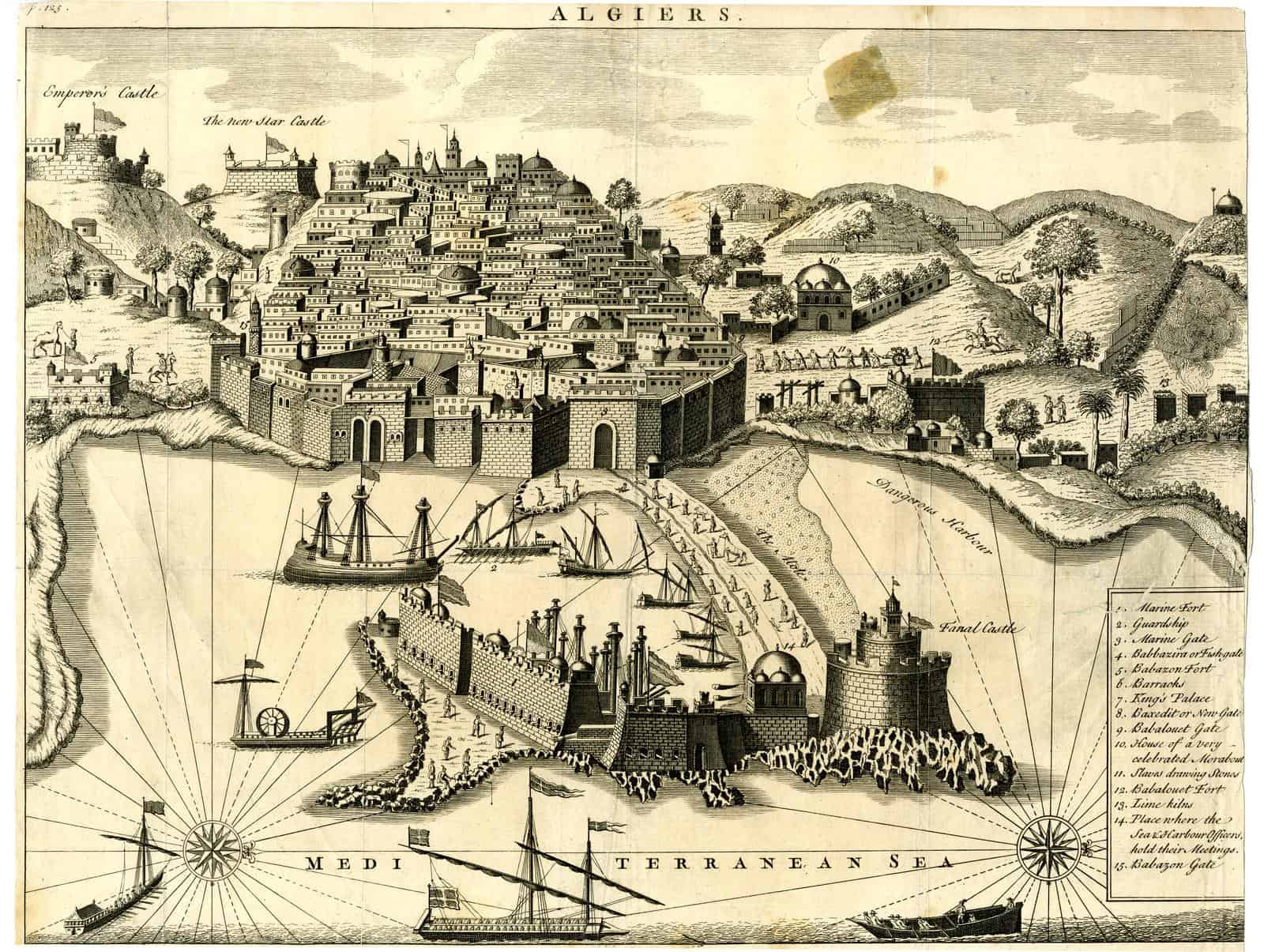
For roughly three hundred years, the Regency of Algiers was one of the principal centres of a Mediterranean-wide system in which European Christians were captured, bought, sold and compelled to labour. Tens of thousands passed through the city’s slave markets and bagnios (large captive barracks), from which enslaved men were dispatched to galleys, construction sites, arsenals and private households. Some were ransomed and sent home. Some died in bondage. Some converted to Islam, were later manumitted (the formal freeing of an enslaved person by an owner or through a recognised legal process), married into local society and became harder to trace in the European records that once counted them. A very small number rose to extraordinary power.
That range of outcomes—from galley death to grand admiral—is precisely what makes this history so easy to distort. Popular accounts tend to collapse it into one of two competing caricatures. In one version, Algiers was a system in which European captives were uniformly brutalised or worked to death; in the other, the institution was mild and conversion offered an easy route to freedom. Neither survives contact with the primary sources. The strongest contemporary accounts—Antonio de Sosa, writing from personal captivity in the 1570s; Emanuel d’Aranda, enslaved in Algiers in the 1640s; William Okeley; and Joseph Pitts—describe a society in which slavery was legally recognised and people were bought, sold, compelled to labour and physically disciplined, but where ransomability, skill, age, owner, occupation and political circumstance could produce vastly different material conditions.
Getting this right matters for Algerian history and for the wider Mediterranean past, neither of which can be understood through a single national lens. It also matters because distorted history—in either direction—is easily recruited into modern political arguments far removed from the early-modern world.
How people became captives
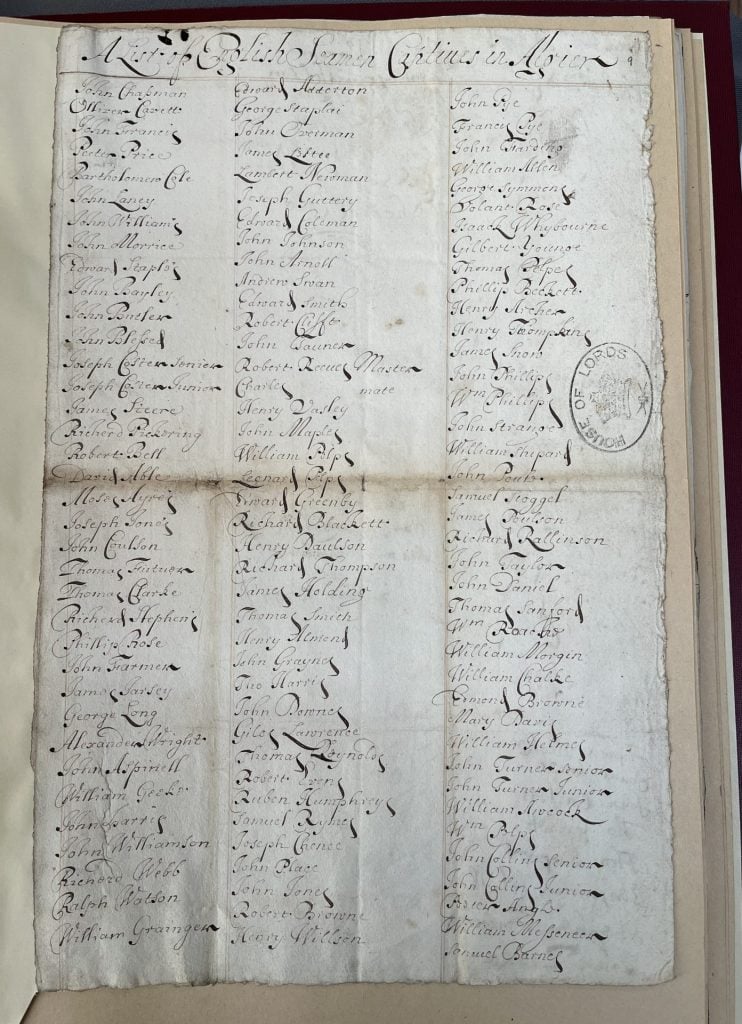
The largest stream of enslaved Europeans entering Algiers consisted of men captured at sea. Corsairs operating under political authority from the Regency cruised Mediterranean and, increasingly in the seventeenth century, Atlantic shipping routes, pursued merchant vessels and fishing craft, and forced crews and passengers to surrender. Bernard Capp’s major study of British captives, British Slaves and Barbary Corsairs, 1580–1750, reconstructs the tactical calculations confronting merchant crews—fight, flee or submit—and notes that early surrender could sometimes prevent the additional violence inflicted after armed resistance.
A second route was the coastal raid. Corsair squadrons attacked vulnerable settlements across Italy, Spain, Mediterranean islands and occasionally much farther afield. The Oxford Research Encyclopedia’s synthesis cites a particularly large Algerian-Ottoman raid in the Bay of Naples in 1544 that reportedly carried off around 7,000 people, although large round figures in early accounts should be treated cautiously. Events on that scale were exceptional, but they demonstrate that enslavement was not confined to sailors.
A third route was ordinary war captivity within the prolonged Ottoman-Habsburg conflicts—the rivalry between the Ottoman Empire and the Habsburg powers of Spain and central Europe—and the wider Muslim-Christian conflicts of the sixteenth century. The boundary between naval warfare, corso (licensed corsairing) and piracy was largely a matter of political perspective: Algerian captains operated under prize conventions that could make a seizure legitimate in Algiers while the victim’s government characterised the same action as criminal.
Upon arrival, captives were assessed according to physical condition, skills, age and expected ransom value. A wealthy merchant, officer or noble might yield far more as a ransom asset than as a labourer, which gave owners a financial reason to keep valuable prisoners alive while bargaining over price. Skilled artisans—shipwrights, smiths, carpenters—could likewise command a premium. Public authority, corsair investors and private buyers all participated in this captive economy, meaning that ownership and employment could change repeatedly during a single person’s captivity.
The numbers: what we know and what we don’t
No complete Algerian register survives from which a three-century total can be calculated. This is not unusual for the early-modern period—no comparable census exists for most slave populations of that era—but it means that modern estimates are reconstructions, not counts.
The most widely cited figure comes from Robert C. Davis, who estimated that roughly one to 1.25 million European Christians were enslaved across the Maghreb—not Algiers alone—between the sixteenth and eighteenth centuries. The Oxford Research Encyclopedia continues to report an upper estimate of about 1.25 million Christian captives for the Maghreb between 1530 and 1780. But Davis’s calculation depends heavily on extrapolating from better-documented high-intensity periods, so the figure remains a reconstruction rather than a count.
The distinction that matters here is between what historians call stocks—the number of captives present at a given moment—and flows—the cumulative number captured over decades or centuries. Multiplying an uncertain stock estimate by an assumed annual replacement rate is precisely where modern totals become controversial.
Accordingly, statements such as “1.25 million white slaves in Algiers” are not supported by the evidence. A more defensible formulation: hundreds of thousands of Europeans were almost certainly enslaved across the Barbary states over the early-modern period; a high-end reconstruction reaches roughly one to 1.25 million; Algiers was one of the most important centres, but its own cumulative total is unknown.
The eighteenth-century decline is much more visible. Federico Cresti’s comparison of European estimates records approximately 2,000 captives in Venture de Paradis’s estimate for 1787 and only 500 in his estimate for 1789, while other observers in the same period produced figures ranging from several hundred to around 2,000. The precise numbers vary by observer and year, but the direction of travel is clear: this was a very different order of magnitude from the tens of thousands claimed by observers during the sixteenth- and seventeenth-century peak. Whatever the reliability of the earlier figures, the late-eighteenth-century evidence fits the wider pattern in which treaties, stronger European navies and more systematic diplomacy had substantially reduced Mediterranean Christian captivity.
Not “white slavery”
A note on terminology is unavoidable. The expression “white slavery” appears frequently in popular treatments, but it imposes a modern racial category onto a legal and political system that operated along quite different lines. Two Christians of similar appearance could have very different legal exposure depending on their sovereign allegiance, Ottoman subjecthood, treaty protections and the circumstances of capture. What determined a person’s status was above all religion and political-juridical belonging— not physical appearance or skin colour. Ottoman freedom suits studied by Joshua M. White explicitly show that legal enslavability was organised around religion and subjecthood rather than ethnicity or skin colour.
This also matters because the Mediterranean system was reciprocal. Muslims from the Maghreb were simultaneously held as slaves in Malta, Tuscany, Spain and France. Captives on both sides organised religious communities, petitioned governments and participated in exchange and ransom systems. The coercion suffered by European captives in Algiers was real, but it belongs within the political economy of the early-modern Mediterranean rather than a framework retrofitted from later racial categories. Modern scholarship on Mediterranean slavery increasingly emphasises this reciprocal context. Reciprocal does not mean identical in scale, legal structure or conditions; it means that enslavement operated across the religious divide in both directions.
Islamic law and enslavement in the Ottoman-Regency context
Classical Islamic jurisprudence did not authorise the indiscriminate enslavement of anyone a corsair could physically seize. Under Islamic and Ottoman law, free Muslims and protected non-Muslim subjects could not lawfully be enslaved, while treaties and safe-conducts could also protect foreign Christians from capture. Lawful enslavement could arise from recognised forms of wartime captivity and, in certain circumstances, inherited slave status. Ottoman documentary evidence shows imperial authorities entertaining freedom suits and ordering the release of unlawfully enslaved Ottoman subjects.
In practice, this left a substantial grey zone. Was a particular Christian ship protected by a treaty? Had the victim been sailing under an enemy flag? Was his ruler at peace with Algiers? These were not abstract questions. Treaties could make subjects of one Christian kingdom protected merchants while subjects of another remained lawful prizes. Gillian Weiss’s Captives and Corsairs shows how French-Ottoman capitulations and French consular diplomacy repeatedly sought precisely this kind of protection.
One legal point is essential for understanding the Christian narratives: conversion to Islam did not automatically free an enslaved person. Standard Islamic legal doctrine explicitly distinguishes becoming Muslim from being manumitted. An enslaved Christian who professed Islam acquired a new religious identity, but his pre-existing ownership was not cancelled. This explains why contemporary accounts describe “renegade slaves”—a convert could remain the legal property of a master until formally freed.
In practice, conversion could still be enormously consequential. A master might free a convert, especially a capable young man who could enter his household, crew or patronage network. A convert might also obtain greater freedom of movement or become socially integrated over time. But these were social and economic consequences of conversion, patronage and manumission—not an automatic legal rule that Islam freed any slave who converted.
Life in bondage
The word bagnio can mislead modern readers. In European accounts of Algiers, it referred not to a prison in the modern sense but to a large captive barracks from which enslaved men might be sent to various forms of work. Some captives were confined closely; others were permitted significant movement during the day and returned at night. Abla Gheziel’s study of captivity in the Regency illustrates the considerable variety of situations concealed by the single category of “captive”.
The harshest routinely documented labour was galley service—rowing under coercion, exposed to violence, disease, poor sanitation and the dangers of naval combat. Capp stresses, however, that conditions on oared galleys should not automatically be projected onto later sail-driven Algerian warships, since the labour systems changed as naval technology evolved. And Christian galleys employing Muslim slaves provide an important comparative reminder that this form of maritime forced labour was Mediterranean, not uniquely Algerian.
Land labour ranged from construction, port and arsenal work to domestic service and skilled crafts. Owners had a financial interest in exploiting a captive’s existing expertise, which helps explain the apparent contradiction between captivity narratives describing severe physical exploitation and others describing slaves conducting business in the city.
Okeley’s experience is a particularly useful corrective to stereotypes. While enslaved, he was allowed to operate a shop and pay his owner a regular sum, retaining profits beyond that obligation. His experience was still slavery—he could be bought and sold—but economically it resembled a hiring-out arrangement: he paid his owner an agreed sum while retaining some of the surplus he earned. D’Aranda’s narrative demonstrates another dimension: slaves could pass through several owners and their treatment could change sharply with each sale.
Violence was inherent in the institution. Captivity began with armed seizure; resistance could lead to wounds or death; the market subjected captives to inspection; compulsory labour was backed by punishment. But source criticism is important. Catholic redemption orders raised money by publicising Christian suffering. Father Pierre Dan’s influential Histoire de Barbarie explicitly framed its captives through their “miseries” and “cruel torments”. Protestant captivity narratives likewise frequently presented slavery as a providential trial and conversion to Islam as apostasy. Such accounts contain indispensable evidence, but their rhetoric cannot be treated as a neutral statistical description of everyday conditions.
A general Algerian mortality rate simply cannot be reconstructed. Galley slaves, quarry labourers, domestic servants, commercially active artisans and high-ransom gentlemen did not share the same hazard profile. The evidence also contains opposing selection effects: memoirs select for survivors, ransom lists select for persons still alive and considered recoverable, and institutional correspondence is most detailed when captives had patrons at home. Gheziel’s study similarly emphasises the variety of captive situations. There was no single “typical” experience.
Routes out of slavery
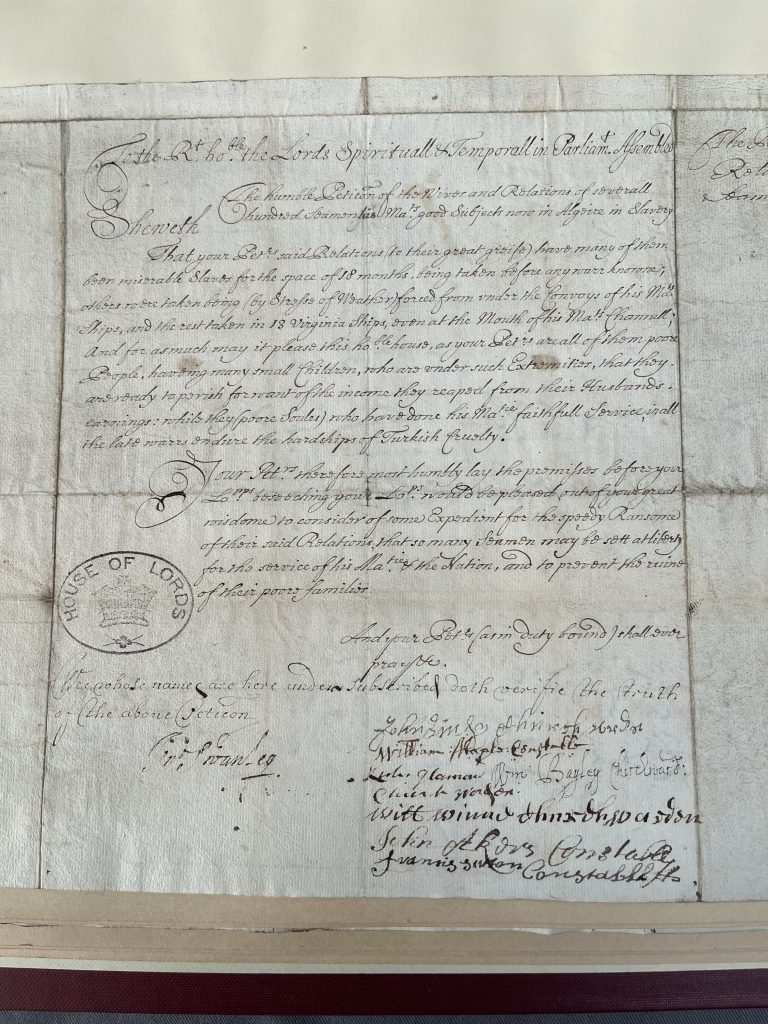
The documented outcomes of captivity include several overlapping categories: ransom or diplomatic exchange; individual manumission; escape; death in bondage; and conversion followed—sometimes but not automatically—by eventual freedom and integration.
Ransom was central enough to shape the economics of capture itself. Catholic Europe possessed specialised institutions for redemption—the Trinitarian and Mercedarian religious orders collected alms, travelled to North Africa, bargained with owners and returned with groups of redeemed Christians. Weiss traces how French redemption gradually shifted from a work of Catholic charity towards diplomatic and governmental intervention, contributing to French state-building and, eventually, colonial rhetoric.
Protestant states developed different mechanisms. English captives and their families petitioned local and central authorities; charitable “briefs” authorised nationwide collections; and a customs surcharge known as the “Algiers duty” was introduced in the mid-seventeenth century. Capp’s study documents these English mechanisms. Merchants and consuls served as indispensable intermediaries because money, identities and safe-conducts all had to move between hostile jurisdictions.
Conversion motives ranged across a spectrum the sources rarely allow us to reconstruct with certainty. Coercion occurred; so did promises of better conditions, attraction to Muslim society, marriage, career ambition, youthful acculturation and genuine religious conviction. Capp explicitly rejects a single model, finding cases of coercion, resignation and incentives as well as conversions that became sincere over time.
Joseph Pitts illustrates the ambiguity. Captured as a teenager in 1678 and sold in Algiers, he converted to Islam while enslaved and later travelled to Mecca with his master, becoming one of the earliest English eyewitnesses to describe the Hajj (pilgrimage to Mecca). He eventually returned to England and Christianity and presented his conversion as coerced. Modern scholarship treats his narrative not as transparent autobiography but as a text shaped by the need to explain to an English Christian readership what it regarded as his apostasy.
Captives, converts and “renegades”: who actually rose from slavery?
“Renegade” is used here as a historical European label for Christians who entered Muslim society and often converted to Islam; contemporary Christian writers commonly used it pejoratively. Maartje van Gelder’s study of Dutch converts notes both the term’s negative connotations and the much more complicated social position of the people to whom it was applied.
A crucial analytical distinction in this history is one that popular accounts almost always fail to make. There are two populations routinely collapsed into one:
Category A comprises Europeans who were genuinely enslaved, then converted and/or were manumitted, integrated into Muslim society and subsequently attained social or political success.
Category B comprises European-born voluntary migrants—pirates, privateers, soldiers, adventurers—who adopted Islam without first being slaves. Their careers demonstrate the permeability of the Ottoman-Maghrebi frontier, but they are not evidence for social mobility out of slavery.
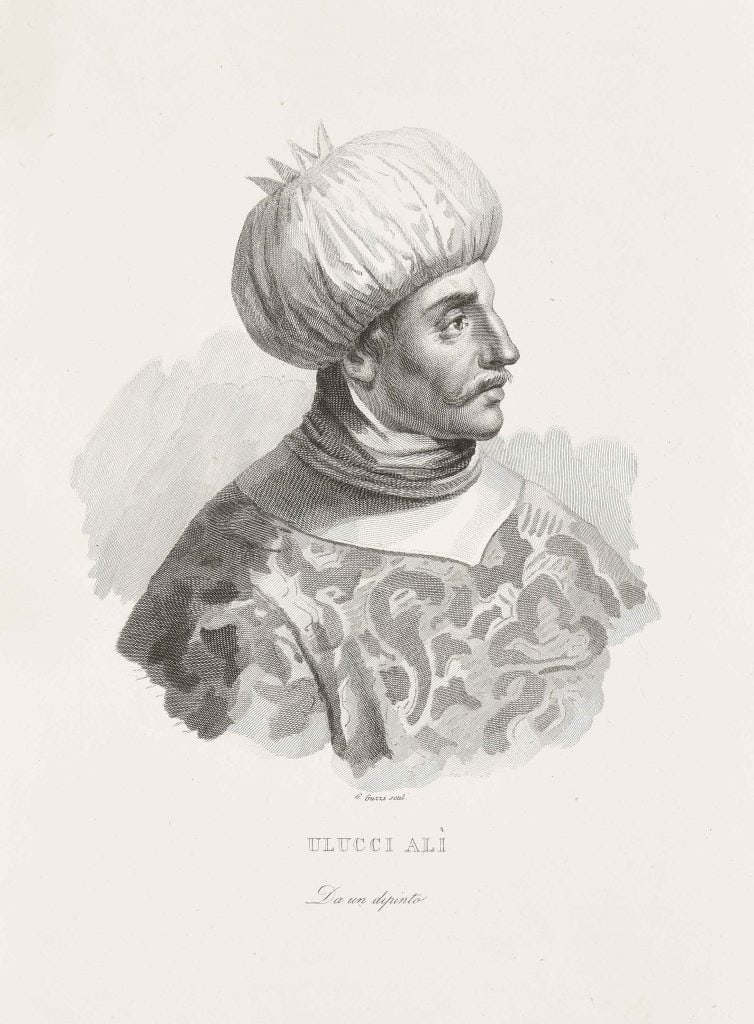
The clearest Category A case is Uluç Ali Pasha (Giovanni Dionigi Galeni, c. 1519–1587). An Italian Christian from Calabria, he was captured and enslaved, converted after a period of servitude, rose through the corsair world, governed Algiers from 1568 into the early 1570s, and after the Battle of Lepanto became Ottoman grand admiral—a position he held until his death. Modern archival scholarship on Uluç Ali connects his extraordinary career to his Christian origins and subsequent rise through Ottoman service. His trajectory was exceptional, but it was facilitated by a particular historical setting: sixteenth-century Algiers was a rapidly expanding Ottoman frontier polity in which naval expertise, personal patronage and successful prize-taking could generate unusual mobility.
Hasan Veneziano, born Andrea Celeste in Venice in 1544, is another well-documented captive-to-elite case. Emrah Safa Gürkan’s archival study records his capture by Turgut Reis in 1563, his subsequent conversion to Islam and, after Turgut’s death, his entry into Uluç Ali’s household. He later governed Algiers twice, in 1577–80 and 1582–85, before rising still further in Ottoman naval service.
Ali Bitchin (d. 1645), the extraordinarily powerful corsair captain whose household d’Aranda described from personal experience as one of his slaves, presents a more cautious case. Later traditions describe him as an Italian boy captured and sold in Algiers, but the early link in the chain rests on a thinner evidential base than popular accounts imply.
Now consider Category B. Ivan Dirkie de Veenboer, who became Süleyman Reis, was a Dutchman recruited into Simon de Danser’s North African corsair network. Van Gelder’s archival study identifies De Veenboer as Süleyman Reis and shows that by 1617 he commanded four or five ships, sat on the corsair ta’ifa (corporation) and the diwan (council), and was chosen admiral of the Algerian corsairing fleet. The documented career does not contain an intervening episode in which he was captured or sold, so he should not be counted as evidence that slaves routinely became admirals.
John Ward, the classic English renegade corsair, operated principally from Tunis and entered the corsair world by choice. Capp treats Ward as distinct from captive converts. His fame has helped popularise an image in which “European renegade” and “former Christian slave” seem interchangeable; historically, they are not.
Once voluntary adventurers are removed from the tally, the roster of unambiguous formerly enslaved Europeans who attained the highest offices becomes dramatically shorter. Several powerful selection effects explain why elite renegades look more common than they were. A man who rose from Italian slave to Ottoman grand admiral generated chronicles, correspondence and diplomatic intelligence; a former slave who converted, was manumitted and became an ordinary sailor generated almost none. Christian observers were also fascinated by apostates commanding Muslim fleets, making renegades disproportionately memorable in the sources.
The most defensible conclusion: upward mobility was institutionally possible, occasionally spectacular, but statistically exceptional at the elite level. Among genuine captives, conversion was far more common than ascent to the ruling elite. And an unquantifiable number of manumitted converts simply disappeared into ordinary Algerian life—an outcome that is, by its nature, the least visible in the surviving record.
The decline of European captivity
European captivity in Algiers contracted long before the French conquest of 1830 brought the Regency to an end. In the eighteenth century, bilateral treaties and the growing power of European navies progressively reduced the number of nationalities vulnerable to capture. The United States’ treaty settlement with Algiers in 1795 led to the release of surviving American captives the following year after years of bondage.
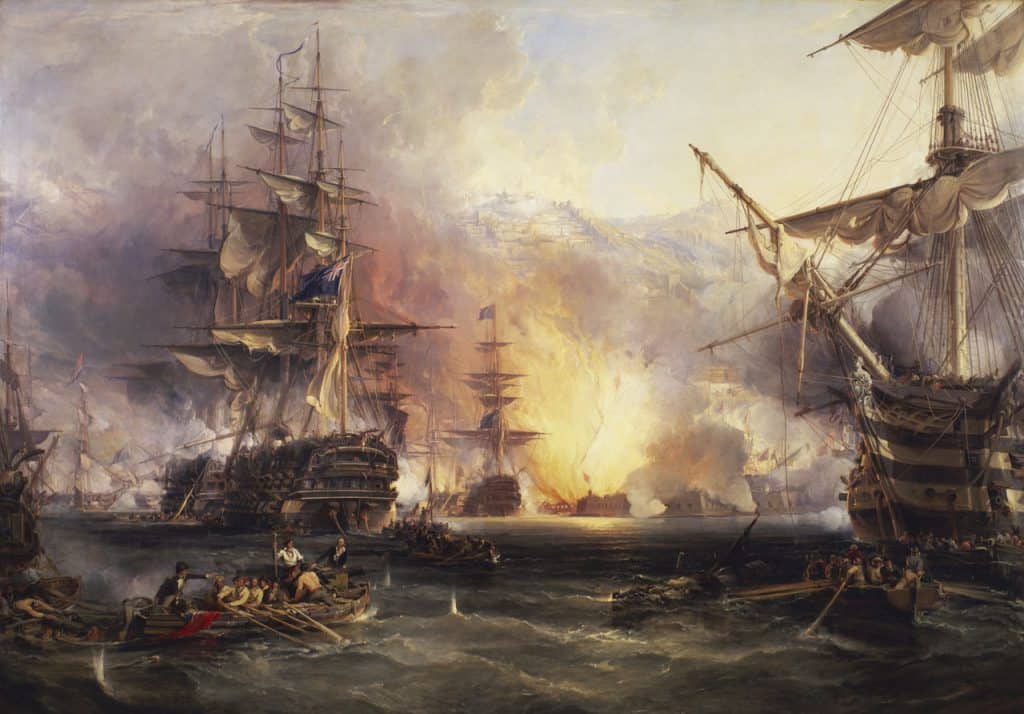
In 1816, Lord Exmouth’s Anglo-Dutch expedition bombarded Algiers with the explicit purpose of compelling the release of Christian captives and ending the enslavement of Europeans. The settlement did not abolish slavery as an institution in Algeria; its immediate focus was the release of Christian captives and a commitment against the future enslavement of Europeans. Abdeljelil Temimi’s publication of Ottoman documents relating to the bombardment provides an important counterweight to an episode long reconstructed predominantly through European records. As the late-eighteenth-century estimates above show, however, European captivity had already contracted sharply from its seventeenth-century peak before 1816, and it shrank further in the decades that followed.
What the evidence supports—and what it doesn’t
The long-term trajectory is not one of an institution operating unchanged for three centuries. European enslavement expanded with sixteenth-century Ottoman-Habsburg warfare, flourished alongside seventeenth-century corsairing and ransom, and then contracted as bilateral treaties, stronger European naval forces and increasingly systematic diplomacy protected more nationalities from seizure.
The evidence supports neither romanticisation nor sensationalism. Algiers was neither a place where every captive experienced identical brutality nor a benign system of temporary detention. It was a society in which slavery was legally recognised, commercially organised and enforced through coercion, where ransomability, skill, age, owner, occupation and political circumstance could produce exceptionally different material conditions.
Conversion could change a captive’s horizon without automatically changing his legal status. Genuine slave-to-elite careers existed—Uluç Ali’s is beyond serious doubt, and Hasan Veneziano provides another well-documented example—but the celebrated success stories are a tiny, highly selected fragment of the institution’s history rather than its representative outcome.
And the history should not be reduced to a simple morality play between religions. Muslims from the Maghreb were simultaneously enslaved across the Christian Mediterranean. Recognising that reciprocity does not diminish the coercion suffered by European captives in Algiers; it locates that coercion within the political economy of its time rather than projecting later frameworks backwards onto it.
The captive narratives of Sosa, d’Aranda, Okeley and Pitts remain indispensable. But they are most revealing when read alongside Ottoman legal records, Algerian and Regency evidence, diplomatic archives and modern Mediterranean scholarship. Taken together, those sources point towards the same uncomfortable conclusion: there was no single typical experience of captivity in Algiers. That is not a limitation of the evidence. It is the evidence.
Continue exploring
 25 July 2026