

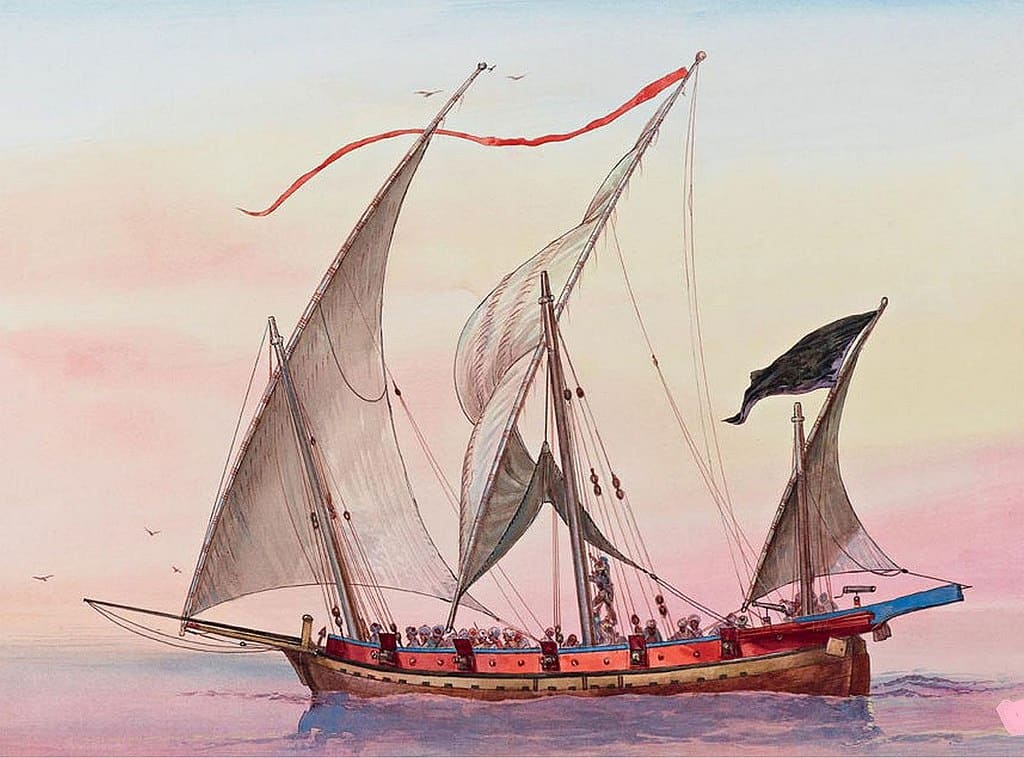
In the summer of 1631, the entire village of Baltimore on Ireland’s southwest coast vanished overnight. Over 100 men, women, and children—fishermen, farmers, mothers with babies in arms—were spirited away across the sea to Algiers, where they would spend the remainder of their lives in captivity. Only a handful, two or three, ever made it back.
The raiders responsible were Algerian corsairs, operating from what was then one of the most powerful maritime polities in the Mediterranean. Often celebrated in Algerian memory as ‘seafaring warriors’, the corsairs of the Regency of Algiers spent over three centuries (1500s–1830) challenging Europe’s mightiest powers—seizing ships, raiding coasts, and helping to reshape the Mediterranean balance of power. On terminology: labels depend on vantage point. To many Europeans, they were ‘pirates’; in Algiers and the wider Ottoman–Maghrebi world, they were state-licensed corsairs—ra’īs (ship’s captain) or ghuzāt al-baḥr (warriors of the sea) in local usage. In this article we use corsair as a neutral shorthand for state-licensed raiders, noting that contemporaries disagreed.
The Rise of a Maritime Power
The story begins in 1516, when the corsair brothers Aruj and Hayreddin Barbarossa entered Algiers at the invitation of Sālim al-Tūmī to drive out the Spanish. What emerged was a unique political entity—part corsair republic, part autonomous Ottoman province—that would become the region’s military and economic engine. This moment followed years of Spanish expansion and military incursions: Spain had seized Mers el-Kébir (1505), Oran (1509), and Bejaïa and Tripoli (1510), and garrisoned the Peñón of Algiers, extracting tribute. Aruj seized power; after his death (1518) Hayreddin placed Algiers under Ottoman suzerainty and in 1529 expelled the Spanish from the Peñón.
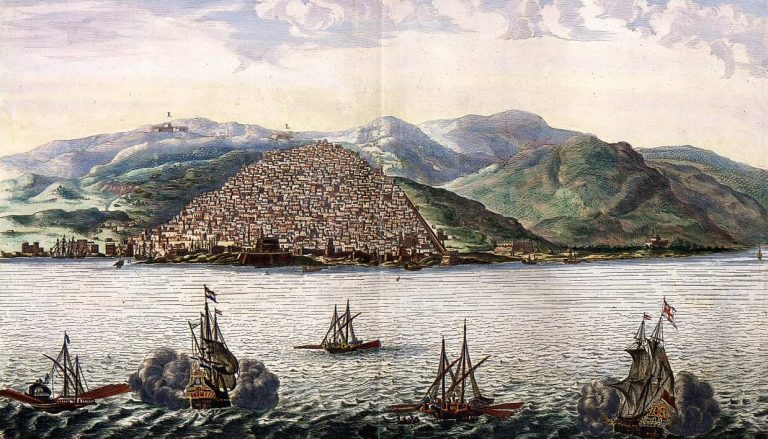
Algiers was no mere haven for lawless brigands. It was a sophisticated state with its own diplomatic corps, naval infrastructure, and complex social hierarchy. The corsair industry became the backbone of the Regency’s economy, funding everything from the city’s impressive fortifications to its bustling markets filled with goods from across the known world.
The human cost of this maritime empire was staggering. Historians estimate that between the late 16th and early 18th centuries, as many as 25,000 Britons alone were enslaved by Barbary corsairs. These weren’t anonymous statistics—they were individuals like Joseph Pitts of Exeter, captured in 1678, who would become possibly the first Englishman to visit Mecca during his years in captivity, later publishing a memoir that gave Europeans their first detailed look at life in Algiers from a slave’s perspective.
A Cosmopolitan Crucible
Despite the prominence of corsairing and captivity, Algiers grew into one of the western Mediterranean’s more cosmopolitan ports. At its height, the city was home to tens of thousands of captive slaves from across Europe—Spanish, Italian, French, Greek, Dutch, British, and Scandinavian. This coerced cosmopolitanism brought Ottoman, Maghrebi, and European seafarers into the same port; European renegades and skilled captives contributed navigation, gunnery, and shipyard know-how, which helped to strengthen Algiers’ corsair fleet. Some captives chose or were pressured to convert to Islam and joined the corsair enterprise. These renegades often rose to positions of prominence.
The Human Stories Behind the Statistics
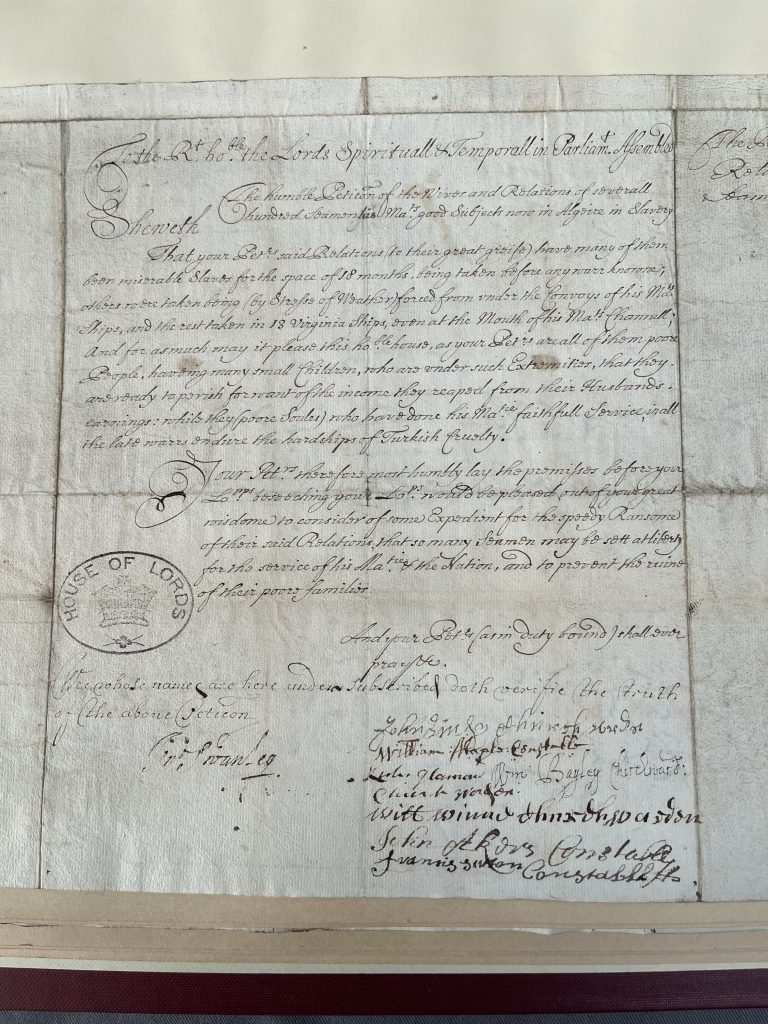
The impact on British society was profound and deeply personal. Among the most striking surviving documents in the Parliamentary Archives at the Houses of Parliament is a petition addressed to the Lords Spiritual and Temporal — submitted not by statesmen or admirals, but by the wives and relations of captured seamen. Written in an urgent, flowing hand, it describes their husbands as having been ‘miserable Slaves for the space of 18 months’, taken from Virginia ships ‘even at the Mouth of his Majesty’s Channell’, and pleads that so many seamen might ‘be sett at liberty for the service of his Majesty and the Nation, and to prevent the ruine of their poor families.’ This petition may represent one of the earliest recorded public petitions by women in British history.
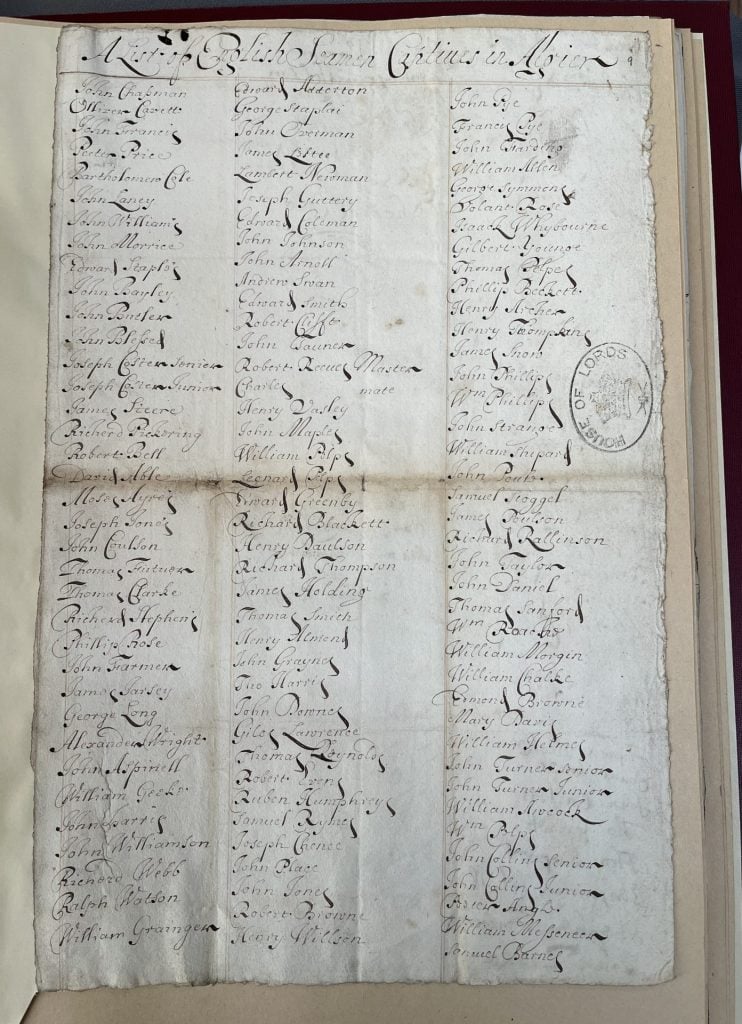
Filed alongside the petition is a handwritten list of over 150 individual English seamen held captive in Algiers — names such as John Chapman, Robert Bell, George Long, William Grainger, and scores of others, each inscribed in a careful 17th-century hand. These were not abstractions but real men, most of them fishermen and merchant sailors, awaiting ransom or a death far from home.
When King Charles I largely failed to act on such petitions, going so far as to ban further ones on the matter, it fuelled the discontent that would contribute to the political crisis of the 1640s. Churches across England collected alms for Captives in Barbary, and by 1646–47, Parliament was levying funds on goods to redeem slaves — marking one of the first systematic British efforts to use state funds for humanitarian purposes. When a ship returned to London that same year with 175 freed English slaves from Algiers, the redeemed captives publicly thanked Parliament in ceremonies that moved the nation.
These weren’t distant colonial conflicts but tragedies that touched ordinary British families. Fishing villages in Cornwall and Devon were periodically raided, with entire communities living in fear of the distinctive sails of Algerian xebecs (a small, fast Mediterranean sailing ship) appearing on the horizon.
The scale of this suffering is further documented in a separate petition dated 5 March 1640–1, presented to the House of Commons by ‘poor seamen and others, now lying in captivity in Algiers’, praying that steps might ‘speedily be taken for their release, as they are now undergoing insufferable oppressions.’ Annexed to this petition is a list of ships taken into Algiers between 18 May 1639 and 15 January 1640–1, organised by English port of origin — London, Dover, Plymouth, Barnstaple, Bristol, Yarmouth, Weymouth, and others — recording each master’s name, vessel name, and number of persons taken.
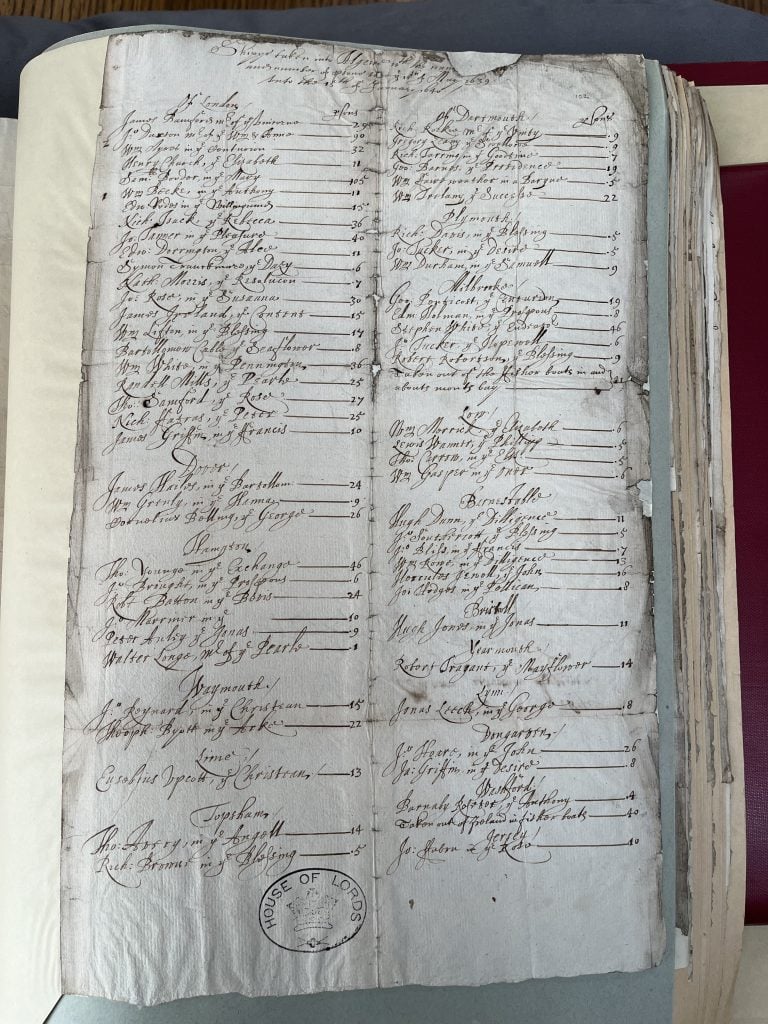
These documents are held in the Parliamentary Archives and can be viewed at the Houses of Parliament library. They serve as a striking reminder that the corsair era was not merely a chapter in naval history but a lived reality for thousands of ordinary people on both sides of the Mediterranean.
Diplomacy and Tribute
What many don’t realise is that for much of this period, Britain and Algiers maintained formal diplomatic relations. The 1662 and 1664 Anglo-Algerian treaties under Charles II were watershed moments in which Britain agreed to pay tribute and ransom enslaved subjects, while Algiers agreed to cease attacks on British shipping carrying proper Mediterranean passes.
These agreements were fragile but marked an important shift: Britain tacitly acknowledged the legitimacy of Algiers as a sovereign negotiator. British consuls resided in Algiers continuously, and the British government regularly sent “consular presents”—including gold, naval stores, and arms—to maintain peace.
The End of an Era
The final confrontation came in August 1816, when Admiral Lord Exmouth led a British fleet to bombard Algiers in what was framed as a humanitarian mission to end Christian slavery. The battle raged through the night, with British ships demonstrating superior firepower and innovative tactics. By morning, much of Algiers’ port quarter lay in ruins and 1,083 Christian slaves were freed immediately, with thousands more freed over the following months.
Yet this victory proved tenuous. Algiers soon lapsed into old habits, leading to another bombardment in 1824. The definitive end came in 1830, when France seized Algiers—ostensibly over piracy and a diplomatic insult (the 1827 ‘fly-whisk’ affair), alongside debt and domestic politics—beginning 132 years of French colonial rule in Algeria (1830–1962).
Legacy and Memory
Today, the era of the Algerian corsairs occupies a complex place in both British and Algerian memory. In Britain, some historians argue it contributed to the national narrative of “Britons never shall be slaves”—a phrase from the 1740s song “Rule, Britannia!” that was, ironically, partly a reaction to the very real fact that Britons had indeed been slaves in North Africa not so long before. The experience of being victims of slavery also informed later British abolitionist movements, as some campaigners drew parallels between the plight of Britons in Barbary and Africans in the Atlantic slave trade.
In Algeria and the broader Maghreb, figures like Barbarossa and later corsair leaders are sometimes regarded as proto-nationalist heroes who resisted Western encroachment, yet the legacy is ambivalent: corsair activity brought wealth and power, but it also entrenched near-constant warfare and a militarised society and left Algiers increasingly exposed as European navies suppressed corsairing—one factor among several that culminated in the French invasion of 1830.
Echoes Across Time
The story of the Algerian corsairs reminds us that the Mediterranean has long been a space of cultural encounter—sometimes violent, sometimes collaborative, always transformative. It challenges simple narratives of European dominance and reveals a period when North African powers could and did challenge the mightiest European empires on equal terms.
The waves they once ruled have long since calmed, but their story continues to ripple through the collective memory of all those whose ancestors felt their impact—a reminder that the Mediterranean has always been, and remains, a sea that unites as much as it divides.

I appreciated the clarity of your explanations and the actionable recommendations you shared.