

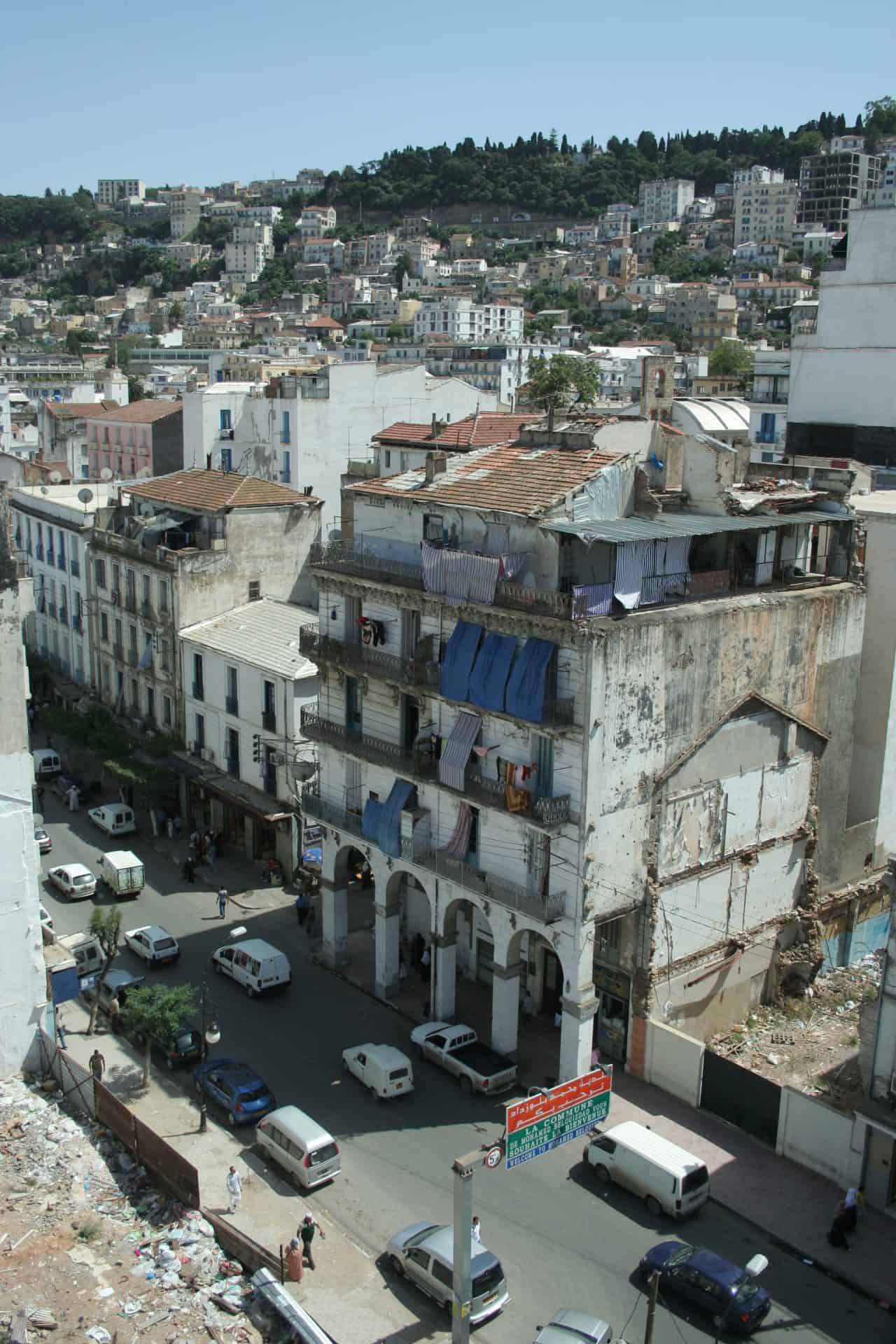
Albert Camus was made by Algeria. Born in a small farming town, raised in a cramped flat in working-class Algiers, he carried Algerian light, poverty, and heat into everything he ever wrote. He also spent much of his career insisting that colonial Algeria was inflicting a profound injustice on its Muslim Algerian population — Arabs and Amazigh alike. Yet when Algerians went to war to end that colonial order, Camus could not follow. He wanted reform, coexistence, a federal future — not the independence that came in 1962. That gap between his Algerian formation and his political limitations is what makes him one of the most debated literary figures in Algerian history, and one of the most instructive.
Belcourt, Not Paris
The facts of Camus’s Algerian life are worth dwelling on because they are so often glossed over in favour of the philosophical legend. He was born on 7 November 1913 in Mondovi — now Dréan — in eastern Algeria. His father was killed at the Battle of the Marne the following year, and Camus grew up in Belcourt, a working-class district of Algiers, in conditions of genuine hardship. That poverty, however, did not cancel his position within the colonial order: Camus was poor, but he was still legally and socially positioned on the European side of a deeply unequal system. The Nobel Committee described him as emerging from “semi-proletarian” origins, and identified his Algerian experiences in the 1930s as the dominant influences on his thought and work.
This matters for how we read him. Camus’s Algeria was not the Algeria of the comfortable colon — the prosperous European settler associated with land, servants and vineyards. It was Belcourt’s Algeria: a cramped apartment shared with a partially deaf mother who could barely read, a grandmother who ruled the household, a brother who went to work rather than to school. The poverty was real, and it left its mark. His recurring themes — sun, sea, physical exposure, the brute weight of labour and illness — are not abstract philosophical choices. They come from a specific place and a specific social position within colonial Algeria.
From Belcourt, Camus won a scholarship to the lycée in Algiers in 1924, then studied philosophy at the University of Algiers. Through the 1930s he threw himself into Algiers’s intellectual and artistic life: acting with and directing theatre groups, writing for Alger républicain, and absorbing the city’s peculiar mix of French republican culture, Mediterranean sensibility, and colonial hierarchy. He spent a significant period in Oran from January 1941 to August 1942 — a city that would later become the setting of La Peste — before leaving Algeria for France in 1942. His ties to Algeria did not end there. He returned in 1945 to report on the deepening colonial crisis, and again in 1956 to call for a civilian truce as the war of independence escalated.
What Camus Saw in Colonial Algeria
The strongest and least contested part of Camus’s Algerian legacy is his journalism. In 1939, working for Alger républicain, he travelled to Kabylia and produced a series of reports, “Misère de la Kabylie” — later collected in Chroniques algériennes— that amount to one of the most unflinching pieces of colonial social reporting produced by a European-Algerian writer of his generation. He recorded schoolchildren eating only one meal a day. He dismissed the idea that the Kabyle crisis was “sentimental” in nature; it was material, he insisted — a product of wages, hunger, broken infrastructure, and administrative contempt. By 1958 he was writing plainly that “the injustice from which the Arab people have suffered is linked to colonialism itself.”
After visiting Algeria in 1945, and writing in Combat in the wake of the massacres at Sétif and Guelma, he argued that “Algeria exists” — a seemingly simple statement that was, in context, a demand that metropolitan France recognise the colonial situation as specific, grave, and inseparable from the lives of its Arab population. These are not the positions of a writer indifferent to colonial violence. His point was not yet an endorsement of Algerian nationhood in the later independence sense, but a demand that France recognise Algeria as a specific colonial society with its own political reality.
In fiction, however, the picture is more contested. Algerian and postcolonial critics have long argued that in L’Étranger and La Peste, Arab Algerians are structurally diminished — unnamed, backgrounded, or deprived of interiority. Edward Said treated Camus’s Arab figures as “nameless beings” serving the requirements of European metaphysics. Algerian scholar Lamria Chetouani, in a 1992 article published in Mots and affiliated with the University of Annaba, reads L’Étranger against the grain of the Arab stereotype, distinguishing between the novel’s heavily discussed metaphysical absurdity and what she calls its “social absurdity”: the socio-historical level at which Arab life and colonial reality become visible beneath the philosophical surface. This critique does not erase the power of Camus’s prose, but it does complicate any claim that his fiction offers a full or equitable portrait of Algerian society. He is more convincing on settler urban routines, bodies under heat, and moral exposure than on Muslim Algerian subjectivity. That imbalance is not incidental to the Algerian debate about Camus; it is one of its central causes.
His social world in Algeria reflected the same asymmetry. His closest documented ties were to European-settler and left-intellectual networks: his teacher Louis Germain, his mentor Jean Grenier, his theatre collaborators, and Pascal Pia at Alger républicain. Yet it is wrong to say he had no meaningful cross-community relationships. He addressed his 1955 “Letter to an Algerian Militant” to Aziz Kessous, a Muslim socialist and long-time interlocutor; he maintained a complex, ultimately fractured relationship with the poet Jean Sénac; and he was addressed, challenged, and later rejected by younger Algerian writers such as Kateb Yacine. These connections were real, but they were selective and most visible in correspondence and political argument rather than in shared everyday life.
Where His Politics Stopped
Camus’s engagement with Algerian politics began well before the war of independence. In 1937 he delivered “The New Mediterranean Culture” in Algiers — a statement about plural Mediterranean belonging that scholars have read both as anti-fascist humanism and, more critically, as a vision of coexistence that still did not break with colonial structures. He supported the Blum–Viollette proposals, which would have extended French citizenship to a limited number of Muslim Algerians without requiring them to abandon Muslim personal status. These were reformist positions, not anti-colonial ones, and they set the pattern for everything that followed.
When the war broke out in 1954, Camus found himself holding three positions simultaneously: justice for Muslim Algerians, condemnation of French repression, and condemnation of FLN attacks on civilians. In Chroniques algériennes he argued that “no cause justifies the deaths of innocent people” and condemned violence against “children, women, and innocent civilians, whether Arab or French.” He called for a civilian truce in 1956, travelling to Algiers to make the appeal in person — an act of some personal courage at a moment of extreme polarisation. And he worked privately for clemency on behalf of condemned Algerian militants. Alice Kaplan, in her preface to the English edition of Algerian Chronicles, notes the estimate by ethnologist Germaine Tillion that Camus intervened in more than 150 individual cases, though not all those interventions succeeded. He also wrote personally to President René Coty in 1957 to request clemency for condemned prisoners whose cases, he argued, did not involve indiscriminate terrorism.
What he would not do was endorse the FLN’s route to independence. He remained attached to the idea of a federal or autonomous arrangement in which Arab and French Algerians could coexist — a position he maintained even as events made it increasingly unrealistic. He explicitly rejected assimilation as historically failed, but he also rejected independence as then being articulated, which he saw as an exclusionary nationalist project. The result was a position that was morally coherent in its own terms but politically overtaken by the war. From an Algerian nationalist perspective, however, this was also the point at which Camus’s humanism reached its limit: he could describe colonial injustice, but not fully accept the political claim that colonised Algerians should determine their own future.
The most famous episode of this impasse has been flattened by retelling. Camus is often remembered as saying, “Between justice and my mother, I choose my mother.” The better-attested context is more specific: he was responding to violence in Algiers and to the possibility that bombs placed on tramways might kill civilians, including his mother. In that context, the statement was less an abstract rejection of justice than a refusal to describe indiscriminate civilian killing as “justice” — even though, for many Algerians, Camus’s refusal to support independence still marked the limit of his political imagination.
The Writers Who Answered Him
Camus died in a car accident in January 1960, two years before Algerian independence. His afterlife in Algeria has never been settled, and that unsettlement is itself revealing.
Sidi Mohamed Lakhdar Barka, writing in the Algerian journal Insaniyat, has argued that Camus’s reception on both sides of the Mediterranean has been shaped by ideological preconception: northern readers often retained only the Nobel laureate of French letters, while Algerian readers encountered him through forms of institutionalised criticism alien to their own tradition. Barka’s contribution is to insist on the ongoing debate about Camus’s algérianité — his Algerianness — as the central unresolved fact of his reception, not a footnote to it.
The most creative responses have been adversarial. Kateb Yacine, one of the towering figures of Algerian literature, wrote to Camus in 1957 — the letter is preserved in the IMEC archive — reportedly describing the two men as “exilés du même royaume“: exiles from the same kingdom. Fraternity and rupture in four words. Kamel Daoud’s novel Meursault, contre-enquête (2013) is now widely understood as a direct literary reckoning: a rewriting of L’Étranger that restores narrative weight, family memory, and a name — Moussa — to the murdered Arab, reopening the colonial scene from the Algerian side.
This is not inheritance. It is answer, correction, and displacement — which is a more durable form of influence than discipleship.
Algeria’s Divided Witness
The most historically accurate description of Albert Camus is probably the hardest one to hold: anti-colonial in his diagnosis of injustice, non-independence in his constitutional imagination. He was formed by colonial Algeria, benefited from the French educational structures that colonialism built, and ultimately could not endorse the dismantling of the Franco-Algerian political arrangement, even as he insisted it was unjust. That is a contradiction — but it is a historically specific contradiction, shaped by poverty, family, place, and the limits of a particular political imagination.
What makes Camus still worth reading in Algeria, and still worth arguing about, is precisely that he did not manage to reconcile justice, coexistence, and decolonisation. He got closer to naming colonial injustice than many writers of his background and position. But he did not arrive at Algerian self-determination. That incompletion is not a reason to dismiss him. It is a reason to keep the conversation going — which, judging by the continuing output of Algerian scholarship and fiction on the subject, is exactly what is happening.