

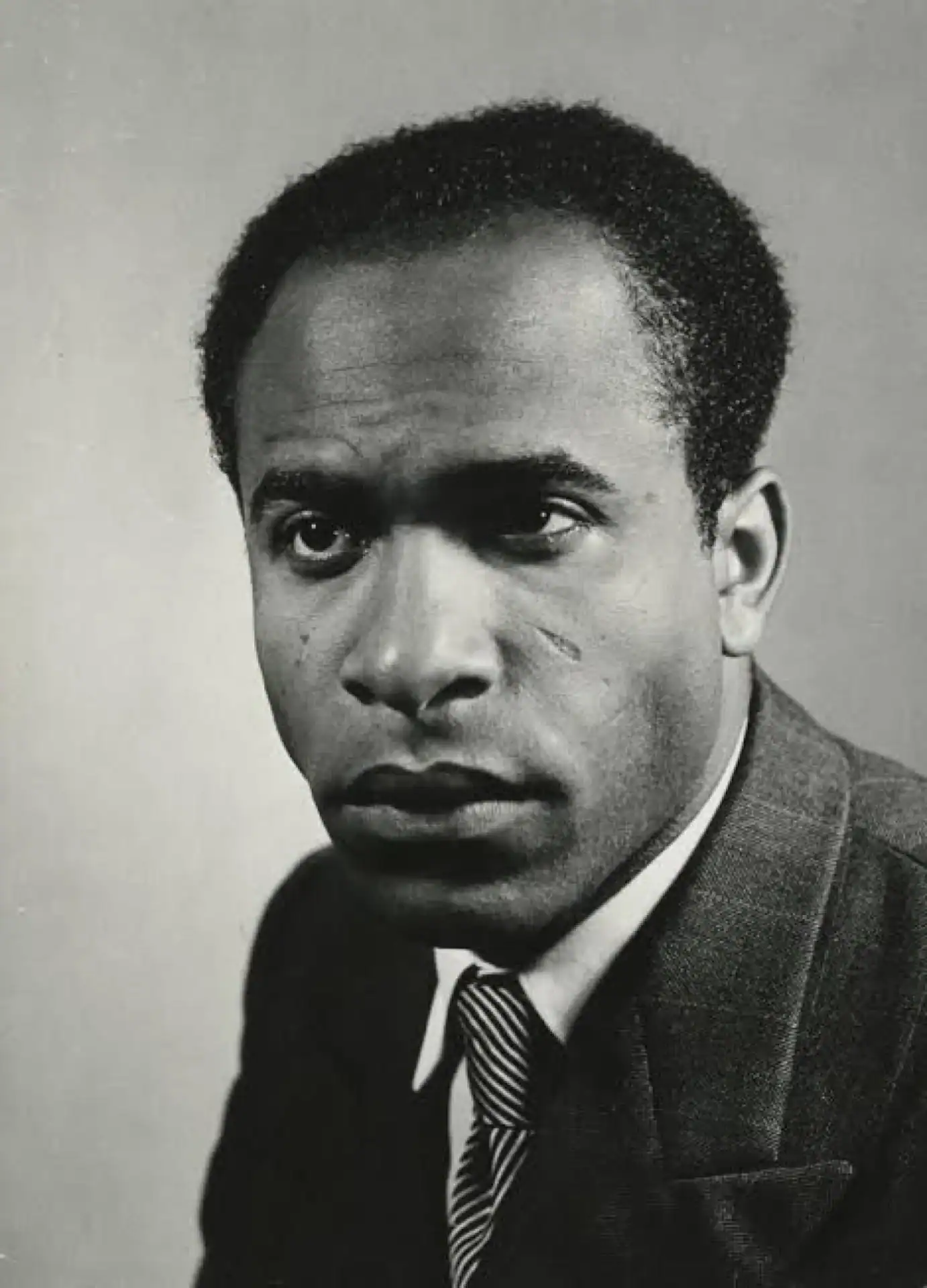
When Frantz Fanon arrived at the Blida-Joinville Psychiatric Hospital in November 1953, he was not yet the canonical voice of decolonisation. He was a young Martinican psychiatrist entering one of colonial Algeria’s most overburdened and unequal institutions. What happened in Blida — in the wards, in the streets, and in the moral collision between his psychiatric training and colonial Algeria’s reality — transformed him into something else: one of the twentieth century’s most powerful witnesses of colonial violence, and a thinker whose mature work cannot be separated from the Algerian experience that reshaped it.
Algeria, in other words, was not Fanon’s backdrop. It was the crucible.
Arrival in Blida
Fanon took up his posting as médecin-chef at Blida-Joinville on 23 November 1953. The hospital formed part of an unequal colonial psychiatric system: first-line services at Mustapha Hospital in Algiers, second-line care at Blida, and annexes at Aumale and Orléansville. Fanon’s own 1955 clinical work described a system straining under overcrowding and stark disparities between the treatment of Muslim Algerian and European patients. Blida, built to serve a far smaller population, had long since buckled under the weight.
Into this institution came a psychiatrist carrying the intellectual legacy of French psychiatric social therapy — a set of methods built for a different society, a different culture, and a different world. The confrontation with Algerian reality quickly exposed its limits.
The Failure That Became a Method
The episode that most clearly anchors Fanon to Algeria is not dramatic in the conventional sense. It involves a hospital ward, a language barrier, and an admission of failure.
In a landmark 1954 clinical article co-authored with Jacques Azoulay, Social Therapy in a Ward of Muslim Men, Fanon described how he had initially attempted to transplant European social-therapy methods into the Muslim men’s ward at Blida — and how that effort had collapsed. The ward required interpreters. It required a departure from assimilationist assumptions. Most fundamentally, it required attention to the actual social worlds of Algerian patients: family and village networks, Kabyle and Arab linguistic and cultural distinctions, religious practice, oral storytelling, and the deep disruptions caused by colonial land settlement and war. The Western model, Fanon concluded, had not simply underperformed. It had failed because it was designed to be blind to the social world of the people it was meant to serve.
That passage represents one of the clearest moments in Fanon’s writing where Algerian social reality forced him to rethink method from the ground up. The Algerian patient was not an obstacle to treatment; the Western model was.
A Hospital Transformed
What followed was not theory but practice. The institutional record of Blida’s transformation is preserved in Notre Journal — a weekly newspaper produced within the hospital between 1953 and 1959, still held in the archives of what is now the Frantz Fanon Psychiatric Hospital in Blida. Its pages show how the hospital was gradually opened to forms of social and cultural life that made more sense to its patients: outings into Blida, cinema and football, collective discussion through the journal committee, religious observance, and gatherings around oral storytelling. The Mufti of Blida visited for Aïd al-Kabir, known across much of the Muslim world as Eid al-Adha, with explicit hope that Muslim religious observance would become a regular presence in hospital life.
Fanon and Azoulay later wrote that regular Muslim feasts and gatherings around a professional storyteller had become concrete facts of the hospital’s social life. These were not gestures of vague cultural sensitivity. They were the outcomes of a method rethought in direct response to Algeria: its languages, its religiosity, its festivity, its oral traditions.
Fanon’s Algeria was not limited to the hospital. His clinical writing moved between the ward, the douar (a rural village community), the mountain village and the colonial city. He wrote on the psychiatric effects of the 1954 Orléansville earthquake, worked with educators at Chréa above Blida, and increasingly confronted the human consequences of a war that had begun in November 1954.
The Moral Break
By December 1956, the accumulation had reached a point of rupture. Fanon wrote to Resident Minister Robert Lacoste, France’s senior colonial authority in Algeria, to resign his post. The letter, preserved and reproduced in the critical edition Alienation and Freedom edited by Jean Khalfa and Robert J. C. Young, does not merely announce a professional departure. It indicts colonial Algeria as a structure of systematic dehumanisation and argues that a genuinely humane psychiatry could not be practised inside such an order. He requested that his mission in Algeria be terminated.
In January 1957, he was expelled.
The resignation letter is, in the documentary record, the moral hinge of Fanon’s Algerian story. It is the point at which the clinical and the political fuse into a single act. And it is signed, with a date and an address, in Algeria.
Into the FLN
Fanon moved from Blida to Tunis, and from Tunis into the wider network of the Algerian liberation movement. By September 1957, he was contributing to El Moudjahid — the organe central of the Front de libération nationale (FLN), the principal newspaper of the Algerian Revolution. Many of its articles were unsigned, collective, and written as revolutionary communication rather than individual authorship; the task of identifying Fanon’s individual contributions was undertaken after his death, through correspondence between the publisher François Maspero and Josie Fanon in Algiers, and many of those texts were eventually republished in Pour la révolution africaine. Attribution must therefore be handled carefully — the documentary record is secure at the level of journalism and revolutionary communication, less so at the level of article-by-article authorship.
In 1959, he published L’an V de la révolution algérienne — a book-length analysis of social transformation in revolutionary Algeria, catalogued by the Bibliothèque nationale de France under the Algerian war of 1954–1962 and later reissued under the title Sociologie d’une révolution. Its central concerns — women, family, radio, medicine, and the process of revolutionary change — were not borrowed from elsewhere. They were drawn from Fanon’s reading of Algerian society in the midst of revolutionary upheaval.
By 1960, Fanon was serving as the Provisional Government of the Algerian Republic’s (GPRA) representative and ambassador to Ghana, working the diplomatic circuits of a continent beginning to shake loose from colonial rule.
He died in December 1961, before Algerian independence. In accordance with his revolutionary commitment, he was buried near the Algerian-Tunisian frontier; his grave is now at Aïn Kerma, in eastern Algeria.

A Caution Against Overclaiming
The strength of Fanon’s Algerian connection is real and document-based. But honest reporting requires distinguishing between what the evidence securely supports and what has been inflated by retrospective myth.
The record is strong on Fanon as clinician, revolutionary communicator, international advocate, and revolutionary writer. It is weaker on claims that he was a formal policy architect inside the FLN apparatus, or that he was the single theorist of the Algerian Revolution. The Stanford Encyclopedia of Philosophy treats his Algerian years as a deep and decisive turning point; but Algerian critics, writing after independence, pushed back against the hagiographic version. Mohammed al-Milli, writing in the Arabic journal al-Thaqafa under the Algerian Ministry of Information and Culture, resisted the idea of Fanon as “the” theorist of the Algerian Revolution and stressed instead how deeply Fanon’s own thought was shaped by the Algerian struggle. Abdelkader Djeghloul and Mohammed Harbi raised related criticisms from a Marxist standpoint. A 2025 briefing in the Review of African Political Economy revisited precisely these Algerian left critiques, focusing on how leftists in post-independence Algeria debated Fanon’s writings and legacy.
Fanon also never became a seamless cultural insider. He needed interpreters at Blida, and later scholars have noted the limits of his grasp of Arabic-Islamic dimensions of Algerian life. Deep solidarity is clear; full cultural belonging is not. The distinction matters — not to diminish Fanon, but to describe him accurately.
The claim that Robert Lacoste immediately expelled Fanon upon receiving the resignation letter is another common simplification. The critical edition of Alienation and Freedom dates the letter to December 1956 and places expulsion in January 1957. Accounts that collapse resignation and expulsion into a single immediate event should therefore be treated with care.
Fanon in Algerian Memory
Post-independence Algeria has remembered Fanon unevenly: honoured in names and commemorations, but not always integrated into education or public intellectual life. He was officially commemorated under Ahmed Ben Bella, then largely sidelined during the Boumediene years. The Algerian psychologist Idriss Terranti later recalled knowing the Boulevard Frantz Fanon and a school bearing his name without ever having been taught who Fanon was — a striking vignette of the gap between official nomination and actual intellectual transmission.
His writing appeared on University of Algiers sociology reading lists in 1966–1967, and Philippe Lucas published Sociologie de Frantz Fanon in Algeria in 1971. Yet the 1974 International Congress of Sociology held in Algiers, despite engaging themes central to Fanon’s work, barely discussed him. That paradox — present but not central, named but not taught — characterises much of his Algerian afterlife.
Today, official recognition is easier to see. Algeria’s CNRPAH curates the Fonds Frantz Fanon, donated by his son Olivier Fanon and comprising 1,400 books, 30 articles and 27 periodicals. In Algiers, his name appears on public institutions and urban space, including a Bibliothèque Frantz Fanon and Boulevard Frantz Fanon. In 2025, the centenary of his birth brought renewed commemoration, including an Algerian postage stamp and public events devoted to his anticolonial thought.
For the diaspora, the evidence is still forming. Recent cinema has begun to reintroduce Fanon to wider audiences: Abdenour Zahzah’s 2024 film revisited the Blida-Joinville years, while Jean-Claude Barny’s 2025 biographical film Fanon brought his Algerian period to French cinema audiences, including viewers in Algerian and wider postcolonial diaspora communities. Film and commemorative culture are now doing work that scholarship on diaspora reception has not yet fully caught up with.
The Algerian Frame
The most important thing to understand about Fanon is not that he became famous, but why. The Wretched of the Earth did not emerge from a desk. It emerged from hospital wards in Blida, from an impossible colonial institution, from the failure of imported methods and the discovery of Algerian ones, from a resignation letter addressed to a colonial minister, from the clandestine press of a liberation movement, and from a diplomatic mission conducted in the name of a country that was not yet free.
Algeria did not provide the setting for that formation. Algeria was where Fanon lived and worked from 1953 to 1956 — three years dense enough to underpin everything that followed. The Algerian patients he could not reach with his French methods sent him back to first principles. The colonial structure he could not reform sent him out the door. The liberation struggle he joined gave his thought its purpose and its audience.
Algeria made Fanon legible to himself. And in doing so, it made him legible to the world.