

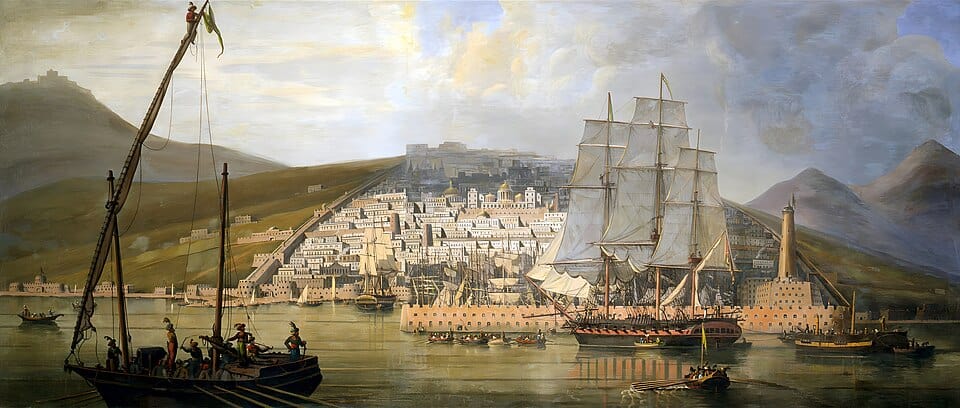
In the 1790s, the United States did not defeat Algiers. It paid Algiers — handsomely, repeatedly, and with a warship added to the bargain.
Long before America became a global power, it was a cash-strapped young republic negotiating from weakness with one of the Mediterranean’s most established maritime powers. The story sits awkwardly in American memory: a chapter of coercion, financial strain and diplomatic humiliation later overshadowed by the more triumphant story of the Barbary Wars. From Algiers’ side, however, the arrangement looked far less exceptional. This was what Mediterranean statecraft often involved in the eighteenth century: precedent, tribute, ransom, maritime pressure and negotiated peace.
That gap in perspective is precisely what makes the episode worth telling.
Between 1785 and 1798, the young United States negotiated, borrowed, paid, ransomed captives and ultimately gifted a purpose-built warship to secure peace with Algiers. The total cost, by one Treasury-derived reckoning, came to more than one million dollars at a time when the American federal government was still finding its footing. The experience left a lasting mark on US naval policy, foreign relations and national identity. And at the centre of it all was Algiers — not as a den of lawless pirates, but as a sophisticated political actor operating within a recognised, if coercive, interstate order.
A Mediterranean Power, Not Simply a Criminal Enterprise
The label “Barbary pirate” has long distorted the history. In the eighteenth-century Mediterranean, Algiers was a semi-autonomous Ottoman regency whose corsair activity, treaty practice, passes, tribute system and ransom arrangements formed part of an established political economy — one shared, in different forms, with major European powers of the era.
It was not simply piracy in the modern criminal sense. None of this made the system benign: it rested on coercion, captive labour and the threat of violence. But it was not lawless in the way later pirate imagery often suggests. Historian Christian Windler has described eighteenth-century Franco-Maghrebi relations through a process of “normalisation”, in which coercion, treaty practice and diplomatic exchange coexisted as recognisable features of interstate relations.
When the Dey of Algiers demanded redemption money, annual maritime stores and customary presents as the price of peaceful commerce, he was not improvising. He was invoking a template already applied to the Dutch, the French, the Spanish, the British and others. As the diplomat and later consul-general James Leander Cathcart recorded, Algerian negotiators repeatedly cited European precedents during discussions: this was how things were done in the Mediterranean, and newcomers were expected to comply.
Americans, largely unfamiliar with this system, were frequently shocked by demands that Algiers considered ordinary.
The American Predicament
The crisis for the United States began almost immediately after independence. Under British colonial rule, American shipping had enjoyed the protection of the Royal Navy. After the Treaty of Paris in 1783, that shield vanished.
The consequences were swift. Moroccan corsairs captured the brig Betsey in 1784, while Algerian corsairs seized the schooner Maria on 25 July 1785 and the ship Dauphin shortly afterwards. Twenty-one Americans were captured and enslaved. Morocco soon settled with the United States. Algiers did not.
The Confederation government could not afford the ransom the Dey demanded, and the Articles of Confederation gave Congress no reliable power to raise funds for naval defence, tribute or ransom. John Lamb’s 1786 mission to Algiers failed entirely, leaving the captives in place and damaging American credibility. By 1790, Richard O’Brien — himself a captive — reported that only 14 Americans remained from the original group, their ransom fixed at 17,225 sequins, with O’Brien and another captain each valued at 3,000 sequins.
A further wave of Algerian captures in 1793 sharpened the crisis and helped push Congress towards a naval response. On 27 March 1794, Congress passed the Naval Armament Act, explicitly citing “the depredations committed by the Algerine corsairs on the commerce of the United States” as justification for building six frigates. Revealingly, the same legislation included a clause — Section 9 — ordering construction to halt if peace with Algiers were obtained. US policy was divided from the outset: between building force and buying time.
The Settlement and Its True Cost
The decisive bargain was struck in September 1795, when US envoy Joseph Donaldson reached Algiers and agreed terms. What followed was not a treaty in the simple modern sense, but a layered financial settlement involving peace payments, captive redemption, annual stores, commissions, remittances and later concessions.
The Treaty of Peace and Amity, formally ratified by the United States on 7 March 1796, required an annual payment in maritime stores valued at 12,000 Algerian sequins. This was not abstract tribute. It was a recurring supply contract: powder, lead, iron, shot, masts, yards, cables, sailcloth, tar, pitch and timber for Algiers’ garrison and arsenal.
The treaty text valued those annual stores at 12,000 Algerian sequins — rendered in one treaty note as $21,600 — while Congress implemented the obligation through a standing appropriation of $24,000 per year on 6 May 1796.
The immediate cash settlement is commonly summarised at $642,500, paid alongside presents and yearly tribute in naval stores. A Treasury estimate reproduced in Hunter Miller’s treaty notes put the wider “price paid and payable” at $992,463.25. Albert Gallatin’s later fiscal reconstruction went further still, estimating the broader expense of the Algerine treaty at $1,131,391.03, after accounting for contingencies, delays, borrowing and remittance losses, naval stores, freight and the promised frigate. These figures are not contradictory; they reflect different stages and scopes of accounting.
Adjusted for consumer-price inflation, that broader figure is equivalent to about $31 million in 2025 money. That gives only a conservative sense of scale. Measured against the young republic’s limited fiscal capacity, the burden was far greater. Modern equivalents using MeasuringWorth are approximate and depend on the method used.
The financial mechanics were as revealing as the headline figures. Gallatin recorded that the United States borrowed $800,000 from the Bank of the United States to fund the Algerian treaty arrangements, but the money did not arrive as ready cash. It was raised through government stock, then transferred and sold through London. By the time the transaction was completed, the $800,000 had produced only $685,572.22 in effective dollars — a loss of $114,427.78 before further exchange losses on the route to the Mediterranean. Gallatin put the combined losses on the remittance at $152,186.59. The United States was not simply short of money; it struggled to turn borrowed credit into usable cash overseas.
The Crescent: A Warship Built for Algiers
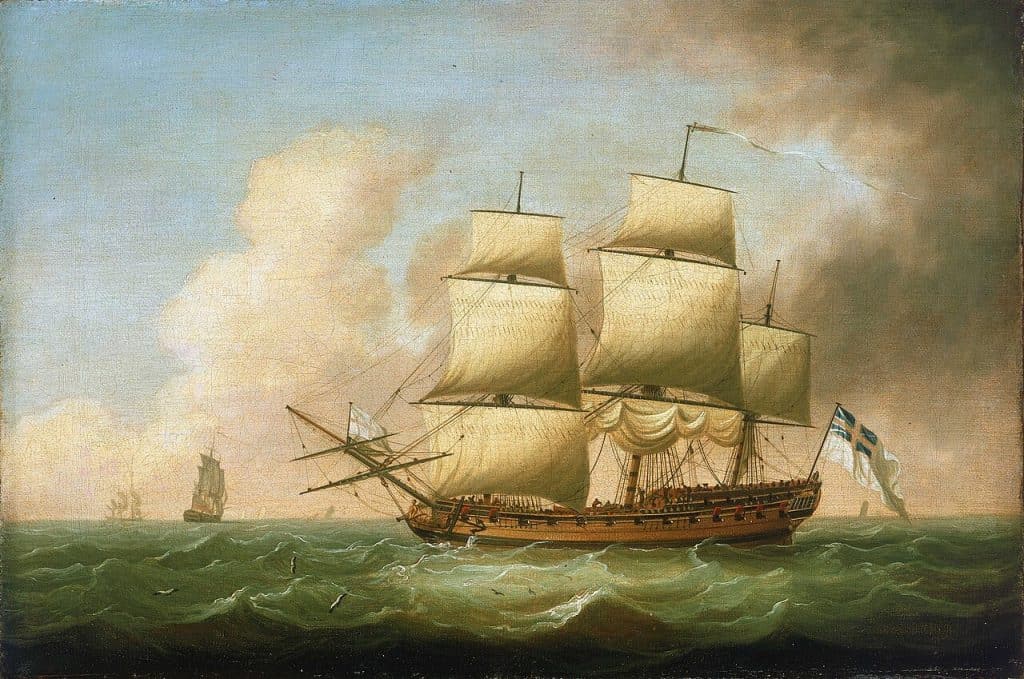
The most striking single concession was not money. It was a ship.
When remittance delays triggered fresh Algerian demands in 1796, the Dey required additional compensation. George Washington, then president of the United States, wrote privately to Secretary of War James McHenry in July 1796, acknowledging that the demand had been “disagreeable” in both reception and compliance, but concluded that there seemed to be “no other alternative but to comply, or submit to the depredations of the Barbary Corsairs on our Citizens, and Commerce.” It was a notably candid admission of American weakness.
The United States would build a frigate for Algiers (a frigate is a fast, medium-sized warship used for escort, patrol and commerce protection).
The ship was named Crescent. She was constructed at Portsmouth, New Hampshire, by master shipbuilder James Hackett and associated with naval constructor Josiah Fox — craftsmen linked to the new republic’s own naval construction. According to the most comprehensive modern account in Naval History Magazine, she had a 122-foot gundeck, a 32-foot beam, a depth of hold of 10 feet and 2 inches, and displaced around 600 tons. Nominally rated at 36 guns, she was made as small as possible while satisfying that classification — a fraction of the size of the larger 44-gun frigates the United States was building for its own navy.
War Department papers track her progress through 1797. By 1 August that year, Hackett reported that she was “completely finished in every part” according to his contract. She had been launched on 29 June 1797. On 18 January 1798, she sailed from Portsmouth carrying the new consul-general Richard O’Brien, nearly 30,000 pounds of shot, around $100,000 in powder, lead, timber, rope and canvas, and $180,000 in silver dollars packed into 26 barrels. She arrived at Algiers on 26 February and was officially delivered on 1 March 1798.
The Crescent was not the only vessel involved. Hunter Miller’s treaty notes refer to the schooner Hamdullah and another schooner, Lelah Eisha, as part of the wider stores-and-shipping diplomacy (schooner is a smaller, usually two-masted sailing vessel). The frigate was the centrepiece of a broader effort to satisfy Algiers through vessels, cargoes and cash.
Naval historians have called the Crescent the “forgotten seventh frigate”: not because she served in the US Navy, but because her story is inseparable from the naval state-building that would eventually end the tribute era.
The Human Cost
Behind the ledger figures were people.
Of the 21 Americans captured in 1785, only 14 remained by 1790, reduced by disease and by the brutal economics of captive labour in Algiers. By the time of the final settlement, official summaries referred to 119 captives taken across the full course of the crisis, while Gallatin’s Treasury accounting counted the redemption of 100 captives as a separate line item. The discrepancy reflects deaths, later captures and differing accounting conventions.
Those who survived did not come home unscathed. Joel Barlow’s dispatch of July 1796 reported that six Americans had recently died of plague, and that survivors included men in near-total blindness, men injured by forced public labour and others whose constitutions had been permanently weakened. Cathcart, drawing on his own years of captivity in Algiers, wrote that Americans captured in 1785 endured extreme hardship and that no class of men had suffered more from the Revolution’s aftermath.
Their release came in July 1796 — more than a decade after the first captures. The peace bought their freedom. It cost the republic dearly.
What Algiers Understood
From Algiers’ perspective, the arrangement was not exceptional.
The treaty’s own language — in the 1930 translation from the Ottoman Turkish original — frames peace as a bargain concluded together with a contractual annual promise to supply the garrison and arsenal. Hunter Miller’s notes add that, in Algerian practice, European-style ratification was secondary: what made a treaty real was receipt of the agreed payments. American parchment, signed in Philadelphia, mattered far less than American silver, delivered in Algiers.
The Dey did not think he was receiving an embarrassing exception to normal practice. He thought he was getting what a Mediterranean power was entitled to demand from a newcomer seeking safe passage through its waters.
A Legacy That Shaped a Navy
For US commerce, tribute worked in the short term. American captives were released in July 1796, and the Crescent’s arrival in 1798 immediately improved the position of US vessels sheltering in Algiers’ harbour. American merchants gained access to Mediterranean trade.
But the system also encouraged escalation. Washington had already recognised in 1796 that the frigate was a new demand layered on top of the treaty. By 1800, the USS George Washington was being sent to carry tribute — and was compelled by the Dey to fly the Algerian flag while doing so. Gallatin later catalogued what he called continuing “extraordinary extortions”. Tribute bought time; it did not create equality.
The frustrations of the 1790s — the borrowing losses, exchange failures, gifted frigate and sense of perpetual vulnerability — strengthened the political case for a permanent United States Navy far more effectively than any peacetime argument could have done. The United States eventually moved from tribute to force, but only because Algiers had made the cost of tribute, over time, greater than the cost of war.
The end point came in 1815, after the War of 1812, when Congress authorised war against Algiers and US naval force replaced annual stores as the instrument of American Mediterranean policy. This did not end the wider corsair system for everyone, but it marked the end of the United States’ willingness to buy peace from Algiers on the old terms.
America’s tribute to Algiers in the 1790s was neither simple cowardice nor simple prudence. It was the strategy of a weak fiscal-military state — one that lacked the credit networks, naval reach and Mediterranean infrastructure to impose its will. The bargain was rational in the short term and corrosive in the long term. And the very cost of it helped generate the political appetite for the navy that eventually ended it.
That is the connection: a North African regency, operating according to its own coherent political logic, helped forge the foundations of what would become one of the world’s most powerful navies. It is a chapter worth remembering, and worth telling on its own terms.