

The relationship between Algeria and China is older than many people realise. It predates Algerian independence itself: Beijing recognised the Provisional Government of the Algerian Republic in 1958, during the war of liberation, becoming the first non-Arab country to recognise the provisional government. Algeria returned the gesture. In 1971, it was among the sponsors of the draft that became United Nations General Assembly Resolution 2758, which restored the rights of the People’s Republic of China at the UN and recognised its representatives as China’s only legitimate representatives to the organisation.
These are not merely historical footnotes. Both governments continue to invoke them frequently in major diplomatic exchanges, framing the partnership as one grounded in anti-colonial solidarity rather than recent commercial convenience.
The medical teams: six decades and counting
One of the lesser-known threads of this connection is also among the most enduring. In 1963, China sent a medical team to Algeria — the first medical mission the People’s Republic ever dispatched overseas. The programme survived political upheavals in both countries and became one of their most durable shared institutions. By 2023, Chinese official figures stated that 3,522 medical personnel had served in Algeria, treating more than 27 million patients and assisting with more than two million births. These are Chinese government totals and are difficult to verify independently, but the longevity of the programme is well documented.
Chinese medical teams have generally worked in provincial hospitals and in specialities identified as priorities by the Algerian health authorities, including obstetrics and acupuncture. Whatever the precise figures, the programme represents a form of cooperation that long predates China’s contemporary global health diplomacy and remains an enduring source of goodwill between the two countries.
From construction boom to “comprehensive strategic partnership”
Economic relations expanded sharply from the late 1990s and early 2000s. Algeria’s large hydrocarbon-funded public investment programmes created enormous demand for rapid construction, and Chinese state-owned enterprises were well placed to mobilise engineering workforces and financing packages. Sinopec entered Algerian upstream oil operations at Zarzaitine in 2002. Chinese construction groups became major participants in housing, roads, public buildings and water infrastructure. China eventually overtook France as Algeria’s largest single-country source of imports.
A major diplomatic elevation came in February 2014, when Algeria became the first Arab state to establish a comprehensive strategic partnership with China. A first five-year cooperation plan was signed that same year; a second, covering 2022–2026, was signed by the two countries in 2022. President Abdelmadjid Tebboune’s state visit to Beijing on 18 July 2023 widened the agenda further — from infrastructure, petrochemicals and mining to agriculture, aerospace, civil nuclear technology, renewable energy, education and defence.
The numbers behind the partnership
The scale of the economic relationship is real. But so is the imbalance. Algeria-reported UN Comtrade data for 2024 show imports from China worth approximately US$10.58 billion — 22.3% of all Algerian imports — while exports to China were about US$1.99 billion, or just 3.8% of Algeria’s total exports. The resulting bilateral goods deficit for Algeria was roughly US$8.6 billion.
Chinese-reported figures produce an even larger gap. According to China’s Ministry of Foreign Affairs, China exported approximately US$11.68 billion of goods to Algeria in 2024 and imported around US$800 million, implying a Chinese trade surplus of about US$10.9 billion. Differences between the two countries’ statistics can result from freight and insurance valuation, reporting dates, product classification and indirect trade. Under either reporting system, however, the imbalance is substantial.
Bilateral trade amounted to approximately US$12.5 billion by either measure but produced a very large Chinese trade surplus. Algeria’s exports to China are not only much smaller but far less diversified: Chinese-reported product data show that they are dominated by mineral fuels and petroleum products.
Meanwhile, Europe remains far more important as the destination for Algerian oil, gas and refined products. In 2024, 63.8% of Algeria’s exports went to the European Union. China is therefore a major source of Algerian imports but a comparatively small destination for Algerian exports.
What the big numbers actually mean
Chinese economic engagement in Algeria is often overstated because construction contracts, announced investment intentions, financed projects and actual foreign direct investment are routinely conflated. Foreign direct investment normally involves an ownership stake or lasting business interest; a construction contract may simply mean that Algeria has paid a Chinese company to build something.
One widely cited estimate, from Chatham House drawing on the China Global Investment Tracker, puts the cumulative value of large Chinese investment and construction transactions in Algeria during 2005–2020 at US$23.85 billion. But much of this consists of contracted infrastructure and engineering work — projects paid for by the Algerian state — rather than equity investment held by Chinese companies.
The Rhodium Group’s China Cross-Border Monitor, by contrast, lists approximately US$1.6 billion under its official Chinese investment-stock measure and around US$1.8 billion as the historical value of completed Chinese foreign direct investment transactions. The datasets use different definitions, reporting periods and thresholds, but the gap illustrates why the value of Chinese-built infrastructure should not automatically be labelled foreign direct investment.
Landmarks and stalled ambitions
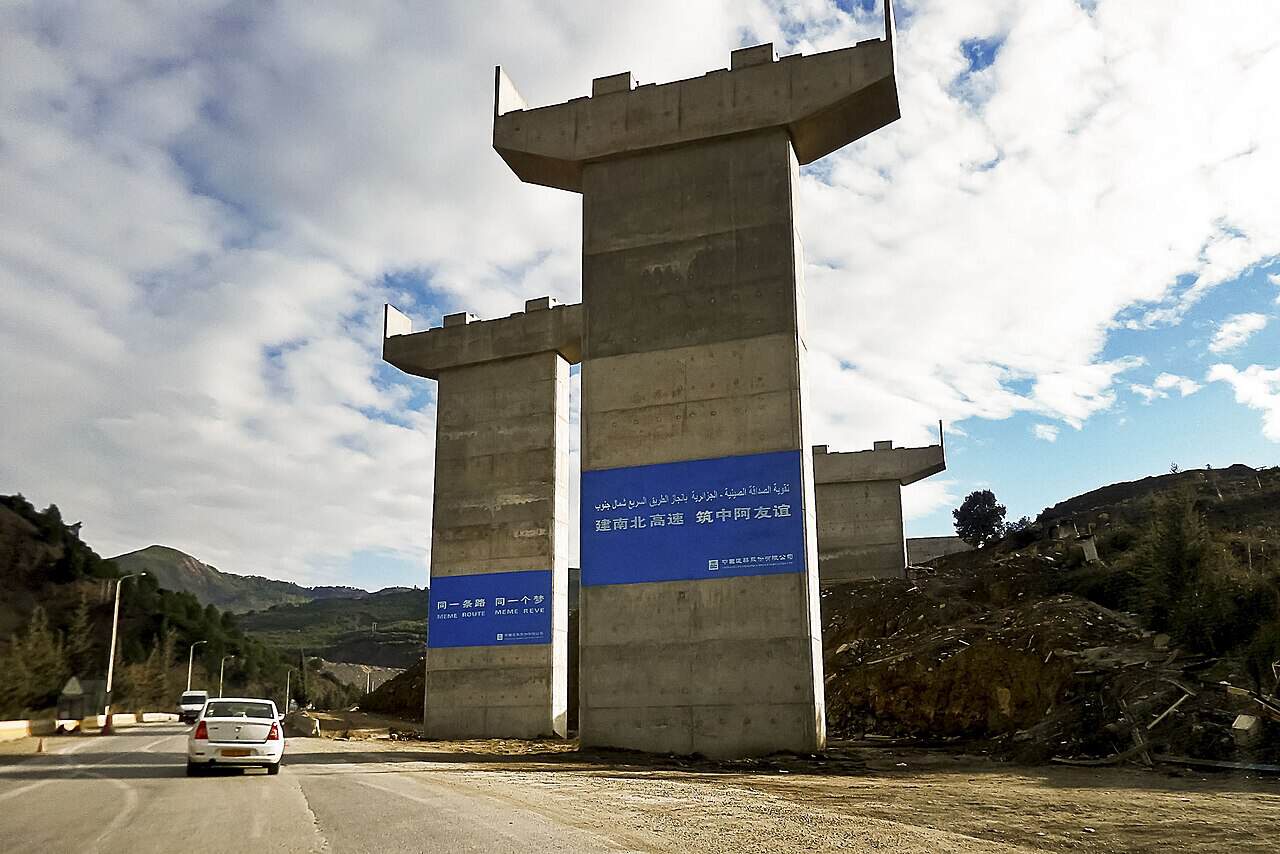
The infrastructure record is nevertheless substantial. Chinese firms built the central and western portions of the 1,216-kilometre East–West Highway, constructed the Great Mosque of Algiers — Africa’s largest mosque — and completed 575 kilometres of the 950-kilometre Western Mining Railway linking Béchar, Tindouf and the Gara Djebilet iron-ore deposit.
The railway opened on 1 February 2026, with the Chinese state-owned-assets authority reporting that Chinese contractors had constructed 575 kilometres of the route. It represents one of the clearest recent examples of the relationship moving from conventional construction contracting towards infrastructure tied to Algerian industrial diversification.
But not every ambition has been realised. The El Hamdania/Cherchell deep-water port, originally budgeted at approximately US$3.3 billion, was suspended in 2019. Subsequent reports have alternately described the project as abandoned, relocated or under reconsideration. As of 31 July 2026, publicly available primary sources reviewed for this article did not establish a financed restart, final location and confirmed construction timetable.
A planned US$7 billion integrated phosphate project was announced in 2022 as a 56:44 Algerian–Chinese joint venture involving the Algerian groups Asmidal and Manal and the Chinese companies Wuhuan and Tian’An. The project has since undergone further restructuring and engineering work. In June 2025, Saipem announced that Sonatrach had awarded it a front-end engineering design contract covering phosphate extraction, fertiliser production, railway connections and improvements to Annaba port. Publicly available documents do not clearly establish whether the original 2022 ownership and financing structure remains in effect.
These cases do not demonstrate that Chinese projects are uniquely problematic; some delays and changes have also reflected Algerian procurement procedures, political decisions, financing arrangements and project oversight. They do show that high-level strategic endorsement does not guarantee timely or transparent delivery.
Energy: a deepening value chain
China is not replacing Europe as Algeria’s principal energy customer — Europe’s geographical proximity and gas pipeline connections make it structurally more important. But China’s role is expanding as an upstream partner, engineering contractor and technology provider.
Sinopec’s continuous presence since 2002 has been reinforced by a series of recent contracts. In February 2025, Sinopec and Sonatrach signed a production-sharing hydrocarbon contract for Hassi Berkane North, involving an estimated US$850 million programme of exploration, appraisal and development.
Chinese companies also won new gas exploration acreage and secured contracts for refinery work at Arzew and for the inspection of 3,576 kilometres of gas pipelines. The pattern suggests a shift from occasional oilfield participation towards a broader presence across Algeria’s hydrocarbon value chain.
Defence: diversification, not replacement
Military cooperation is meaningful but secondary to Algeria’s long-standing defence relationship with Russia. According to SIPRI’s measure of the volume of major arms transfers — rather than their monetary value — Russia supplied 48% of Algeria’s arms imports in 2020–2024, followed by China with 19% and Germany with 14%. Chinese supplies included six-armed uncrewed aerial vehicles, or drones.
The most visible recent event was the November 2023 visit to China by Algeria’s Chief of Staff of the People’s National Army, General Saïd Chanegriha. The visit included discussions with China’s Central Military Commission, defence industry firms Poly Technologies and CETC, a naval base and a People’s Liberation Army Air Force unit. The pattern indicates diversification of procurement and technical cooperation — not a wholesale shift from Russia to China.
Publicly available evidence does not indicate that Algeria hosts a Chinese military facility, while Russian equipment continues to dominate its major arms imports. Cooperation with China is therefore better understood as part of a broader policy of supplier diversification and strategic autonomy than as a military realignment.
In 2026, President Tebboune continued to describe Algeria as maintaining good relations with the United States, Russia and China, while insisting that Algeria would not abandon its established partners. This is consistent with Algeria’s official tradition of non-alignment and strategic autonomy.
How Algerians see China
Public attitudes towards China appear comparatively favourable. In Arab Barometer fieldwork conducted in 2021–2022, 67% of Algerian respondents expressed a favourable view of China, compared with 47% for the United States. The same survey found that 38% wanted economic relations with China to become stronger, while 41% preferred them to remain at their existing level.
Yet positive views coexist with more critical currents. Coverage differs according to an outlet’s ownership, editorial position and intended audience. Algerian coverage reflects different editorial priorities. State media tend to emphasise the historical friendship, sovereignty and official language of “win-win” cooperation, while economic reporting and commentary also examine the trade deficit, local employment, subcontracting, technology transfer and delayed projects.
A 2025 review of selected French, Algerian and Tunisian media coverage also identified concern in some commentary that Morocco was attracting Chinese industrial and export-oriented investment more rapidly than Algeria, particularly in ports, electric vehicles and export manufacturing. This represents one current within regional media debate rather than a nationwide Algerian consensus.
The available polling suggests a broadly favourable image of China, while Algerian media debate shows more qualified assessments of the economic results. China is often regarded as a friendly major power and a capable builder, but the commercial relationship draws sharper scrutiny when Algerians ask whether projects create durable local employment, exports and industrial know-how.
Cultural ties: deep roots, limited reach
The medical-team programme remains the relationship’s most important people-to-people institution. Educational cooperation is also expanding: Algeria’s first Confucius Institute opened at the University of Algiers II on 23 September 2025, although it remains too new for its wider impact to be assessed.
The Great Mosque of Algiers — constructed through Algerian–Chinese cooperation, with China State Construction Engineering Corporation as the principal contractor and Algerian workers participating in the project — was formally inaugurated by President Tebboune in February 2024. The building demonstrated Chinese engineering capacity while remaining fundamentally an Algerian national project: it was commissioned and financed by the Algerian state and realised with substantial Algerian participation. It is therefore best understood as a major Algerian project delivered through close cooperation with China.
The mosque’s history also generated debate within Algeria over its cost, delays and association with former president Abdelaziz Bouteflika. At the same time, its scale, religious purpose and incorporation of Algerian and wider North African architectural elements cannot be reduced to the political controversies surrounding its construction.
For all the diplomatic warmth, cultural relations with China remain less socially embedded than Algeria’s dense connections with the Arab world, France and the wider Mediterranean. Arabic and Tamazight are Algeria’s national and official languages, while French continues to be widely used in higher education, administration, media and diaspora networks. Knowledge of Chinese remains comparatively limited.
For many Algerians, China is therefore encountered principally through consumer products, businesses, construction projects and commercial networks rather than through family, linguistic or migratory ties.
What comes next
The most likely trajectory to 2030 is managed deepening rather than an alliance or an economic transformation overnight. Chinese firms are likely to remain important in railways, mining, hydrocarbons, industrial engineering and telecommunications. Algeria is also likely to continue using cooperation with China to diversify beyond its concentrated European economic ties, while preserving access to European markets and avoiding excessive dependence on any single external partner.
Whether the relationship becomes more balanced will depend on several things: whether the mining railway supports commercially viable steel production; whether Sinopec’s ventures generate local services and training; whether planned factories move beyond memoranda; and whether Algerian non-hydrocarbon exports gain meaningful access to the Chinese market.
A potentially important development came on 1 May 2026, when China extended zero-tariff treatment to imports from Algeria and 19 other African countries. The policy built on existing zero-tariff arrangements for 33 African least developed countries, extending preferential access to Algeria and 19 other African states. It therefore covered all 53 African countries maintaining diplomatic relations with Beijing.
The policy may improve formal market access, although tariffs are only one constraint. Algerian exporters will still need to meet Chinese standards, establish distribution networks and develop sufficient productive capacity. The extent of local employment, Algerian subcontracting, technical training, technology transfer and domestic production will offer further tests of whether the partnership is becoming more balanced.
The question is no longer whether Chinese companies will remain present in Algeria — they are highly likely to do so. The question is whether the next phase builds durable Algerian industrial capacity alongside Chinese commercial activity. Without that shift, political relations will remain warm and infrastructure cooperation extensive, but the economic partnership is likely to remain marked by a substantial imbalance.