

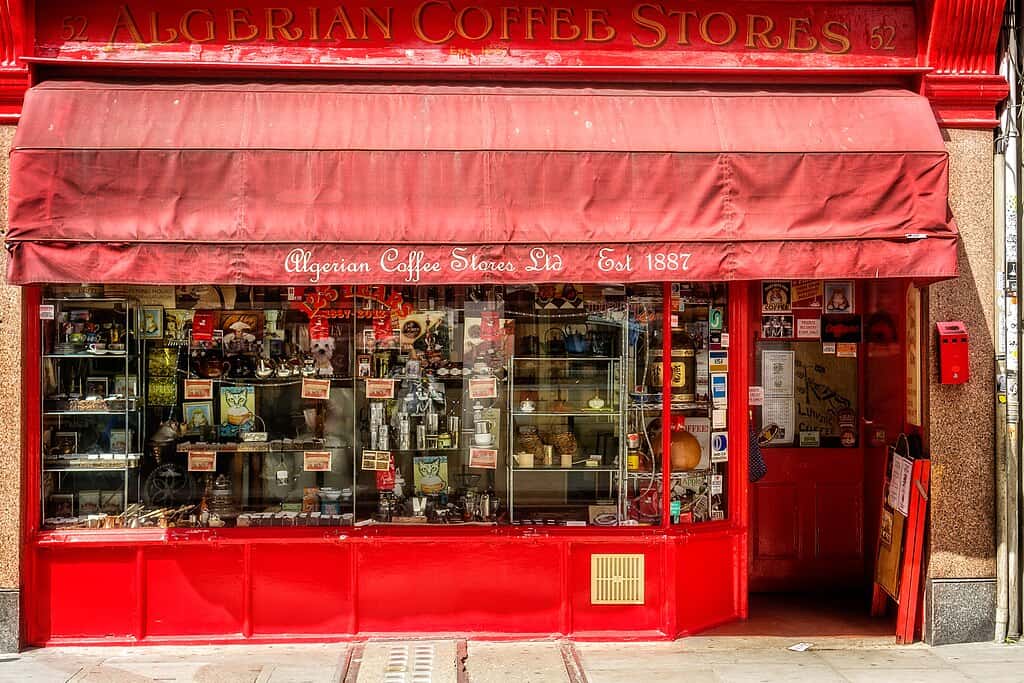
In the heart of Soho, at 52 Old Compton Street, a crimson-red shopfront has stood for nearly 140 years. Behind its original 19th-century wooden fascia lies Algerian Coffee Stores, founded in 1887 by an Algerian immigrant known as Mr Hassan. Historic photographs show the name M. Siari on early window signage, and some writers identify him as Hassan Siari, the probable original owner.
The shop appears to be one of the earliest documented examples of an Algerian entrepreneur establishing a successful business in Britain, at least in the English-language record. While London’s coffee house culture dates back centuries, Algerian Coffee Stores is widely cited as among the city’s oldest continuously operating coffee and tea retailers.
A Legacy Passed Through Hands
Mr Hassan’s venture changed ownership several times over the decades, passing to a Belgian merchant named Mr Boerman in 1928, then to an Englishman, Mr Jones, in 1946. The shop remained open throughout the Second World War, surviving the Blitz even as bombs devastated neighbouring Soho buildings.
The current custodians are sisters Marisa and Daniela Crocetta, who represent the third generation of their family to run the business. Their father, Neapolitan-born Paul Crocetta, joined in the 1970s after marrying Mr Jones’s daughter, and still visits the shop today.
Remarkably, despite this succession of Belgian, English, and Italian-English ownership, the name has never changed—a choice the current owners see as a tribute to its Algerian founder.
Stepping Back in Time
Walking through the door is an exercise in sensory immersion. The original wooden sales counter and bespoke wall-to-wall shelving, dating from the late 19th century, remain in use. Dark wood shelves stretch to the ceiling, lined with jars and tins containing over 80 varieties of coffee beans and approximately 120 varieties of tea.
The coffee selection spans origins from Jamaica’s Blue Mountains to Ethiopia, Kenya, Colombia, and beyond. Many house blends follow decades-old recipes, hand-mixed in the cellar before being sent for roasting—a labour-intensive tradition the Crocettas maintain for consistency.
There is no seating, no Wi-Fi, and precious little floor space. Customers stand shoulder-to-shoulder between packed shelves, chatting with staff while the rich aroma of freshly ground beans fills every corner. A small espresso counter near the entrance serves drinks to go at prices that seem almost defiant in central London: recent reports put a double espresso at around £1.50.
An Algerian Name in British Heritage
For the Algerian diaspora, the shop holds particular significance. Algerian media have celebrated it as “une caverne d’Ali Baba algérienne à Londres” and even argued that it has become part of Britain’s cultural heritage in its own right.
The connection to Algeria today is largely symbolic. Beyond the founder’s portrait on the wall and the name above the door, the product range has become globally eclectic, reflecting international coffee and tea culture rather than any single national tradition. Yet the legacy of Mr Hassan’s original vision—his emphasis on quality, freshness, and hospitality—arguably persists in the shop’s ethos.
In the late 1880s, an Algerian merchant brought something distinctive to London’s West End: freshly roasted coffee sold by weight directly to customers. That commitment to quality over convenience remains the shop’s guiding principle.
Resilience as a Business Model
The Crocettas have chosen to remain a single-location operation, focusing on what they do best rather than franchising or expanding. The business supplements its retail trade with a long-established mail-order service, now continued through an e-commerce website offering UK and international shipping.
This approach—part old-world values, part pragmatic adaptation—has allowed the shop to outlast countless trends and competitors. As Marisa Crocetta told CNN, the shop is “like our home”.
The owners note that the business has weathered “two World Wars, two pandemics, terror attacks, gentrification, and many other movements” while remaining at the same address. In an era of chain coffee shops and corporate homogenisation, Algerian Coffee Stores represents something increasingly rare: a family business that has endured by staying true to itself.
For visitors to London seeking a glimpse of how Soho once was—and a reminder of the Algerian immigrant who helped shape its character—the shop at 52 Old Compton Street remains open, much as it has been since 1887.