

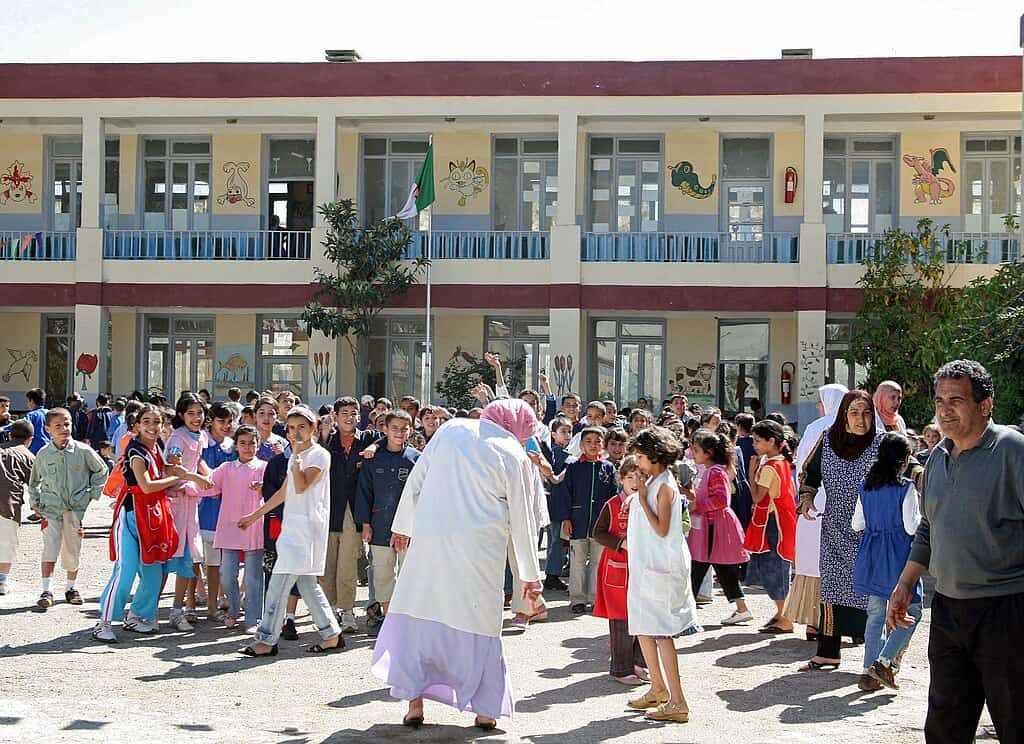
Sixty-three years after independence, Algeria’s education system tells a story of remarkable transformation—from a colonial system primarily serving settler interests to a mass system offering free education to millions. Yet this achievement comes with nuances that reveal both the country’s commitment to universal education and the challenges that remain.
The Post-Independence Miracle
The numbers speak volumes. In 1962, when Algeria gained independence from France, illiteracy exceeded 85% of the population and fewer than 750,000 children attended primary school. Recent estimates put adult literacy around 80–82% and youth literacy ~94–97%. Primary school enrolment has achieved near-universal coverage at 97-98%, a figure that meets international standards.
This dramatic expansion required massive state investment. By 1990, education received ~29.7% of the state budget; in recent years spending is ~5–7% of GDP and ~13–18% of government outlays—above average for countries at its income level—with education consistently commanding one of the largest shares of the national budget.
The Ministry of National Education established in 1963 quickly implemented an ambitious campaign to universalise primary schooling. A cornerstone policy was “Arabisation”: French was progressively replaced with Arabic as the language of instruction in schools. Arabic became the main medium in basic/secondary schooling through the late 1960s–1970s, while French persisted in selected technical/higher tracks—a split that continues to shape debates today. Since 2003, Algeria has used a 5–4–3 structure (five years of primary, four of middle, three of secondary), replacing the earlier 6–3–3 model. The reform overhauled curricula, teacher preparation and school organisation, and was designed to tackle large classes, repetition and drop-out, and shortages of trained staff. From 2025, medical schools begun switching from French to English, signalling a further tilt.
The Gender Success Story
Perhaps Algeria’s most striking achievement is gender parity—and in some levels, female advantage—in education. Girls’ primary enrolment virtually equals boys’ at around 97%. By secondary level, the gender parity index reaches 1.04, meaning there are approximately 104 girls for every 100 boys in secondary school.
This disparity becomes even more pronounced in higher education, where women account for ~60%+ of university students (several consecutive years). Algeria has achieved one of the highest female tertiary enrolment rates in Africa. Interestingly, female students not only enrol in greater numbers but often have higher success rates, with the female Baccalauréat pass rate typically exceeding the male pass rate.
The Language Question
Language policy remains one of Algeria’s most politically charged educational issues. The system operates with a complex linguistic landscape: Modern Standard Arabic serves as the primary language of instruction in public schools, French is taught as a subject starting in Grade 3, and English was traditionally introduced in middle school.
However, a significant reform in 2022 marked a watershed moment. President Abdelmadjid Tebboune decreed that English would be taught starting in primary 3rd grade (about age 8). Since 2022/23, English has been introduced from Year 3 (two 45-minute lessons weekly), with rapid teacher recruitment and new textbooks; authorities have also signalled an expansion and university-level shifts in some programmes. The reform aims to make English “the language of science and global communication” for Algerian students.
Yet the rollout faces logistical challenges. Some remote regions, especially in the Sahara, lack qualified language teachers, meaning students there have limited access to the new English classes. Even French teachers are scarce in some areas, creating disparities in language education access.
Another linguistic dimension involves Tamazight (Berber), recognised as an official language in 2016. By 2017–2018, roughly 343–350k pupils studied Tamazight in 38 wilayas (≈4% of pupils), with gradual rollout thereafter.
The University Expansion—and Its Dilemmas
Algeria’s higher education sector has undergone remarkable expansion. In 1962, Algeria had only 3 universities enrolling under 2,000 students. Recent counts report 1.5–1.7 million students across ~130 higher education institutions; gross tertiary enrolment has exceeded 50% in recent years—meaning over half of college-age Algerians are in some form of post-secondary education.
However, this expansion has brought quality challenges. A majority enrol in humanities and social sciences (≈two-thirds, recent analyses). This imbalance has raised concerns about job-market alignment, as many humanities graduates face limited employment options. Graduate under-employment and job mismatch are persistent concerns; protests by PhDs and placement bottlenecks illustrate the pressure.
Adding another layer of complexity is the language discontinuity at university level. Most science, engineering, and medical programmes are taught in French, while students studied those subjects in Arabic throughout high school (Medical faculties are now shifting to English from 2025, aiming to reduce misalignment with global literature). This forces students to effectively switch languages upon entering university—a challenge often cited as a cause of difficulties for first-year students.
Vocational Training: The Alternative Path
Recognising the mismatch between academic education and labour market needs, Algeria has expanded its technical and vocational education and training (TVET) system significantly. As of 2025, the vocational training sector counts over 1,200 public training institutions across all 58 provinces.
The Ministry of Vocational Training and Education opened 312,225 new training spots for the February 2025 session alone. Currently, around 600,000-700,000 trainees are enrolled in vocational programmes at any given time, studying in 406 specialties across 23 professional fields—including newly emerging fields like renewable energy, aviation maintenance, and recycling.
Historically viewed as a “second choice” for students who struggled in an academic environment, the government has been working to upgrade TVET’s image and pathways. In 2025, the government moved from discussion to pilot implementation of a Baccalauréat professionnel and lycées professionnels in selected wilayas.
Disparities That Persist
While Algeria has achieved near-universal access at the primary level and improved regional equity significantly, disparities remain:
Socioeconomic factors: Children from wealthier families can supplement education with private tutoring and tend to attend better-equipped schools. The rise of private tutoring (cours particuliers) after school, which wealthier families utilise, can widen achievement gaps.
Urban-rural differences: While virtually all children attend primary school in both settings, rural youth have lower upper-secondary and tertiary participation. Secondary schools are fewer in remote areas, requiring rural students to face longer commutes or relocation to attend upper secondary.
Regional gaps: The south (Saharan regions) and certain highland areas still have somewhat lower secondary participation and exam success, correlating with teacher shortages and socioeconomic factors. Remote schools often lack laboratories, libraries, or experienced teachers.
Quality concerns: Overcrowding and double-shift timetables are periodically reported, particularly in high-demand urban zones. Algeria’s performance on international assessments has been modest—in 2015, Algeria’s mean scores were roughly reading 350, maths 360, science 376 on PISA tests, below OECD averages.
Looking Forward
Algeria’s education system stands at a critical juncture. It has achieved quantitative success—near-universal primary education, high youth literacy, gender equity, and mass higher education enrolment. The historical evolution from Arabisation in the 1960s to competency-based curricula in the 2000s shows adaptability to new educational paradigms.
Yet the focus now must shift to quality and relevance. Recent reforms introducing English instruction earlier, strengthening STEM fields, and modernising vocational training represent steps toward addressing contemporary needs. The government continues to invest heavily, with ongoing school construction programmes to reduce overcrowding and teacher training initiatives to improve pedagogical quality.