By the end of the 1960s, Algiers had earned an epithet that few cities could claim. Amílcar Cabral, the Guinea-Bissauan revolutionary and leader of the African Party for the Independence of Guinea and Cape Verde (PAIGC), is said to have captured the sentiment in a formula that has endured ever since: “Muslims go on pilgrimage to Mecca, Christians to the Vatican, and national liberation movements to Algiers.”
It was not an idle comparison. In the years following Algerian independence in 1962, the capital became a meeting place, diplomatic platform, sanctuary and communications centre for liberation movements from across Africa, Asia and the Americas, including Palestinian organisations. Vietnamese revolutionaries maintained offices there. Palestinian organisations found a base. The Black Panther Party’s International Section, led by Eldridge and Kathleen Cleaver, operated from a villa in El Biar that had previously been used by the National Liberation Front of South Vietnam.
But Algiers did not arrive at that status overnight. The story of how a colonial capital became a global symbol of anti-colonial resistance is one of urban transformation, wartime sacrifice, diplomatic ingenuity and contested memory.
A city built on inequality
To understand why Algiers could become a revolutionary symbol, it helps to start with the city’s colonial structure. French conquest began in 1830, and colonial rule gradually produced a deeply stratified society. The indigénat (a special colonial system of administrative punishment) subjected Muslim Algerians to forms of sanction not applied to ordinary French citizens. Nationality, citizenship, personal status and political rights were distributed unequally among Muslim Algerians, European settlers and Algerian Jews, although these distinctions evolved over time.
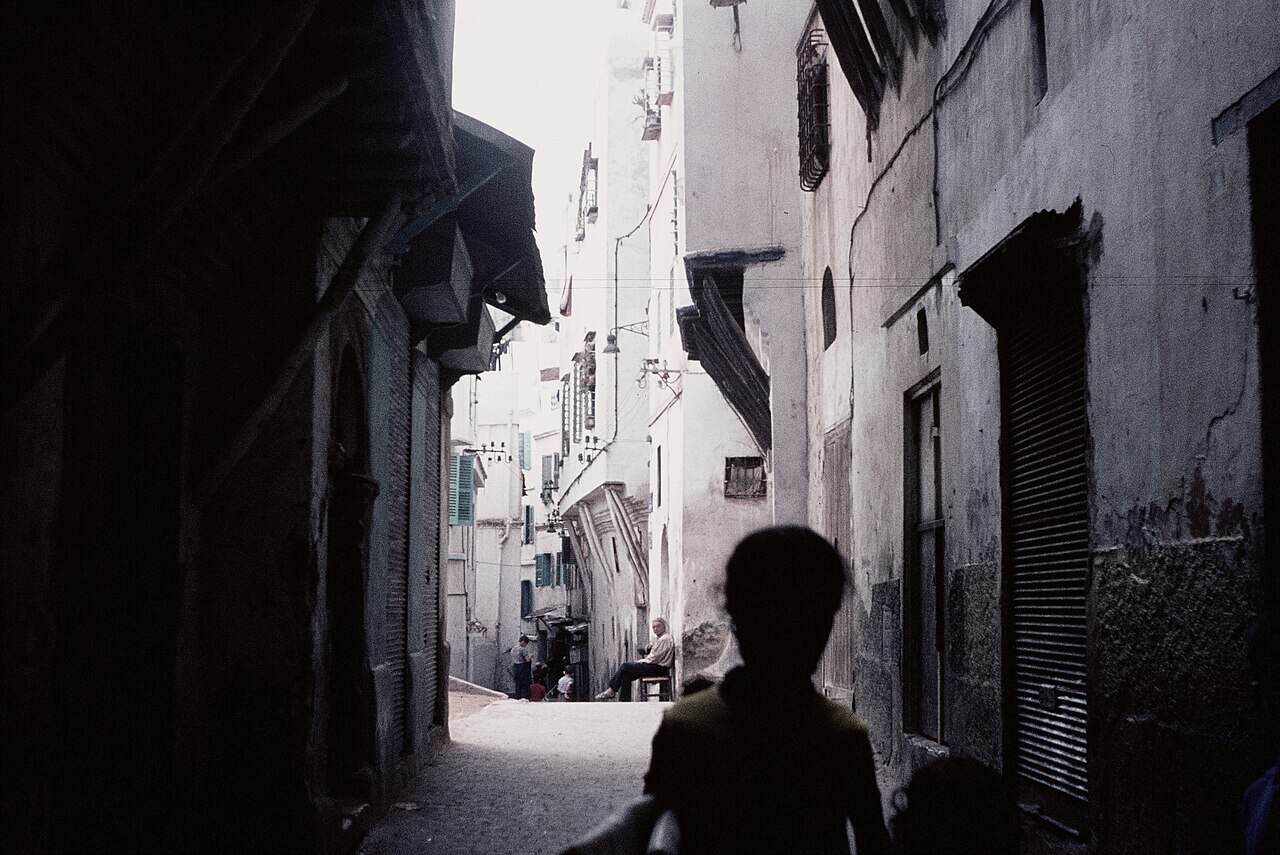
The city’s geography made that inequality visible. French redevelopment had transformed the lower city into administrative and commercial districts resembling a Mediterranean European capital. Above it, the Ottoman-era Casbah (the historic fortified quarter) survived as a predominantly Muslim neighbourhood. By the 20th century, rapid migration had also produced large informal settlements — the bidonvilles (shantytowns) — in areas such as Mahieddine, close to central Algiers yet difficult for colonial authorities to control.
The revolution comes to Algiers

The Proclamation of 1 November 1954 by the National Liberation Front (FLN) demanded national independence and explicitly paired internal armed struggle with external diplomatic action. The movement understood from the beginning that armed struggle alone would not be enough against a major NATO power. Algeria had to become an international question.
Algiers quickly became one of the war’s principal urban stages. In 1956, the FLN’s clandestine newspaper El Moudjahid (The Combatant) appeared for the first time in the capital. Meanwhile, the Soummam Congress, held at Ifri in the Soummam Valley in August 1956, reorganised the movement’s political and military structures. By January 1957, when General Jacques Massu’s paratroopers were given sweeping powers in Algiers, the city had become the war’s most visible urban front.
The battle itself was a paradox. French forces under General Jacques Massu succeeded in dismantling much of the FLN’s urban network through surveillance, mass arrests, torture and disappearances. Yet the methods used produced a political and moral crisis that ultimately strengthened the case for Algerian independence. France itself now officially acknowledges that the system established under the “special powers” facilitated torture and disappearance. In 2024, the French presidency formally acknowledged that French forces killed FLN leader Larbi Ben M’Hidi in 1957, having previously acknowledged France’s responsibility in the deaths of Maurice Audin (in 2018) and Ali Boumendjel (in 2021).
This was the fundamental contradiction of the Battle of Algiers: France could destroy an urban clandestine apparatus and simultaneously lose political ground. The very methods used to defend French sovereignty reinforced the FLN’s contention that colonial rule was incompatible with the democratic principles France claimed to represent.
Beyond the Casbah: a wider geography of resistance
Popular imagination — shaped powerfully by Gillo Pontecorvo’s landmark 1966 film The Battle of Algiers — tends to locate the revolution within the Casbah’s narrow lanes. But the reality was more complex.
Working-class peripheries such as Mahieddine and Clos-Salembier (now El Madania) were also significant. These expanding Muslim quarters on the hills above the colonial centre had long frustrated colonial attempts at administrative control. Their strategic importance is an important correction, as historians have noted, to the tendency to reduce revolutionary Algiers to the Casbah alone.
The war’s logistical arteries, meanwhile, largely bypassed the city altogether. A 1957 US National Intelligence Estimate assessed supply routes running from Egypt through Libya and Tunisia, together with arms purchases in southern Europe. The key point is that while Algiers organised urban resistance with relatively small quantities of materiel, the Algerian National Liberation Army’s (ALN) strategic logistics were trans-Mediterranean and cross-border.
Diplomacy, media and the culture of revolution
The FLN’s diplomatic campaign was, by most scholarly accounts, remarkably effective. At the United Nations, the Algerian question evolved from a matter the General Assembly declined to pursue in 1955 to one where, by December 1960, Resolution 1573 recognised the Algerian people’s right to self-determination and independence. The historian Matthew Connelly has characterised Algeria as a case in which decolonisation itself reshaped Cold War diplomacy; Jeffrey James Byrne similarly emphasises the FLN’s diplomatic flexibility, adapting its language to different audiences rather than adhering rigidly to one ideological bloc.
Media played a parallel role. El Moudjahid was not merely a newspaper for domestic morale — it created an authoritative FLN narrative for foreign correspondents, supporters and diplomats. Radio broadcasts through the “Voice of Fighting Algeria” sought to bypass French censorship. Frantz Fanon, whose writings on Algeria remain among the most influential analyses of anti-colonial struggle, made radio one of his examples of how a technology once associated with colonial authority could be appropriated by a national movement.
Culture extended the revolution’s reach further still. Algeria’s national anthem, Kassaman (قسماً, “We Pledge”), was written by the nationalist poet Moufdi Zakaria while imprisoned in Serkadji-Barberousse Prison in Algiers in 1956. Its music was initially composed by Mohamed Triki and subsequently revised by the Egyptian composer Mohamed Fawzi. According to the Embassy of Algeria in London, it became the national anthem at independence. According to a widely told account, Zakaria wrote the lyrics on his prison cell wall using his own blood — a story that has become an enduring part of Algeria’s revolutionary memory.
The “Mecca” takes shape: Algiers after 1962
The famous description of Algiers as a revolutionary Mecca belongs primarily to the post-1962 city. Drawing on Byrne’s account, independent Algeria possessed three assets that few new states could combine: revolutionary prestige — the FLN had survived a long war against a major NATO power; institutional experience — during the war it had built diplomatic missions, propaganda organisations and international friendships; and material capacity — the Algerian state could offer foreign movements office space, identity documents, money, military instruction and a communications platform.
The result was a remarkable political ecosystem. Representatives of movements fighting Portuguese colonialism in Guinea-Bissau, Cape Verde, Angola and Mozambique could meet one another in Algiers. Palestinian organisations maintained offices. Vietnamese revolutionary missions operated in the city. And the network effect was crucial: a revolutionary office in Algiers was valuable not simply because it provided access to Algeria, but because it put activists in proximity to embassies from Asia and Africa, foreign journalists, international organisations and other guerrilla movements.
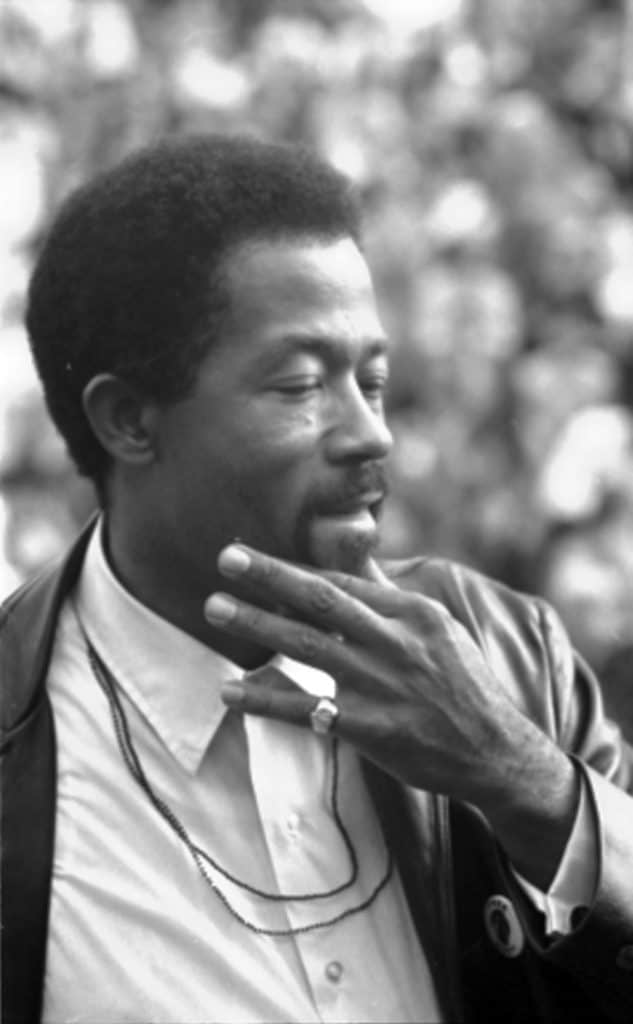
The Black Panther episode illustrates the system with particular clarity. Eldridge Cleaver arrived in Algiers from Cuba in 1969. Algerian officials permitted him to remain and hold a major press conference. The Panthers were subsequently recognised as a sponsored liberation movement. M’hamed Yazid — who had represented the Algerian cause in New York during the independence struggle — helped secure them a villa in El Biar formerly used by the South Vietnamese NLF. According to Elaine Mokhtefi, whose memoir provides an exceptional eyewitness account of this period, the arrangement included telephone and telex connections, Algerian identity documents, visa privileges and a monthly allowance.
The Panthers then met North Vietnamese, Chinese, North Korean and Palestinian representatives in Algiers, while contacts with support networks in Europe extended their reach further. Algiers was functioning, as Mokhtefi recalls, not merely as a metaphorical “Mecca” but physically as an intercontinental communications node linking Oakland with networks across Europe, Africa, the Middle East and Asia.
The 1969 Pan-African Cultural Festival
One of the cultural high points of revolutionary Algiers came with the first Pan-African Cultural Festival, held from 21 July to 1 August 1969. Musicians, writers, filmmakers, political delegations and liberation movements converged on the city. William Klein’s film of the festival records a moment when artistic performance, Pan-African identity and anti-colonial politics were deliberately fused.
Elaine Mokhtefi remembers the streets filled with performances and participants including Miriam Makeba and Archie Shepp, while the Black Panthers operated an Afro-American Centre on Didouche Mourad Street where they distributed literature and showed films. Revolutionary internationalism temporarily occupied not only ministry offices but shop fronts, streets, hotels, cinemas and concert spaces.
The diplomatic realities of revolutionary Algiers
Algiers’ role as a revolutionary capital was not without its diplomatic complexities. While Algeria provided substantial support to liberation movements, the government also had to manage its relationships with the organisations operating on its soil. In 1972, following a dispute over ransom money brought to Algeria by US aircraft hijackers, the authorities temporarily closed the Black Panthers’ office and suspended its communications. The episode illustrates how Algeria’s international revolutionary commitments operated alongside its responsibilities and interests as a sovereign state.
A city of transformations
The most historically useful way to understand Algiers is not simply as the place where a revolution happened, but as a city in which several transformations occurred in sequence. Colonial segregation produced an intensely unequal capital. Algerian nationalism turned that capital into a contested political space. The FLN made it a laboratory of urban insurgency and international advocacy. French counterinsurgency made it synonymous with the moral crisis of torture. Independence converted revolutionary legitimacy into state power. And that state then opened parts of the city to movements struggling from Guinea-Bissau to Palestine and the United States.
The ‘Mecca of revolutionaries’ was therefore both a memory of Algeria’s own liberation and an infrastructure for exporting its political meaning to the wider world. Understanding that dual character — its genuine solidarity and the diplomatic interests that helped shape it — is essential to appreciating what Algiers represented in the 20th century, and what it continues to mean today.