

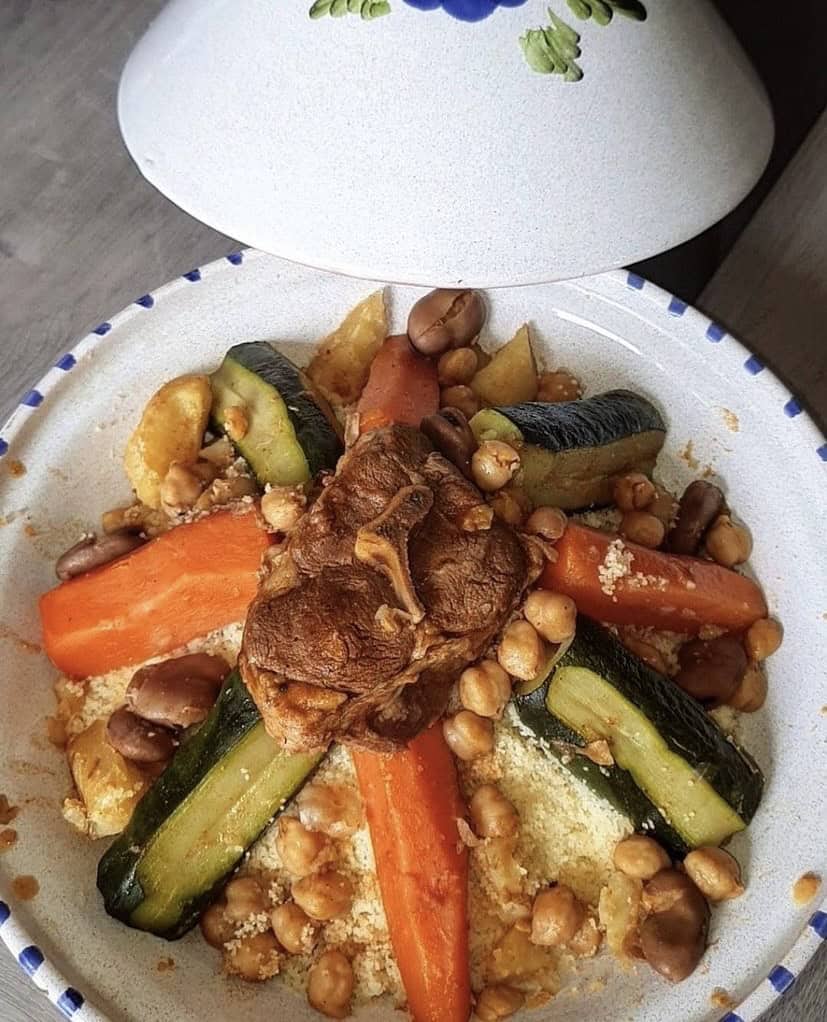
The steaming couscoussier (couscous pot) releases its fragrant clouds across Algerian kitchens every Friday, carrying with it the essence of a nation’s soul. More than mere sustenance, couscous stands as Algeria’s most treasured culinary ambassador—a dish that connects ancient Berber wisdom to modern national identity.
Algeria’s relationship with couscous runs deeper than its official designation as the national dish. This is a story that begins in the mists of antiquity, where archaeological evidence from 3rd century BC burial sites in Numidia reveals cooking vessels remarkably similar to today’s couscoussiers. These artifacts, discovered in Tiaret and Kabylia and now preserved in Constantine’s Cirta Museum, belong to the Berber kings who first transformed simple semolina into golden grains of tradition.
Ancient Roots, Enduring Legacy
Current consensus puts the birth of couscous somewhere in the Berber-speaking Maghreb, with the earliest couscous-like steamers found in 3rd-century BCE Numidian tombs in present-day Algeria. Culinary historian Lucie Bolens has argued that the dish was already known in King Masinissa’s Numidia, though the hypothesis remains debated.
Neolithic grinding stones from the Tassili n’Ajjer highlands (c. 5500–1500 BCE) do show early cereal processing, but the oft-quoted date of 18 000 BC is not supported by current archaeology, nor could it involve durum wheat, which reached North Africa only in the first millennium BCE.
What is clear is that couscous predates Arabisation and European rule, and UNESCO now recognises the dish as a shared intangible heritage of Algeria, Morocco, Tunisia and Mauritania.
A Culinary Canvas of Regional Identity
To speak of Algerian couscous is to acknowledge a remarkable diversity that mirrors the nation’s varied landscapes. Estimates suggest between 300 to 1,000 different variations exist across Algeria’s regions, each telling its own story through local ingredients and preparation methods. Every wilaya possesses its own special recipe for Merga—the flavourful stew that transforms simple semolina into a feast.
Coastal areas naturally favour seafood accompaniments, whilst inland regions showcase lamb and chicken. The lavish “Couscous Royale” celebrates special occasions with its rich assortment of meats, including merguez sausage. Sweet variations like Mesfouf offer a delightful contrast, often incorporating raisins, grapes, or pomegranate seeds alongside cultured milk or clarified butter.
The diversity extends to names themselves: Na’ama (meaning “blessing”), Ta’am (“the food”), and the original Berber terms Kousksi and Seksou all reflect couscous’s integral status in Algerian culture. This linguistic richness illustrates how deeply the dish has woven itself into the fabric of daily life.
The Art of Preparation: Preserving Ancient Wisdom
The traditional preparation of couscous remains a testament to centuries of accumulated knowledge, predominantly transmitted from generation to generation through women’s hands. The meticulous process begins with separating coarse semolina from finer grains, followed by a specific three-step rolling technique that creates the characteristic spherical granules.
Authentic preparation involves multiple steaming cycles in the essential couscoussier—a specialised two-tiered pot that directs steam through the grains whilst the accompanying stew simmers below. The grains are moistened, rested, tossed with oil, steamed, and repeated until they achieve the perfect fluffy texture. This labour-intensive process stands in stark contrast to industrial production methods, highlighting the cultural value placed on authenticity and the communal act of preparation.
The accompanying Merga requires equal attention, with its foundation of sautéed onions and tomatoes enhanced by traditional spices like cumin, coriander, turmeric, and the complex blend known as Ras el hanout. Chickpeas provide both texture and nutrition, whilst vegetables such as carrots, turnips, and courgettes add colour and flavour depth.
Beyond the Plate: Symbol of Identity and Unity
Couscous transcends its culinary function to embody profound symbols of hospitality, generosity, and enduring tradition within Algerian society. Its preparation often serves as a communal activity that strengthens family bonds and maintains cultural connections across generations. For Algeria’s vast diaspora, couscous provides a tangible link to home—a “taste of memory” that evokes nostalgia and reinforces cultural identity.
The dish marks life’s significant moments, from joyous celebrations to solemn gatherings. It graces wedding tables and funeral spreads alike, accompanies religious observances, and features prominently in celebrations like the Berber New Year, Yennayer. Special preparations, such as couscous au beurre, hold particular cultural significance and are traditionally eaten during Ramadan’s pre-dawn meal.
The UNESCO Recognition: Shared Heritage, Distinct Identity
The 2020 UNESCO inscription of couscous traditions represents a remarkable moment of regional cooperation. Algeria, alongside Mauritania, Morocco, and Tunisia, successfully gained recognition for the “Knowledge, know-how and practices pertaining to the production and consumption of couscous” as intangible cultural heritage. This achievement transcended the historical “couscous wars” that had seen nations compete for exclusive ownership of the dish.
The UNESCO recognition explicitly acknowledges the fundamental role of women in preserving both the practical skills and symbolic meanings associated with couscous preparation. Historically, mastery of couscous preparation formed an important element of a young woman’s dowry—an intangible asset that carried cultural value beyond its culinary application.
A Living Symbol of Cultural Resilience
During Algeria’s tumultuous War for Independence (1954-1962), couscous served as a cultural anchor for displaced communities. The Algerian diaspora used this familiar dish to maintain connections with their heritage, contributing to couscous’s remarkable journey from North African staple to global favourite.
Today, couscous continues to evolve whilst maintaining its essential character. It adapts to contemporary lifestyles through industrial production whilst UNESCO recognition ensures traditional methods remain valued and preserved. This dynamic balance reflects Algeria’s broader cultural narrative—honouring ancient traditions whilst embracing modernity.
The story of Algerian couscous ultimately illustrates how food serves as more than sustenance. It is a living, breathing component of the nation’s soul. It continually connects past, present, and future generations through its distinctive taste, its meticulous preparation, and the profound communal experiences it fosters, embodying the very spirit of Algeria.