

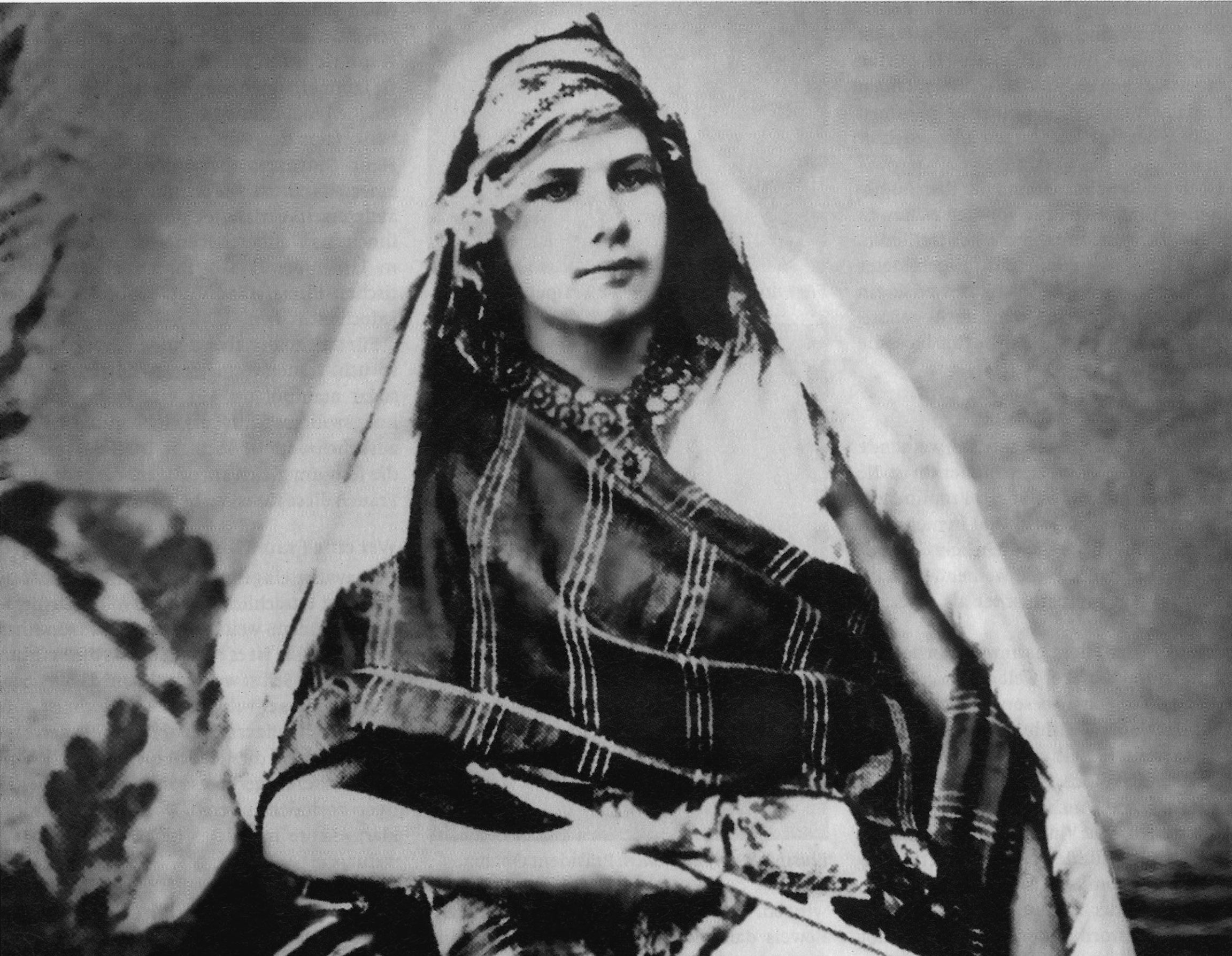
In the popular Western imagination, Isabelle Eberhardt is a romantic figure: the Swiss-born rebel who wore men’s clothing, converted to Islam, travelled through the Sahara and died in a flash flood at the age of 27. It is a compelling story, but it is not the most interesting one. The more historically valuable Eberhardt is the one who emerges when Algeria itself—its faith, its landscapes, its people, its colonial machinery—is placed at the centre of the narrative rather than at the margins of a European adventure.
Algeria did not merely give Eberhardt material to write about. It gave her the religious, linguistic, social and imaginative structures through which she remade herself. And yet her relationship with Algeria resists simple categories. She was neither a colonial eccentric in disguise nor a fully decolonial revolutionary avant la lettre. She was, as Algerian scholar Houria Talbi has argued, something more difficult to place: a figure caught between an espionage thesis and exaggerated idealisation, whose sympathies were real but whose contradictions were never fully resolved.
Bône: where it began
The decisive transformation of Eberhardt’s adult life began in 1897, when she went to Bône (now Annaba) with her mother. The Archives nationales d’outre-mer (ANOM) treat this as the starting point of her Algerian trajectory. Her mother died there that year and was buried in Bône’s Muslim cemetery, on a hill facing the sea. Leïla Sebbar, in her essay “Isabelle, l’Algérien”, emphasises how powerfully that burial fixed Bône in Eberhardt’s emotional geography. Eberhardt later wrote of wanting a desert grave herself, and would ultimately receive one at Aïn Sefra. Algeria thus became associated unusually early in her adult life with family loss, chosen belonging and death.
From Bône, her Algeria expanded along an east–south–west arc that was not principally the Algeria of colonial Algiers: Batna, the Souf around El Oued, Bou Saâda and El Hamel, Ténès, and then the high plateaux and the South Oran frontier around Saïda, Aïn Sefra, Beni Ounif and Béchar; her travels also carried her across the frontier into the Figuig region of Morocco. The ANOM records stress the military character and shifting administrative limits of these southern colonial territories—conditions quite unlike the stable administrative geography familiar today.
A faith that was not a costume
Her Islam was sincere in the meaningful historical sense, though the exact moment and ritual form of her conversion are less certain than many biographies suggest. In a public declaration made during the 1901 crisis surrounding the attempt on her life, Eberhardt insisted that she had never been Christian or baptised and had been Muslim “depuis fort longtemps”—for a very long time. This evidence is stronger than later biographers’ attempts to assign a dramatic conversion moment. The ANOM simply states that she converted to Islam; Eberhardt herself later went further, claiming in a 1903 autobiographical account that she had been “born Muslim” and had never changed religion. The surviving sources cited here do not establish a single, dated conversion ceremony.
That uncertainty does not diminish the faith. Her public and private self-identification, funeral wishes, Sufi affiliation and years spent within Algerian Muslim communities would be an extraordinarily elaborate structure to explain as mere disguise. Islam furnished the concepts through which she interpreted existence—divine unity, submission, impermanence, mektoub, prayer at sunset—and these recur too consistently across her reportage, fiction and journals to be reducible to a travel costume. In her writing, Islamic time interrupts European clock time: Maghrib, Ramadan, prayer calls and the vocabulary of destiny reshape narrative rhythm. Arabic terms thread through her French prose, often without being fully domesticated into French; this can be read as part of the linguistic world through which she understood Algeria rather than as exotic decoration.
At the same time, sincerity should not be confused with conformity. Accounts of her life frequently mention her drinking, cannabis use and irregular life. Those behaviours may show that she did not live according to every conventional moral prescription, but they do not decide whether she believed herself Muslim. The texts point towards mysticism, mektoub and devotional belonging rather than legalistic observance.
Qadiriyya and Lalla Zaynab
The strongest institutional component of her religious identity was her affiliation with the Qadiriyya, the Sufi order tracing its spiritual genealogy to ʿAbd al-Qadir al-Jilani of Baghdad. In a surviving letter transmitted by Victor Barrucand, Eberhardt wrote that Sidi Elhoussine ben Brahim, the Qadiriyya sheikh of Guémar, had given her the order’s initiation and prayer beads. Barrucand’s preface to Notes de route also records her saying that the Algerian mokhazni with whom she camped at Beni Ounif welcomed her as an initiated Qadiri—associating that acceptance with her religious identity rather than with cross-dressing alone.
Her Sufi world also reached beyond the Qadiriyya. The most important relationship was with Lalla Zaynab, the powerful leader of the Rahmaniyya zawiya at El Hamel—daughter of its founder and, after a contested succession, a religious leader in her own right. Algerian historian Tayeb Chenntouf’s research on the succession shows how closely the French military administration and Governor-General followed—and intervened in—the dispute that pitted Zaynab against a male cousin. Eberhardt visited her at El Hamel, wrote admiringly of her authority and reported that Zaynab assured her of lasting friendship.
This friendship is analytically significant. The familiar Western image of Eberhardt sometimes presents her as uniquely emancipated because she wore men’s clothes, while representing Algerian women as passive. Lalla Zaynab complicates that picture considerably: Eberhardt encountered an Algerian Muslim woman who exercised religious authority, institutional leadership and political leverage without imitating European gender norms.
A densely social Sahara
The most persistent Eberhardt myth is the lone European woman disappearing into an otherwise closed desert. Her surviving writings show something richer. She stayed in camps, travelled with armed auxiliaries, conversed with scholars and labourers, entered religious establishments by permission and used the social identity “Si Mahmoud” to move within overwhelmingly male spaces. Her 1903 Sud-Oranais reportage describes setting out as a reporter after news of the battle of El-Moungar, travelling by railway and on horseback through military posts and camps. Her ability to travel rested upon a social infrastructure of Algerian hospitality, Muslim recognition, military connections and linguistic competence—not simply a masculine costume.
Her marriage to Slimène Ehnni, an Algerian Muslim non-commissioned officer in the spahis, was simultaneously an emotional relationship, a crossing of the colony’s racialised boundary and a decisive legal event. They were married in a civil ceremony in Marseille on 17 October 1901, after the French administration had expelled Eberhardt from Algeria. Ehnni was an Algerian Muslim who had been naturalised French; through the marriage, Eberhardt acquired French nationality and could return. It was a colonial paradox: Ehnni’s exceptional legal status gave a formerly Russian woman a route back into Algeria within a system that distinguished French nationality from full citizenship and that, under the 1865 sénatus-consulte, classed Muslim Algerians as French but required individual admission for the rights of French citizenship. The ANOM finding aids preserve correspondence and papers relating to both the marriage and the expulsion.
Colonial power and the Lyautey paradox
French unease about Eberhardt stemmed from attributes the colonial security imagination found difficult to classify: a Russian subject, wearing men’s North African dress, speaking Arabic, connected to Sufis, crossing administrative boundaries. The Béhima affair of 29 January 1901—when Abdallah ben Si Mohammed ben Lakhdar attacked her near El Oued—became the crucial collision. Colonial authorities presented the assault as an act of Muslim “fanaticism” linked to Eberhardt’s Qadiriyya affiliation, but later examination of the episode has called that interpretation into question and pointed to other possible motives. After the assailant’s trial, at which Eberhardt pleaded for leniency, the colonial administration expelled her. The supposed victim of Muslim “fanaticism” was treated by the colonial state as a security problem herself.
Her politics were anti-colonial in sympathy more reliably than in programme. She condemned injustice and wanted to establish herself as a defender of her “frères musulmans d’Algérie.” But Talbi notes that her South Oran reportage praised French auxiliaries while leaving Cheikh Bouamama’s armed resistance largely outside the frame. Eberhardt also developed a warm rapport with Hubert Lyautey. Talbi argues that censorship and dependence on L’Akhbar explain some silences—but not all. The broader paradox is that what Lyautey and the colonial authorities presented as “peaceful penetration” depended upon deeper knowledge of Arabic, Islam and local elites: the same cultural competence that allowed Eberhardt to empathise with Algerians could also serve an expanding colonial state.
Algerian scholar Lynda Chouiten’s revisionist research is essential here. Chouiten argues that Eberhardt never fully escaped the colonial hierarchies and stereotypes of her own culture—that one can enter the social worlds of colonised people without ceasing to carry habits learned from the dominant one. The critique prevents “friendship with Algerians” from becoming a certificate of decolonisation.
The grave in the sand
On 21 October 1904, a flash flood destroyed much of Aïn Sefra. Eberhardt was among the dead, at 27. She was buried in the local Muslim cemetery—not in a European section, not repatriated to Geneva. Sebbar describes the grave bearing both identities: the Arabic name “Sidi Mahmoud” alongside the French inscription identifying Isabelle Eberhardt as the wife of Ehni Sliman. She had written that she wanted burial away from what she regarded as the profanation of the invading West. The burial can be read as a final claim of local and Muslim belonging—one that outlasted colonial rule itself.
The most convincing Isabelle Eberhardt is neither the colonial eccentric, the perfect Algerian convert, the feminist saint, the French spy nor the flawless anti-colonial rebel. She is more difficult and more historically valuable: a European-born Muslim writer whose encounter with colonised Algeria transformed her identity so thoroughly that the boundary between observer and participant became unstable, while the colonial asymmetry between privilege and subjection never disappeared.
Algeria made Isabelle Eberhardt. How far her chosen belonging could overcome the privileges and asymmetries of colonial rule is a question that her grave, with its two names and one resting place, poses more honestly than any biography.