

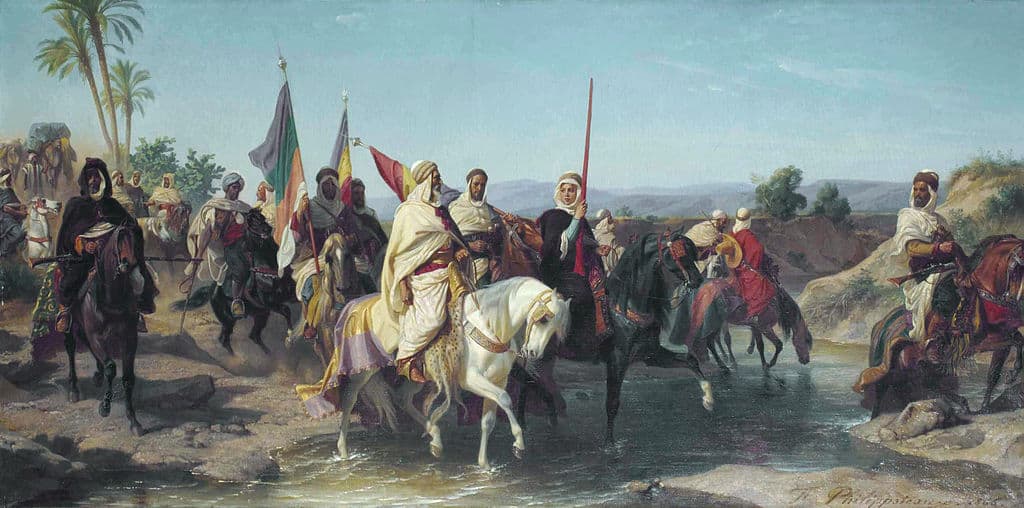
In the mountainous heart of 19th-century Kabylia, when French colonial forces sought to subdue Algeria’s Amazigh (Berber) heartland, an extraordinary woman emerged who would challenge both imperial conquest and patriarchal tradition. Lalla Fatma N’Soumer (from Soumer), born around 1830, became one of Algeria’s most remarkable resistance leaders—a figure whose story weaves together spiritual authority, military prowess, and an uncompromising refusal to accept the constraints of her time.
Sacred Learning and Rebellious Spirit
Born Fatma Sid Ahmed ou Meziane c.1830 in the village of Ouerdja near Aïn el-Hammam, she entered a world already transformed by colonial upheaval. The French had captured Algiers the year of her birth, beginning what would become one of history’s most devastating colonial campaigns—historians estimate Algeria lost roughly one-third of its population between 1830 and 1872 due to war, famine, and disease.
Yet in the early decades, Kabylia’s rugged mountains provided sanctuary. Here, Fatma grew up in a scholarly marabout family, absorbing religious learning at her father’s Rahmaniyya Sufi school. She memorised the Qur’an simply by listening to students recite, displaying what contemporary observers called exceptional intelligence and piety. After her father’s death, she and her brother took over the zawiya (religious school), where her reputation for wisdom and spiritual insight flourished.
The young woman’s defiance of conventional expectations became legendary. In 1849, when her family arranged her marriage to a cousin, Fatma refused—not merely declining, but actively resisting through what sources describe as fierce determination, ultimately forcing the marriage’s dissolution after just one month. This act of self-determination was virtually unprecedented for women in her society, earning her the nickname “Fatma N’Ouerdja”—which Kabyle oral tradition interprets as “the one who refuses to comply with customs.”
From Spiritual Teacher to Military Commander
By the late 1840s, French forces had turned their attention to ‘pacifying’ Kabylia. Fatma left her village with her brother Sidi Tahar, settling in Soumer—the village that would later inspire her appellation “N’Soumer.” Here she allied with prominent resistance figures, including the charismatic Islamic preacher Sherif Boubaghla, supporting his popular uprising in 1850.
What followed was extraordinary: according to local accounts the village assembly (tajmaʿat) appointed Lalla (Maghrebi honorific) Fatma and her brother to jointly command the Imseblen, or “volunteers of death,” drawn from numerous tribes across the Djurdjura Mountains. This role—effectively co-general of resistance forces—was unprecedented for a woman. Her spiritual authority, rooted in her marabout lineage and reputation for baraka (divine grace), legitimised her leadership in the eyes of traditionally conservative tribesmen.
The Victory at Tazrout
In 1854, following Sherif Boubaghla’s death in battle, Fatma assumed sole leadership of the rebel forces. That summer, she led roughly 5,000 mujahideen armed mostly with sabres and daggers against a French column of about 8,000 troops under General Charles Joseph Wolff. The Battle of Tazrout (Oued Sebaou) raged for two months before the French were decisively routed, forced into what their own accounts described as a humiliating retreat.
News of this triumph spread throughout Kabylia. Mosques and zawiyas sang her praises, and Lalla Fatma—then only about 24—was hailed as the heroine of Djurdjura. Her rallying cry, “Fight for Islam, the land, and liberty… They are sacred!” became legendary. Even French commanders acknowledged her strategic acumen. It was reported that her strategic predictions, the fruit of keen analysis by a woman of rare intelligence, often proved correct in battle.
Capture and Dignified Defiance
The French response was overwhelming. In 1857, Marshal Jacques-Louis Randon assembled 35,000 French troops for a massive offensive, adopting ruthless scorched-earth tactics. Surrounded and outnumbered, Fatma’s coalition became the final bastion of Kabyle resistance.
On 11 July 1857, French forces discovered the hideout and captured Lalla Fatma N’Soumer. As one French officer noted, “from the moment [Fatma] was in our hands, all resistance ceased.” Rather than execute her—perhaps fearing martyrdom—the authorities exiled her to the zawiya of Beni Slimane near Tablat.
Even in captivity, her reputation drew crowds. Reports describe long queues of both Kabyle and Arab visitors seeking the blessings of the famous Lalla Fatma. Yet imprisonment, compounded by her beloved brother’s death in French custody in 1861, took a severe toll. She died in captivity in late 1863 at the age of 33.
Legacy of Resistance and Faith
Today, Lalla Fatma N’Soumer stands as a towering figure in Algerian memory. In 1995, her remains were transferred to Algiers’s El Alia cemetery, the ‘Carré des Martyrs’ (Martyrs’ Square) reserved for Algeria’s greatest heroes—a symbolic rehabilitation that sparked renewed public interest in her extraordinary story.
Her legacy extends beyond military resistance to encompass something more complex: the interweaving of spiritual authority, defiance, and anti-colonial struggle. She challenges assumptions about women’s roles in 19th-century Islamic societies whilst embodying the deep cultural and religious currents that sustained Algerian resistance.
Schools, streets, and monuments across Algeria now bear her name. In 2014, filmmaker Belkacem Hadjadj brought her story to cinema in Fadhma N’Soumer. Yet perhaps her most enduring memorial lies in the oral traditions of Kabylia, where her story continues to inspire—as early as 1867, French ethnographers recorded Kabyle poems praising Lalla Fatma as the noble lady of Djurdjura who defended her people.
In scholarly analysis, Lalla Fatma N’Soumer represents what one researcher calls a figure of significant historical and cultural importance—not merely as a resistance commander, but as a spiritual leader whose dual authority was key to her extraordinary influence. Her story reveals the complex ways in which faith, culture, and resistance intersected in colonial Algeria, embodying the resilience of the Algerian people and standing as a testament to courage, intellect, and integrity for generations to come.