

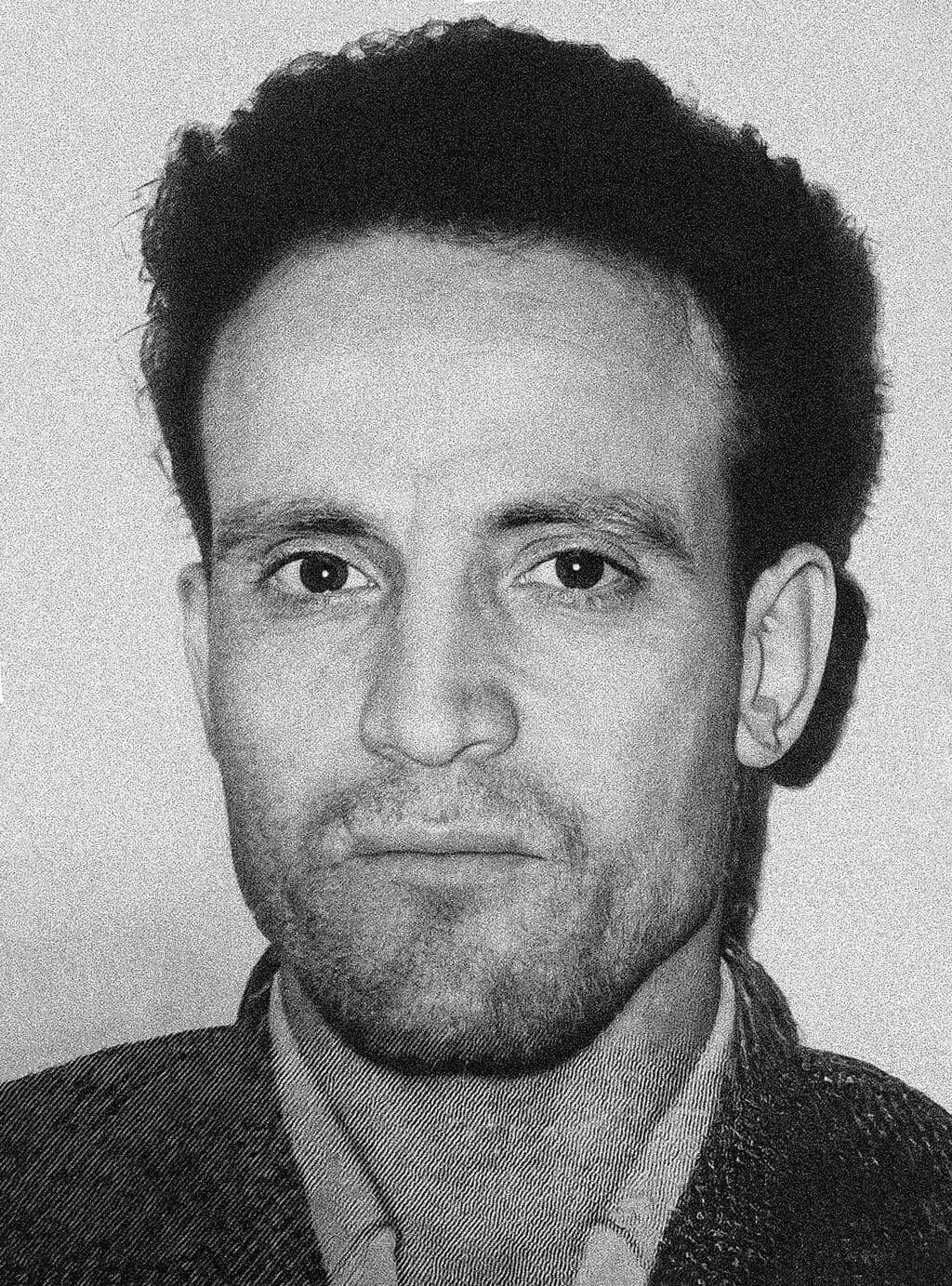
Mohamed Larbi Ben M’hidi was born in 1923 in the village of El Kouahi near Aïn M’lila in eastern Algeria, into a family associated with local religious scholarship (marabout tradition). From the age of four, he studied the Qur’an at his grandfather’s school, eventually memorising the Qur’an (becoming a ḥāfiẓ). Alongside his religious education, he attended French primary school in Batna, earning his certificat d’études primaires (primary school certificate) before his family relocated to Biskra, where he continued his secondary studies.
Early Political Awakening
Ben M’hidi’s path toward revolutionary activism began in 1939 when, as a teenager, he joined the Scouts Musulmans Algériens (Algerian Muslim Scouts), quickly rising to become a local troop leader. His political consciousness sharpened through exposure to nationalist ideas during World War II and involvement with the Parti du Peuple Algérien (PPA), a nationalist party led by Messali Hadj that advocated for indigenous rights under French rule.
The pivotal moment came on 8 May 1945—V-E Day—when Ben M’hidi witnessed and participated in protests by Algerians calling for equality and independence. These demonstrations were met with brutal repression in Sétif, Guelma, and Kherrata, where French forces massacred thousands of Algerians. Ben M’hidi himself was reportedly arrested in Biskra the day after the Sétif uprising and spent approximately four months in prison. The Sétif massacre proved formative, solidifying his conviction that only determined struggle could end colonial rule.
After his release in 1946 under a general amnesty, Ben M’hidi continued his nationalist activism. He joined the clandestine Organisation Spéciale (OS), a paramilitary wing formed in 1947 to prepare for armed revolt. When French authorities dismantled the OS in 1950–1951, Ben M’hidi was convicted in absentia and sentenced to ten years in prison. By his early thirties, he had dedicated his life entirely to the cause of liberation.
Founding the FLN
Frustrated with the stagnation of existing nationalist movements, Ben M’hidi became instrumental in planning Algeria’s armed independence struggle. In March 1954 in Algiers, Ben M’hidi was among a small circle of militants who helped form the Comité Révolutionnaire d’Unité et d’Action (CRUA), a step that paved the way for the FLN. Later in 1954, he was also among the ‘Group of 22’ who met clandestinely to endorse the launch of an armed insurrection.
By October 1954, Ben M’hidi and five fellow CRUA leaders formally founded the Front de Libération Nationale (FLN) and its armed wing, the Armée de Libération Nationale (ALN). The FLN launched coordinated attacks across Algeria on 1 November 1954—known as Toussaint Rouge (“Red All Saints’ Day”)—marking the beginning of the war against French colonial rule. Ben M’hidi was one of the “six chefs historiques” (historic leaders) of the FLN, celebrated as the “Men of November” in Algerian history.
Strategic Leadership
Within the FLN’s original leadership structure, Ben M’hidi was initially appointed commander of Wilaya V, the fifth military region covering Oran in western Algeria. Despite severe constraints and shortages of arms, he helped build the FLN’s network in the Oran region. By late 1955, Ben M’hidi was operating in and around Algiers and worked closely with figures such as Yacef Saâdi as the FLN’s urban network expanded in the capital.
Ben M’hidi is often described by historians as a key strategist within the FLN’s internal leadership. He took part in the Soummam Congress (20 August 1956), a clandestine meeting that set out a political platform and created a clearer organisational structure for the revolution. At Soummam, Ben M’hidi attended as the sole delegate from Wilaya V (Oran) and presided over the opening session, with Abane Ramdane serving as secretary. The congress is widely associated with principles that placed political direction above purely military action and affirmed the primacy of leadership inside Algeria over external, exile-based structures.
His pragmatic approach earned him the nickname “El Hakim” (“the Wise”) among comrades. At Soummam, some accounts portray him as warning that indiscriminate violence would damage the cause internationally. He is also widely credited with the line: “Jetez la révolution dans la rue, et le peuple l’embrassera” (“Throw the revolution into the street, and the people will embrace it”), capturing his faith in popular mobilisation.
The Battle of Algiers
Ben M’hidi is most renowned for playing a leading strategic role during the Battle of Algiers (1956–1957), the urban guerrilla campaign that brought the war to the Algerian capital. After moving to Algiers in 1956, he built an effective insurgent network in the Casbah and European districts. Under his direction, the FLN launched bombings and sabotage in September 1956 targeting colonial police stations, bars, and cafés frequented by Europeans.
Ben M’hidi is often quoted as making the point that it was hypocritical to call FLN tactics cowardly while French forces used aircraft and napalm against defenceless villages—and that if the FLN had bombers, they would not be reduced to improvised means like carrying explosives in baskets.
In January 1957, Ben M’hidi helped coordinate a general strike in Algiers that significantly disrupted the city and drew international attention to the Algerian cause. French authorities responded by deploying elite paratrooper units under General Jacques Massu. Despite constant pressure—with 2,000 French paratroopers conducting raids and systematic torture to locate FLN cells—Ben M’hidi maintained calm, determined leadership, constantly shifting hideouts while encouraging his fighters and the population to hold firm.
Capture and Execution
Ben M’hidi’s luck ended on 23 February 1957, when French forces under Lt. Colonel Marcel Bigeard tracked him to a hiding place in central Algiers. Photographs published afterwards showed the 33-year-old leader in handcuffs yet smiling calmly—an image that became emblematic of fearless defiance in Algerian memory.
Despite intense interrogation over two weeks, Ben M’hidi divulged nothing of value to the French. Colonel Bigeard, impressed by his composure, reportedly remarked: “If I had ten men like him [Ben M’hidi] among my troops, I could conquer the world.”
Concerned that a public trial might spark international outrage or provide Ben M’hidi a platform to rally support, French commanders decided to eliminate him quietly. On the night of 3 March 1957, Major Paul Aussaresses removed Ben M’hidi from his cell and transported him to a farm outside Algiers. There, on 4 March, they tortured and hanged him in a staged suicide.
The French authorities announced that “Ben M’hidi committed suicide by hanging himself with strips of his shirt” in detention. Few believed this story. Algerian accounts later claimed that when his remains were reburied after independence, signs consistent with gunshot wounds were observed—contradicting the suicide narrative. General Aussaresses eventually admitted in 2001 that Ben M’hidi was killed in custody on orders from superiors. In November 2024, President Emmanuel Macron publicly recognised that French soldiers had assassinated Larbi Ben M’hidi in 1957.
Enduring Legacy
In Algeria, Ben M’hidi is venerated as one of the great heroes of the independence struggle. After independence in 1962, his body was reburied in Algiers’ El Alia Cemetery, where many national figures are interred. His name is widely commemorated across Algeria in streets, schools and public institutions including the University of Oum El Bouaghi in his home region.
His legacy extends beyond official commemoration into popular culture and collective memory. Children learn about Si Larbi (his affectionate nom de guerre) in school textbooks as the embodiment of resistance and integrity. Ben M’hidi’s name and spirit was also invoked during Algeria’s 2019 Hirak protest movement.
Ben M’hidi was famously depicted in Gillo Pontecorvo’s classic film The Battle of Algiers (1966), which recreated his dialogue with journalists and his dignified bearing in captivity. In March 2024, Bachir Derrais’ long-delayed biopic Larbi Ben M’hidi was screened in Algeria, including showings around 4 March 2024, the anniversary of his death.
Historian Alistair Horne suggests that Ben M’hidi’s death helped turn him into a defining martyr-figure—fuel for the FLN’s legend and for the war’s wider political momentum. While French forces tactically “won” the Battle of Algiers, the moral impact of Ben M’hidi’s martyrdom helped fuel international sympathy for the Algerian cause and steeled his compatriots’ resolve.
In the annals of Algeria’s fight for freedom, Larbi Ben M’hidi stands as a founding father of the nation—a key strategic thinker whose political and military tactics shaped the revolution. His wristwatch, preserved at the National Museum of the Moudjahid in Algiers, remains a poignant reminder of the man who calmly faced either victory or death in service of his country’s independence.
This guide isvery informative and well-timed
Departement of historia
Departamento de History
https://www.univ-msila.dz/site/shs-ar/
https://www.univ-msila.dz/site/shs/