When the green and white banner first rose over newly independent Algeria on 5 July 1962, it signalled more than a political transition—it marked the culmination of a 132-year struggle for self-determination. Today, the Algerian national flag remains one of the most powerful symbols of resistance, sacrifice, and national unity across North Africa and beyond.
A Flag Forged in Resistance
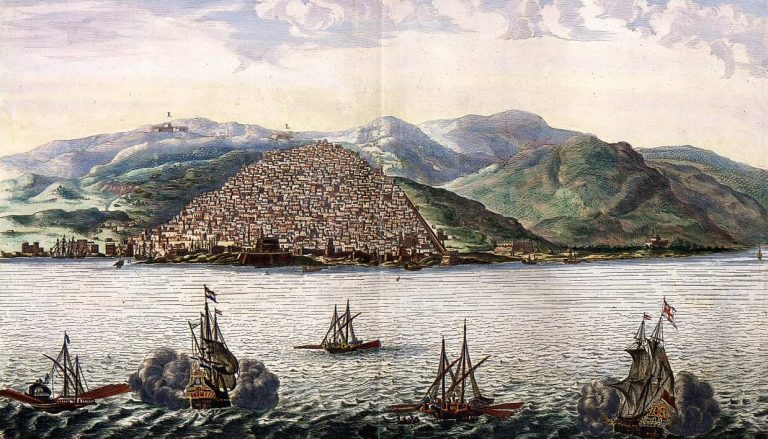
The story of Algeria’s modern flag begins not in 1962, but decades earlier, rooted in a long tradition of resistance symbols. During the Ottoman-era Regency of Algiers (1516–1830), several sources—notably Algerian historians ʿAbd al-Rahman al-Jilālī and Ahmed Tawfīq al-Madani—describe a distinctive horizontal tricolour of red, green, and yellow that flew over the city’s gates and forts, representing the autonomous polity under Ottoman suzerainty. This early emblem signified Algeria’s break from Spanish occupation and the authority of the Barbarossa brothers (corsair-rulers, ra’īs).
When French colonisation began in 1830, indigenous resistance movements adopted their own banners. Emir Abdelkader, who led the resistance from 1832–1847, used green and white standards—colours that would later inspire nationalist movements. His principal standard bore Qur’anic inscriptions and the Hand of Fatima (khamsa), symbolising divine protection.
The modern green-white flag with its red crescent and star emerged gradually within the interwar nationalist movement, especially around Messali Hadj’s Étoile Nord-Africaine and its successor, the Parti du Peuple Algérien (PPA). In the mid-1930s, leading militants agreed on the three colours and Messali’s wife, the activist Émilie Busquant, is widely remembered for sewing one of the first nationalist flags for ENA/PPA demonstrations.
As for the flag’s current design, a three-person committee appointed by the PPA in April 1945 – Hocine Asselah, Chadli Mekki and the young militant Chawki Mostefaï – finalised its proportions and layout, according to a historical account presented at a conference on the national emblem and reported in the Algerian press. The independent Algerian state then legally codified the flag’s exact geometry and colours in Law 63-145 of April 1963, presenting it as the emblem spontaneously adopted and sanctified by the people’s struggle.
The flag’s revolutionary charge crystalised on 8 May 1945, when independence demonstrations in Sétif, Guelma and Kherrata—where nationalist symbols were displayed—were met with mass repression.
Symbolism: More Than Colours
Each element of the flag carries layered meaning drawn from Algeria’s history, faith, and aspirations:
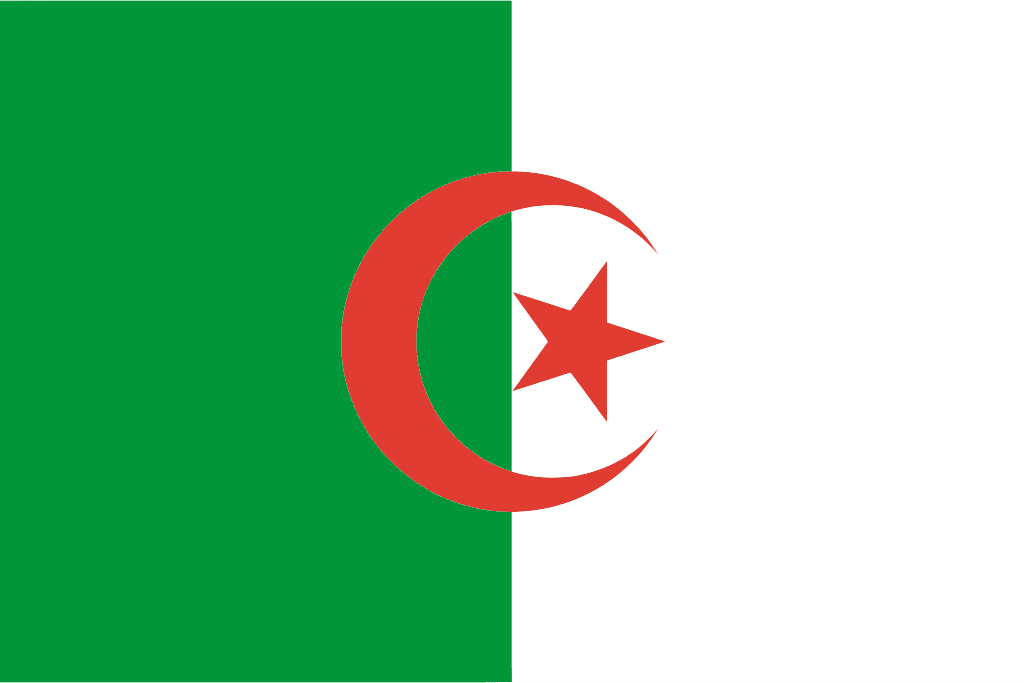
Green and White: Green traditionally represents Islam, Algeria’s majority faith, and symbolises the land’s fertility and hope for prosperity. White represents peace and purity, reflecting the Algerian people’s desire for peace after prolonged struggle, as well as ideals of integrity and honesty.
The Red Crescent and Star: The crescent represents the moon and is a historic emblem of Islam dating back to the Ottoman era in North Africa. The five-pointed star represents light and guidance, with many interpreting its five points as representing the Five Pillars of Islam. The colour red stands for the blood of martyrs and heroes who sacrificed their lives in the fight for independence.
Some scholars offer alternative interpretations. Historian Benjamin Stora notes that the three colours—red, green, and white—were originally intended to represent the three Maghreb nations (Algeria, Tunisia, Morocco) in a spirit of regional unity.
Design Precision
Article 6 of the 2016 Algerian Constitution enshrines the flag as an immutable symbol of the Revolution, and Law 63-145 of 25 April 1963, precisely defined the characteristics of the national emblem.
The specifications are exact: the law sets the 2:3 proportion, the vertical division, and geometric rules: the star inscribed in a circle of radius 1/8 of the flag’s height; the crescent defined by two concentric circles with radii 1/4 and 1/5 of the height; and placement on the medians.
The law also specifies colours by wavelength (not Pantone). In practice, official renderings commonly use Pantone 356 C (green) and Pantone 186 C (red), as referenced by Algerian diplomatic sources and vexillological guides.
A Sacred Symbol in Daily Life
For Algerians, the flag is inseparable from the memory of the War of Independence and is treated with deep respect as the symbol of freedom regained after 132 years of colonial rule.
By law and protocol, the flag must be flown on all government buildings, including schools, military installations, and municipal offices. Classrooms in Algeria customarily display the flag, and schoolchildren often begin or end the week with a flag-raising ceremony.
The legal protections are stringent. Article 160 bis of the Algerian Penal Code imposes penalties of 5 to 10 years’ imprisonment for anyone who wilfully and publicly tears, soils, or desecrates the national flag.
The Flag in Movement
The flag has repeatedly served as a unifying symbol during critical moments. During the nationwide Hirak protests of 2019–2020, crowds of Algerians marched weekly with a sea of national flags, with the green and white banner becoming an emblem of the people’s voice and solidarity across ideological lines.
In June 2019, Army Chief Ahmed Gaid Salah stated that only the national flag would be permitted at demonstrations; supporters framed it as a unifying stance, while others saw it as limiting the display of the Amazigh flag, prompting debate and arrests.
In sports, the flag becomes a celebration of national pride. After Algeria won the Africa Cup of Nations in 2019, jubilant crowds flooded streets across Algeria and in diaspora communities in France, all draped in the national colours.
A Global Emblem
Algeria joined the United Nations on 8 October 1962, becoming the UN’s 109th member, and the Algerian flag was raised for the first time at UN Headquarters in New York in a ceremony still remembered by older generations.
For the millions of Algerians living in France, Canada, the UK and elsewhere, the diaspora frequently displays the flag to assert their identity, with large Algerian flags appearing during Independence Day gatherings and political developments back home.
The flag has even reached unexpected places—planted atop Mount Everest by a French-Algerian adventurer in 2008, carried by Algerian doctors in China during the COVID-19 crisis, and flown at UN peacekeeping camps from the Democratic Republic of Congo to Mali.
A Living Symbol
More than six decades after independence, the Algerian flag remains what it became during the revolution: a symbol of hard-won freedom, Islamic and cultural heritage, and the unity of a diverse nation. As 1970s official discourse framed it—particularly in the 1976 National Charter—the national symbols were bound up with the Revolution’s legacy, collective struggle, and the forging of a shared national identity.
For younger Algerians who never experienced colonisation, the flag still carries profound meaning, taught through stories of martyrs and celebrated in classrooms, stadiums, and streets. It represents not just a past struggle, but ongoing aspirations for a nation that continues to define itself on its own terms.