

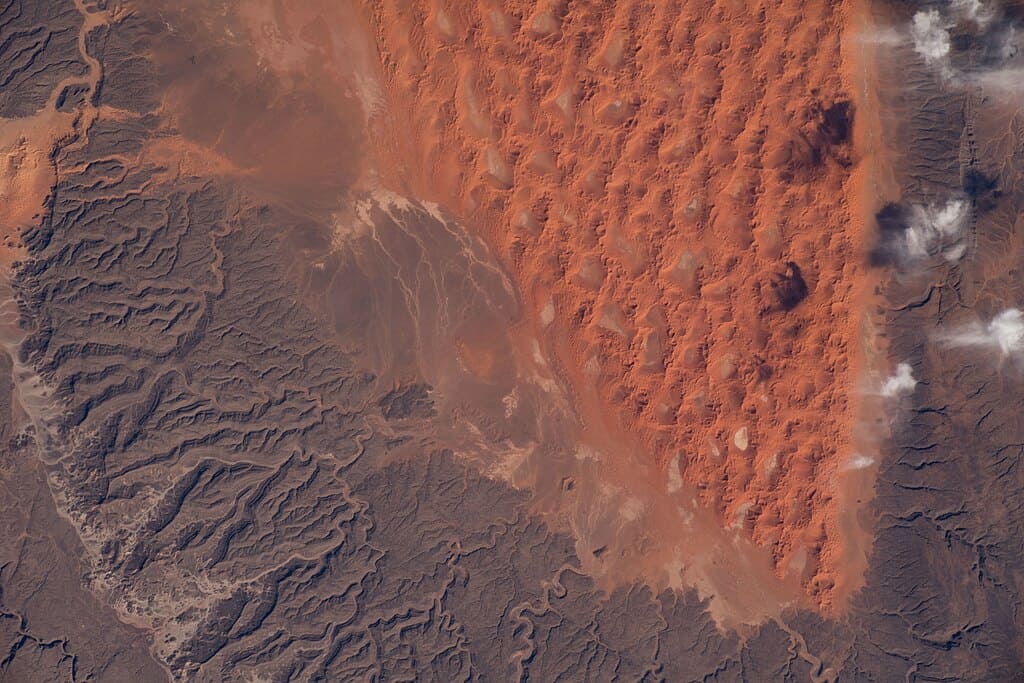
The Algerian Sahara stretches across roughly 80% of the country’s territory, yet it remains one of the world’s most misunderstood landscapes. Far from the endless sand dunes of popular imagination, this vast expanse encompasses a remarkable diversity of terrain, climate, and cultures that have shaped North African civilisation for millennia.
A Land of Unexpected Diversity
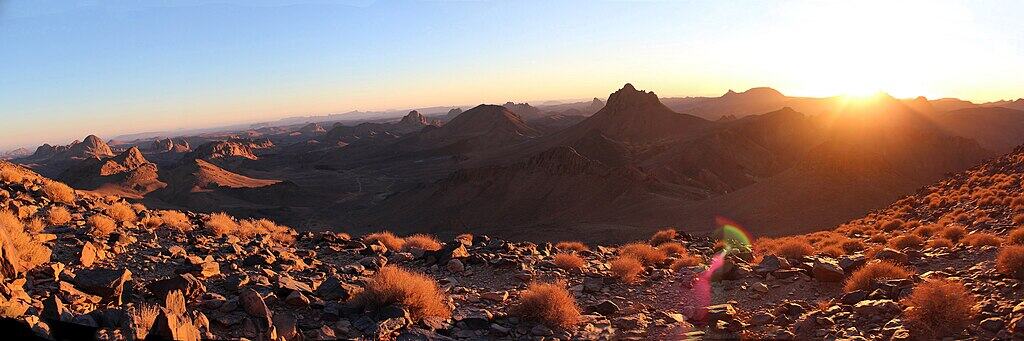
Covering approximately 1.9 million square kilometres, the Algerian Sahara forms the western portion of the world’s largest hot desert. Yet its geography tells a story of striking contrasts. The Grand Erg Oriental (العرق الشرقي الكبير) contains vast fields of star dunes; many exceed 100 m and some reach 300–400 m in height. Beyond these ergs lie the ḥammāda (حمّادة) — extensive stony plateaus that cover large portions of the Sahara which are strewn with gravel and pebble that comprise much of the desert’s surface.
In the southeast, the Ahaggar/Hoggar (الأهقار) massifs rise dramatically from the desert floor, their volcanic peaks reaching over 2,000 metres. Here lies Mount Tahat (جبل تاهات), Algeria’s highest point at approximately 2,918 metres. Adjacent to this massif, the Tassili n’Ajjer Plateau (طاسيلي ناجر), presents an otherworldly landscape of eroded sandstone formations that local inhabitants describe as rock forests.
Climate of Extremes
The Sahara’s climate shapes every aspect of life within its boundaries. Summer temperatures routinely exceed 38–40°C across the region, with some areas experiencing average highs of 45°C during peak season. Stations such as Bou Bernous are often cited in climatology literature for exceptionally high July mean maxima (~47 °C), though this category isn’t formally tracked by the WMO.
Yet it’s the scarcity of water that truly defines this environment. Most of the Algerian Sahara receives less than 20 millimetres of rain annually, with vast central areas potentially experiencing no measurable precipitation for years. The northern fringes might receive up to 100–250 millimetres in wetter years, whilst hyper-arid zones like the Tanezrouft (تنزروفت) may average under 5 millimetres annually.
Echoes of Ancient Civilisations
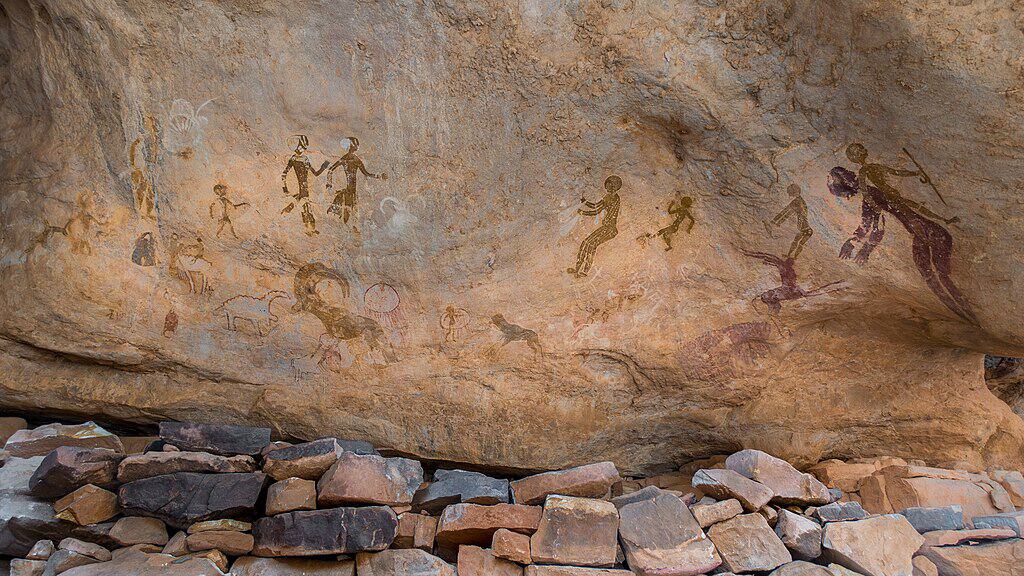
The Sahara’s most profound secrets lie not in its geography, but in its human history. In Tassili n’Ajjer, more than 15,000 rock engravings and paintings date from c. 6000 BC to the first centuries CE (often described as up to ~10,000 years old), depicting fauna, herding, and shifting climate.
Rock paintings from around 4000–2500 BC show pastoral communities thriving in what was then a savanna-like environment. As the climate progressively dried around 3000–2000 BC, human activity concentrated around reliable water sources, and the foundations of trans-Saharan trade networks began to emerge.
The Great Trading Highways
From the 8th century CE the Sahara became a bridge: Amazigh guides led camel caravans linking the Maghreb with Sahelian polities. In today’s Algeria, oases such as Touat–Gourara–Tidikelt (أقاليم توات/ڤورارة/تيدكلت) and Ouargla, together with the MʾZab valley (مزاب), functioned as key staging points and merchant communities in these networks.
The oasis of Ghardaïa and others in the M’Zab and Gourara regions became crucial caravan hubs by the medieval era. These trading networks carried more than goods; they facilitated the spread of Islamic culture, learning, and architectural traditions that continue to define Saharan communities today.
Living Heritage: The Desert’s Peoples
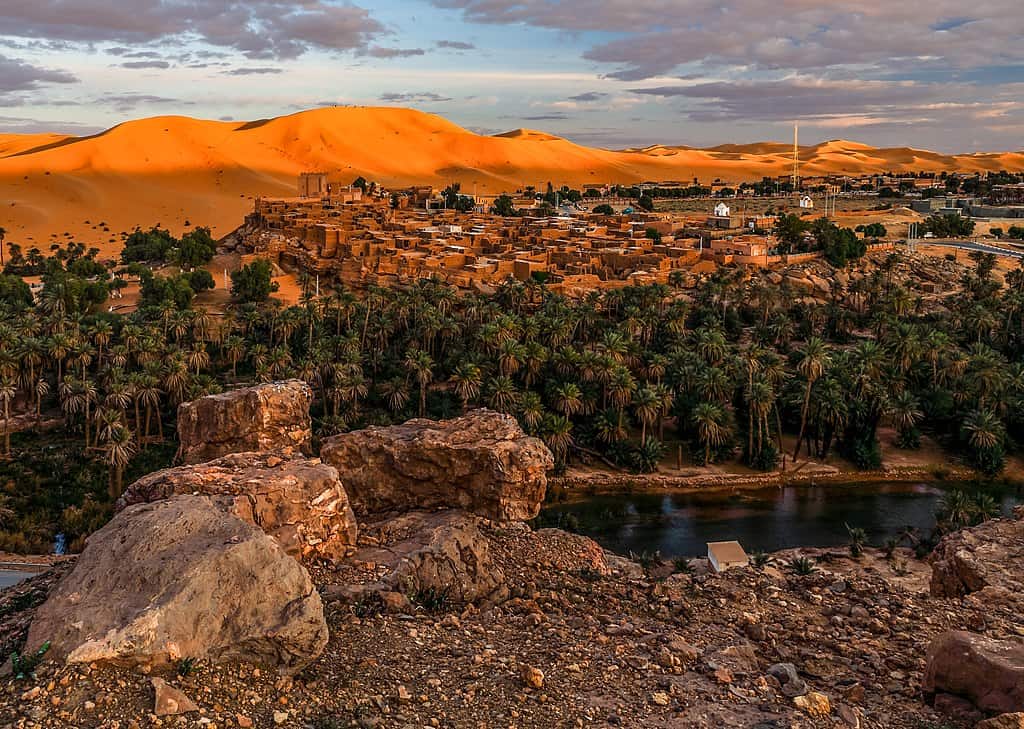
Today’s Saharan communities represent a living testament to cultural adaptation and resilience. The Tuareg, known as the ‘blue men of the desert’ for their indigo-dyed garments, maintain their role as desert navigators and skilled artisans. Their society, notable for its matrilineal descent and the high social status of women, preserves traditions passed down through generations.
In the M’Zab Valley, the Mozabites (بني مزاب) have created one of the world’s most remarkable examples of desert architecture. Their five fortified towns (ksour), built in the 10th–11th centuries, remain largely intact today. Each settlement centres on a fortress-like mosque whose minaret doubles as a watchtower, surrounded by concentric rows of houses constructed from sun-dried mud brick and painted in white or pastel hues.
This architectural harmony so impressed modern designers that Le Corbusier cited M’Zab’s towns as inspiration for climate-adapted urban planning. UNESCO recognised the M’Zab Valley as a World Heritage Site in 1982, acknowledging its outstanding cultural and architectural value.
Cultural Continuity in Modern Times
Despite modernisation’s encroachment, traditional festivals continue to bind communities together. The Sebeïba festival in Djanet exemplifies this cultural persistence. Every year during the Islamic month of Muharram, Tuareg communities engage in an elaborate ten-day competition featuring dances, songs, and costume parades that culminate in a friendly mock battle dance.
UNESCO recognised the Sebeïba ceremonies as Intangible Cultural Heritage of Humanity in 2014, highlighting their role in promoting peace and cultural continuity. Similarly, the haunting music of the Imzad – a single-string bowed lute played exclusively by Tuareg women – received UNESCO recognition in 2013.
Preserving Desert Wisdom
The Algerian Sahara challenges us to reconsider our understanding of both landscape and culture. Here, communities have developed sophisticated strategies for thriving in one of Earth’s most demanding environments. From the ingenious foggaras (underground irrigation channels) that bring water to oasis gardens, to the social structures that have maintained peace between diverse groups for centuries, the desert offers profound lessons in sustainability and coexistence.
As satellite dishes appear alongside traditional tents and smartphones find their way into ancient ksour, the Sahara’s peoples continue adapting whilst preserving their essential identity. Their story reminds us that even in the world’s most extreme environments, human creativity and cultural resilience can flourish.