

More than a thousand years before Algeria existed as a nation, a mobilisation that began in its mountains changed the course of Middle Eastern history. In 969 CE, a Fatimid army crossed North Africa and conquered Egypt, establishing a new imperial capital beside Fustat that would become Cairo — one of the great cities of the Islamic world. At the heart of that army were the Kutama, an Amazigh (Berber) people from what is now north-eastern Algeria, whose roughly seventy-five-year journey from tribal confederation to imperial military force remains one of the most remarkable stories of the medieval Mediterranean.
A people of the mountains
The Kutama homeland lay in some of the most rugged terrain in North Africa. Their territory centred on the Babor and Collo massifs and extended towards Jijel, Mila, Sétif and Constantine — a mountainous, forested region in which outside authorities often struggled to establish effective control. Research published in the Encyclopédie berbère tentatively connects the Kutama to the Koidamousii mentioned by Ptolemy (a second-century Greek geographer) and, more securely, to a late antique inscription near Jijel apparently referring to a rex gentis Ucutumanorum (king of the people of the Ucutumani).
By the ninth and tenth centuries, the Kutama were not a single, tightly defined tribe in the modern sense. The research also cautions that medieval tribal names could describe political coalitions and shifting confederations as much as fixed descent communities. “Kutama” probably functioned at times as a widening political label, with groups attaching themselves to a successful name. That caveat matters — but it does not diminish the scale of what this confederation achieved.
The missionary and the movement
The story takes a dramatic turn around 892–893 CE, when Kutama pilgrims encountered the Isma’ili missionary Abu Abd Allah al-Shii at Mecca. He reached their homeland in 893. Working initially from his base at Ikjan, al-Shii built a missionary and military movement that, with the support of Kutama communities, developed into a disciplined fighting force. The contemporary Fatimid jurist al-Qadi al-Numan, writing in his Iftitah al-dawa (Commencement of the Mission) around 957, is the principal early source for this process. Al-Numan had served the first Fatimid caliphs and had access to state archives — though his account also carries the ideological imprint of the dynasty he served.
The Kutama armies took Mila in the early campaigns, then Sétif, Bélezma and other strongholds, before toppling the Aghlabid regime in 909. Fatimid power was consequently created not by an existing imperial army but through an alliance between an Isma’ili missionary movement and Kutama communities that supplied its principal fighting force. Modern scholarship on the Kutama–Fatimid alliance identifies the Kutama as central to the military power of the early Fatimids, not merely one auxiliary group among many.
Yet victory also exposed tensions within the movement. After al-Mahdi became the first Fatimid caliph, he appointed officials who had previously served the Aghlabids, establishing an administration that was not entirely dependent on the Kutama or their missionary leader. Some Kutama figures became disillusioned with the new order. In 911, al-Mahdi had Abu Abd Allah al-Shii killed amid accusations of conspiracy. The Fatimid account portrayed the killing as a response to treachery, but Takashi Uhara argues that eliminating such a powerful figure may have helped al-Mahdi consolidate his authority, regardless of whether the alleged conspiracy occurred. The precise circumstances remain disputed.
There were further setbacks. Kutama forces participated in failed invasions of Egypt in 914–915 and 919–921, suffering heavy losses. Their military strength was also eroded by wars in the western Maghreb (North-west Africa) and by the revolt of Abu Yazid in the 940s. But the core relationship endured.
The conquest of Egypt
By 968, Egypt was politically vulnerable. The death of the powerful Ikhshidid regent Kafur in April of that year left an under-age ruler, divided military factions and severe provisioning difficulties. The Fatimid imam-caliph al-Muizz li-Din Allah seized the moment, preparing an expedition on an extraordinary scale.
According to historical research, drawing on al-Maqrizi’s later account, the army assembled near al-Mansuriyya, where soldiers were paid according to their rank, before a ceremonial military parade on 5 February 969. Medieval accounts describe a force of more than 100,000 horsemen, mostly Amazigh. Such figures should be treated with caution — medieval chroniclers frequently inflated army sizes, and no surviving muster roll independently confirms the number — but by any measure, the force was enormous by the standards of its day. Accounts discussed by some historians also record that al-Muizz personally contributed 24 million dinars to the enterprise, although this reported sum cannot be independently verified.
The expedition was commanded not by a Kutama chief but by Jawhar, al-Muizz’s freedman and general, whose geographical origins remain uncertain. The army’s ethnic composition was mixed, but the Kutama constituted its hard core and principal early fighting force. The dynasty’s reliance on them was structural: they were its original supporters, not simply mercenaries replaceable at will.
Jawhar secured Fustat in July 969 after limited armed resistance. The transition was comparatively smooth — Egyptian notables negotiated an aman (guarantee of safety) that promised security of persons and property, continuity in aspects of administration and protection of pilgrimage routes. The document also guaranteed that Sunni Muslims could continue practising their religion according to their established traditions.
Building Cairo
Once Fustat was secured, Jawhar established a fortified settlement to its north-east. This was not an open commercial city but a walled palace city designed around the caliphal residence, military quarters, ceremonial space and a congregational mosque. Fustat, with its merchants and Egyptian households, continued as the civilian and commercial centre for generations.
Later chronicles record that the enclosure was initially called al-Mansuriyya, after the Fatimid capital in Ifriqiya (a region centred on present-day Tunisia), and became al-Qahira (the Victorious) around the time of al-Muizz’s transfer of his court to Egypt in 973. The popular legend connecting the name to the planet Mars rising when construction began belongs to later foundation mythology; a deliberately triumphal imperial name is safer historically. The Ashmolean Museum’s historical account confirms the association between the city’s renaming and al-Muizz’s arrival.
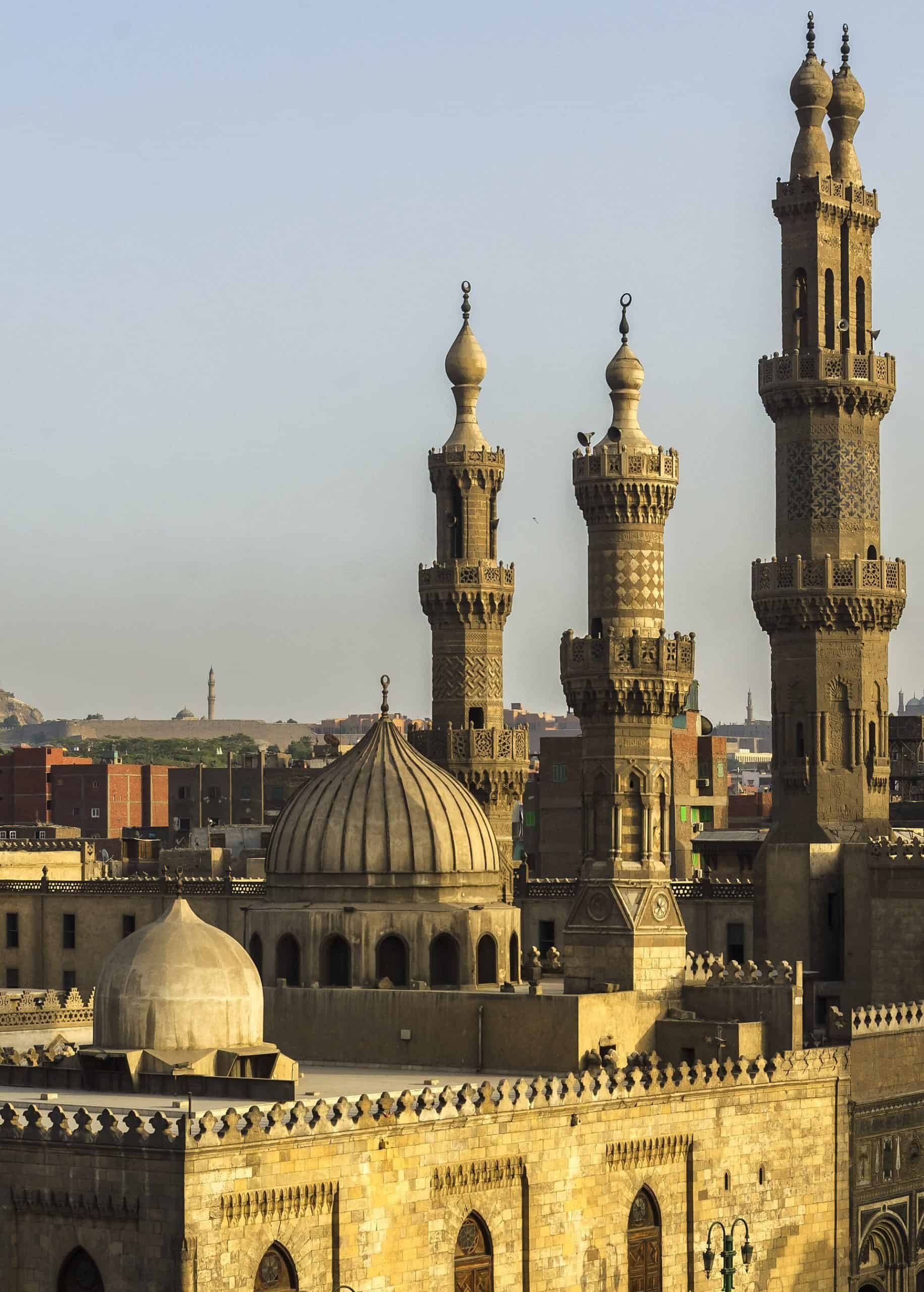
Jawhar also founded al-Azhar, begun around 970 and used for Friday worship by 972. It was not initially a modern “university” but the congregational mosque of the Fatimid city, later becoming a major centre for Isma’ili teaching before undergoing further institutional transformations.
The conquering army’s composition was also inscribed into Cairo’s geography. The new capital contained haras (quarters), often associated with military, ethnic or court groups. Among them was Harat Kutama (the Kutama quarter), a neighbourhood named after the Amazigh people who had helped bring the Fatimids to power. The medieval Egyptian historian al-Maqrizi records that Kutama settlers who arrived from the Maghrib with Jawhar and later Fatimid rulers lived there. Other early quarters bore the names of groups such as the Zuwayla and Rum, while further military communities established themselves as the city expanded. The Egyptian historian Ayman Fuad Sayyid identifies the Kutama quarter among those probably established during Cairo’s earliest development — one of the clearest ways in which the conquering coalition shaped the city’s urban fabric.
Archaeological evidence adds another layer. Excavations by the Institut français d’archéologie orientale (IFAO) and the Aga Khan Trust for Culture have uncovered Fatimid-era remains beneath later Cairo fortifications. Among the discoveries was a substantial rammed-earth wall that archaeologist Stéphane Pradines and his team have identified as part of Jawhar’s first enclosure, dating to around 969–971. The construction method is unusual in Egypt, and Pradines argues that the technique probably came from the Maghreb, where rammed-earth building traditions were well established. The findings suggest a possible North African technical contribution, though the archaeological evidence cannot identify the builders’ specific tribal origins.
A Fatimid achievement with Algerian roots
It is important to state what the evidence does and does not support. Cairo was a Fatimid imperial project. Al-Muizz supplied the political purpose, legitimacy and financing. Jawhar supplied operational command and urban execution. Egyptian officials, workers and taxpayers supplied much of the bureaucratic, economic and human infrastructure that made permanent rule possible. The surviving evidence does not establish that Kutama leaders independently planned or financed Cairo’s construction.
Yet within that structure, the Kutama contribution was extraordinary. A mountain population centred in present-day north-eastern Algeria became the military base of an Isma’ili revolutionary movement. That movement destroyed the Aghlabids, survived repeated defeats, helped create a trans-Maghrebi caliphate, crossed North Africa and became the principal military constituency of the regime that established a new capital beside Fustat. Their relationship with the Fatimid rulers also evolved as the movement developed into an empire with increasingly diverse military and political interests. Few episodes in medieval North African history demonstrate so vividly how a regional Amazigh confederation could become a driving force in the creation of an empire far beyond its homeland.
The Kutama did not think of themselves as “Algerian” — that concept did not yet exist. They understood themselves within tribal, Islamic and Fatimid frameworks radically different from modern nationality. But the historical connection to the territory that is now Algeria is genuine and well documented. Cairo’s foundation is best described as a Fatimid imperial achievement rooted in a Kutama Amazigh mobilisation in what is now Algeria — a formulation that preserves the link without forcing medieval people into modern national categories.
Over a millennium later, the mountains around Jijel, Mila and Constantine still stand. The story of what once came out of them — a force that helped reshape the political map of the medieval world — deserves to be better known.