

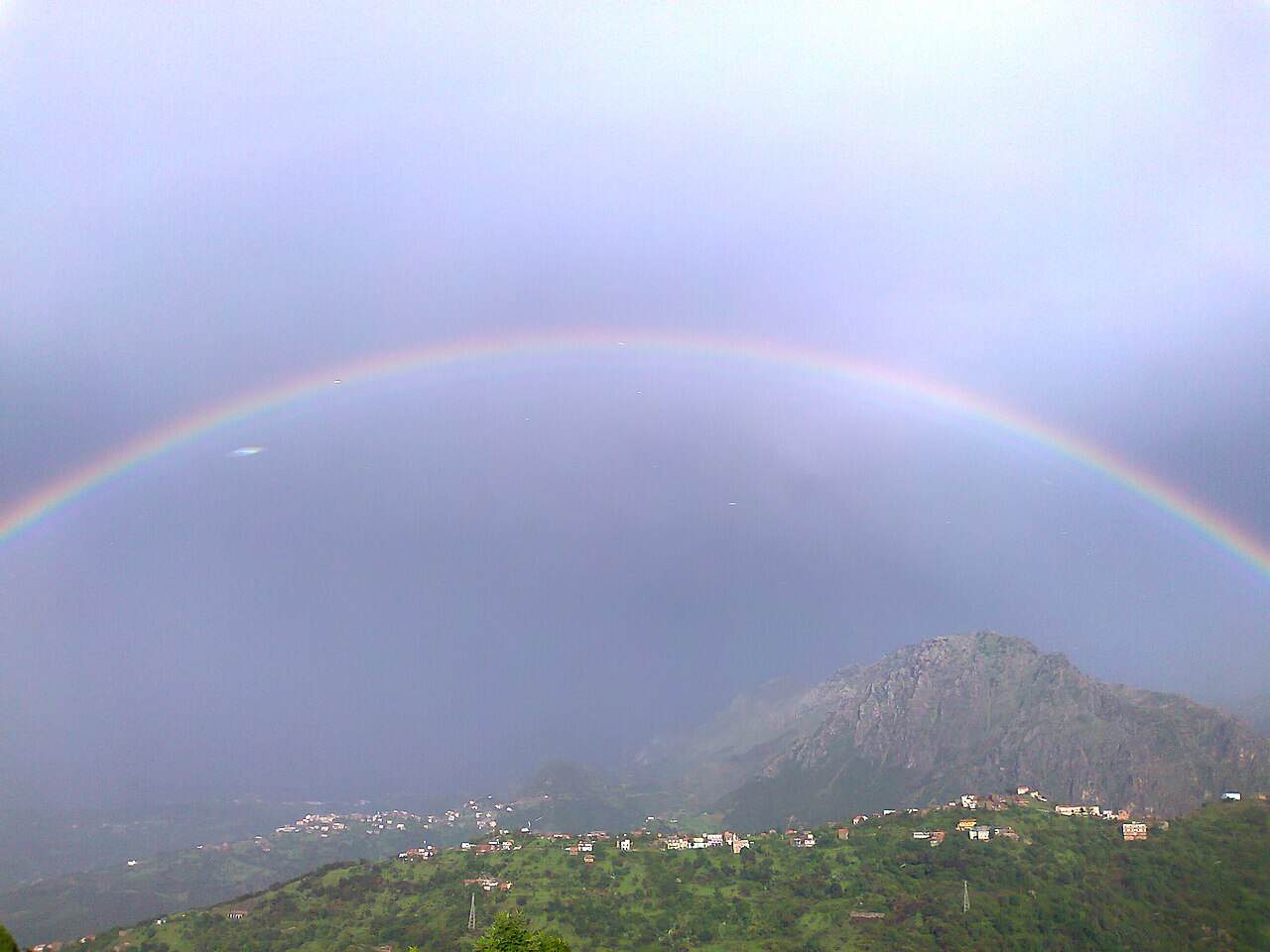
A shower passes over the Atlas while sunlight still catches the falling drops. Someone says ʿers ed-dīb — “the wolf’s wedding”. Thousands of kilometres to the east, under the same meteorological paradox, a Japanese speaker says kitsune no yomeiri — “the fox’s wedding”. In Armenia a wolf may be marrying; in Bihar a jackal; elsewhere a monkey, a tiger, or a rat.
The resemblance between the Algerian and Japanese expressions is real and remarkably specific. Both describe a sunshower — rain falling while the sun continues to shine — as the wedding celebration of a canid (an animal from the dog family). Both are traditional expressions whose origins predate the written sources discussed here. And both sit within a much larger worldwide family of animal-wedding sayings that stretches from sub-Saharan Africa to northern Europe.
Whether that resemblance reflects a single ancient tradition, repeated borrowing, or the independent workings of human imagination remains one of comparative folklore’s most genuinely open questions.
What ʿers ed-dīb actually means
In contemporary Algeria, ʿers ed-dīb (عرس الذيب) is an expression used when rain falls from a bright or partly blue sky while sunshine remains visible. Algerian accounts describe it as inherited popular folklore, and modern retellings sometimes accompany it with an explanatory story: a wolf who did not want the responsibilities of marriage agrees to wed only under an impossible condition — that his ceremony take place while rain and sunshine occur simultaneously. Nature eventually obliges, the wolf must honour his promise, and the strange weather has been called ʿers ed-dīb ever since.
That story deserves a caveat. The expression itself is demonstrably traditional, but the antiquity of this particular explanatory plot is not established by the earlier ethnographic literature. The “reluctant bachelor who sets an impossible condition” narrative is best described as a contemporary or orally transmitted aetiological legend — a story that explains an existing expression — unless an older written version can be identified.
There is also a translation trap in the animal’s name. Standard Arabic ḏiʾb (ذئب) means “wolf”, which explains the usual English translation of the Algerian Arabic expression. But the Amazigh (Berber) expressions recorded by North African ethnographers use uccen or wuššen, commonly glossed as “jackal” in that scholarship — a usage also reflected in IRCAM’s Amazigh lexicographic material, which gives tamȥra n wuccn literally as “the jackal’s wedding” and defines it as sunshine accompanied by rain. Vernacular animal labels do not always map neatly onto modern zoological categories, which helps explain why French-language discussions oscillate between mariage du loup and the older ethnographic mariage du chacal. The English formulation “wolf’s/jackal’s wedding” accurately reflects both source traditions rather than forcing them into a single zoological category.
Deeper than modern folklore
The ʿers ed-dīb is not an isolated modern curiosity, and it does not belong exclusively to Algerian Arabic. It sits within a broader North African tradition that has been documented in Amazigh as well as Arabic forms across multiple countries and dialect zones.
One of the earliest published Maghrebi attestations identified in the specialist literature is Émile Laoust’s 1920 work Mots et choses berbères. Working with Moroccan Amazigh dialects, Laoust recorded the expression tamgra n-uššen — “the jackal’s wedding” — and explained that Amazigh speakers used it for a set of atmospheric phenomena involving fine rain under a sunny sky. Later researchers repeatedly cite page 189 of Laoust for this tradition.
For what is now Algerian territory, another important early record comes from the colonial-era linguistic work of Charles de Foucauld among the Kel Ahaggar Tuareg in the central Sahara. Foucauld lived and collected linguistic and ethnographic material among the Tuareg between 1905 and his death at Tamanrasset in 1916. His Textes touaregs en prose were published posthumously in Algiers in 1922. The later Encyclopédie berbère specifically points to text 173 for the Tuareg form éhen n ebeggi — again, the “jackal’s wedding”.
The chronology matters. By publication date, Laoust’s 1920 Moroccan attestation currently precedes the Algerian Tuareg text published in 1922. By date of field collection, however, Foucauld’s material was necessarily gathered before December 1916. He may well have recorded the expression earlier in the field, though the precise year remains uncertain.
For Kabylie, the Encyclopédie berbère‘s 1989 article on the rainbow by Salem Chaker and Hélène Claudot-Hawad explicitly stated that the expression occurs there as well, in forms such as tameɣra bbuššen. The same synthesis established that in numerous Amazigh-speaking regions the rainbow forms part of the same meteorological complex called the “jackal’s wedding” — the appearance of a rainbow alongside rain in a sunny sky was explained through the celebration of the jackal’s nuptials.
The sources currently identified document the tradition particularly clearly across Morocco and Algeria, while Tunisian usage likewise records ʿers ed-dīb for light rain while the weather remains sunny. It would be premature to label the expression universal throughout every Maghrebi country or dialect without equivalent documentation from Libya, Mauritania, and all Saharan communities.
A note on Anẓar
There is an adjacent — but not identical — Amazigh tradition that deserves mention: Anẓar, the personified rain, and the ritual of the “bride of Anẓar” (tislit n Unẓar). Ethnographic accounts from Kabylie and Morocco describe symbolic bridal rituals intended to bring rain, while Algerian anthropological research on rain rituals likewise places the “bride of the rain” alongside tamɣra n wuccen, the “jackal’s wedding”.
It is tempting to fuse the Anẓar bride and the jackal wedding into one primordial North African myth. Scholars have compared them, because both connect marriage, rain, and fertility. But the evidence does not prove that one originated from the other. They are best understood as parallel or overlapping elements within a broader North African symbolic vocabulary of rain and nuptial fertility — not as two names for precisely the same ritual.
Across Eurasia: Japan’s fox wedding
Japan provides one of the best-documented comparisons, and its tradition has a rich independent history.
Kitsune no yomeiri (狐の嫁入り) literally means “the fox’s bride-entering”, conventionally translated as “the fox’s wedding”. Major Japanese dictionaries give it two meanings: a sunshower — rain while sunshine remains visible — and a mysterious nocturnal line of lights resembling the lanterns of a bridal procession, traditionally explained as a procession of foxes or kitsunebi (“fox fire”).
That second sense matters. A Japanese audience hearing kitsune no yomeiri might think not only of weather but of a supernatural bridal procession concealed from ordinary humans. The fox in Japanese folklore is famously associated with disguise, transformation, and deception. The Nipponica encyclopaedia interprets both meanings through the long-standing idea that foxes could bewilder or deceive humans.
The documentary trail in Japan goes back significantly further than the currently located Maghrebi written record. The Seisenban Nihon Kokugo Daijiten records its earliest example for the sunshower meaning in the 1732 jōruri drama Dan no Ura Kabuto Gunki. The passage refers to a sudden shower as “the fox’s wedding” rain — evidence that the expression was sufficiently familiar in early eighteenth-century Japan to function in popular theatre. The expression may of course have circulated orally earlier, but the written evidence does not tell us when that usage began.
During the Edo period, the image became increasingly visible in print and visual art. Japan’s National Institute of Japanese Literature catalogues the illustrated work Hideriame Kitsune no Yomeiri (“Sunshower: The Fox’s Wedding”), while the National Diet Library discusses the same Edo-period genre of stories depicting anthropomorphised animal marriages. In Hideriame Kitsune no Yomeiri, the fox bride’s party travels towards the groom’s home while a sunshower is falling. The meteorological expression and the imagined wedding scene had become explicitly fused in popular visual culture.
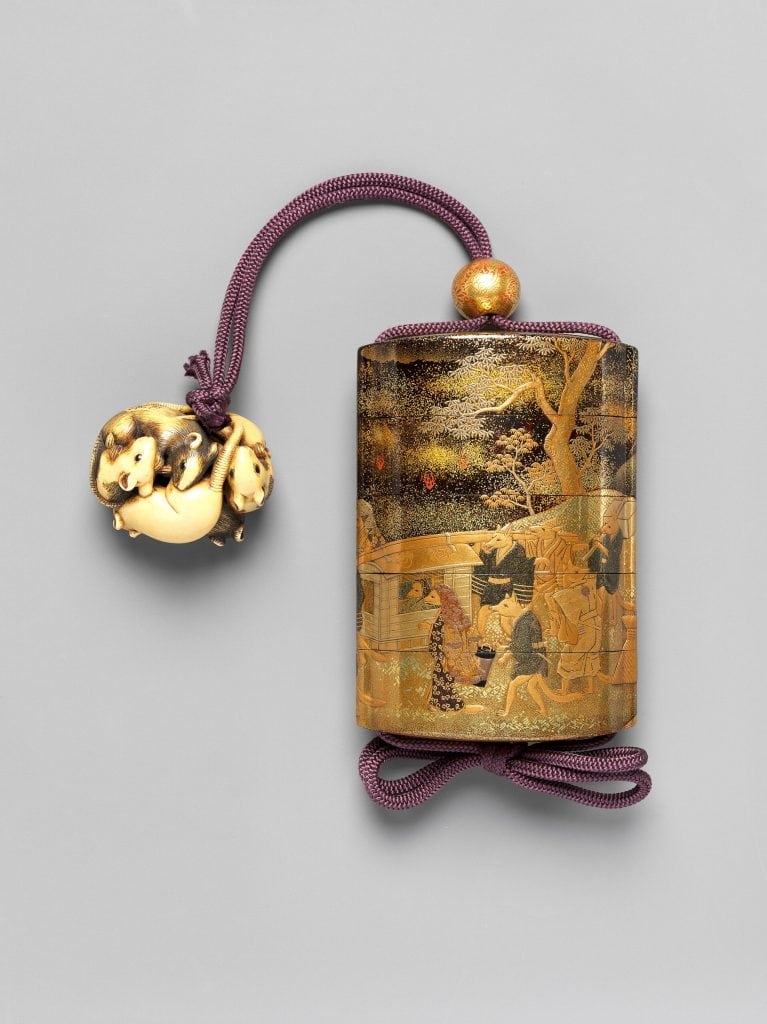
Even today, Japanese usage is not entirely uniform. A large Weathernews survey found substantial regional variation in whether people preferred the straightforward tenki-ame (天気雨, “sunny-weather rain”) or kitsune no yomeiri. Nationally, tenki-ame was more common, but kitsune no yomeiri was markedly stronger in western Japan, reaching 83 per cent in Kansai.
The structural correspondence is therefore genuine. In both North Africa and Japan, a canid’s wedding is associated with the unlikely-looking conjunction of rain and sunshine. In North Africa, the rainbow is also explicitly incorporated into documented versions of the tradition.
But there is also a significant difference. The North African animal is principally the jackal or wolf; the Japanese animal is the fox, embedded in a specifically Japanese complex of fox transformation and fox fire, with wider associations between foxes and Inari belief. That local elaboration makes a simple one-way copying explanation less persuasive, although it does not by itself rule out historical diffusion.
A worldwide family of animal weddings
The Algeria–Japan comparison becomes much less isolated once the world distribution is examined. The Finnish folklorist Matti Kuusi’s 1957 monograph Regen bei Sonnenschein (“Rain While the Sun Shines”) was the classic attempt to assemble this international material. Later surveys by the Austronesianist Robert Blust in his 1999 article in Anthropos and linguist Bert Vaux in a 1998 LINGUIST List survey added substantial data from speakers and scholars across dozens of languages.
The parallels extend far beyond foxes. The examples below come from comparative surveys and historical sources; some refer to particular dialects or communities rather than entire countries.
| Region or language | Recorded sunshower saying |
|---|---|
| Algeria (Arabic) | “The wolf’s wedding” (ʿers ed-dīb) |
| North Africa (Amazigh) | “The jackal’s wedding” (tamgra n-uššen and variants) |
| Japan | “The fox’s wedding” (kitsune no yomeiri) |
| Syria and Lebanon (Arabic) | “The rats are getting married” |
| Armenian dialects | “The wolf’s wedding”; the wolf gives birth |
| Sena:ya Neo-Aramaic (Sanandaj area, Iran) | Wolves are marrying |
| Hindi (Bihar, India) | “The jackal’s wedding” |
| Malayalam (India) | “The fox’s wedding” |
| Korean | A tiger is marrying; “tiger rain” and “fox rain” |
| South African English | “Monkey’s wedding” |
| Tigrinya | A fox gives birth |
| Oromo | A hyena gives birth |
| Rutoro (Uganda) | A leopard taking her daughter to be married |
| North-eastern Brazil (Portuguese) | “The vixen’s wedding” |
| Calabria and Salento (Italy) | Foxes marry during rain and sunshine |
| Finnish | The fox is getting married; mice are getting married |
Vaux’s data need a methodological qualification — they came from an international linguistic enquiry rather than a controlled ethnographic atlas, so individual responses sometimes represent a dialect or village rather than an entire country. But the recurrence is nevertheless striking: across a vast territory, a sunshower often prompts one of several recurring formulas — an animal marries, an animal gives birth, or some normally hidden event is taking place.
The animals themselves vary and are often locally familiar or culturally significant, although the reasons for a particular animal’s selection are not always recoverable. Wolves and jackals appear in parts of North Africa, western and southern Asia, and the Caucasus; foxes become prominent from India through East Asia and in parts of Europe; hyenas and leopards appear in African versions. What may travel is not the literal sentence “the fox is getting married” but a more abstract formula: paradoxical weather implies a secret, anomalous social event attributed to an animal or supernatural agent.
One possible symbolic logic lies in the widespread association of rain with fertility, while a sunshower visibly combines apparent opposites — sun with rain, brightness with storm, light with water. North African ethnography explicitly connects the rainbow-and-jackal-wedding complex with fertility symbolism. André Boncourt’s 1978 study of the jackal among the Moroccan ʿĪsāwa documents an ambivalent symbolic role in which the jackal could be associated with sterility and drought, yet also invoked in contexts concerned with human fertility.
But that very naturalness cuts both ways. It could explain how a single ancient tradition spread successfully — or why different societies independently invented comparable explanations for the same uncanny sky.
Did the story travel?
This question has produced three strikingly different scholarly answers.
Kuusi, in his 1957 monograph, argued for an extremely old history centred on India. In his reconstruction, an early belief associated sunlit rain with a celestial fox, and from South Asia related ideas supposedly moved east towards Japan and west through western Asia and North Africa. It was a bold piece of mid-twentieth-century comparative folklore.
Blust later rejected this reconstruction as unconvincing. In his 1999 Anthropos article, he accepted the striking worldwide parallels but questioned the proposed chain of descent. Among the problems: the expected motif is absent in China, despite China lying on the proposed route between India and Japan; and no convincing mechanism connects a celestial-fox fertility belief to the marriage expression. Blust concluded that no single clear functional explanation accounts for the entire worldwide distribution.
A more recent diffusionist model comes from Julien d’Huy’s 2021 paper in Les Cahiers de l’AARS. D’Huy begins explicitly with the Maghrebi and Saharan “jackal’s wedding” and asks whether computational methods borrowed from evolutionary biology can recover a historical branching pattern.
His conclusion differs sharply from Kuusi’s. Instead of prehistoric India, d’Huy’s reconstruction places the deepest point in a broad zone involving Africa and south-western Asia, arguing more specifically that the motif may have emerged in North Africa or the Levant, then spread east as far as Japan and southwards into sub-Saharan Africa.
This is the main recent scholarly argument for the possibility that Algeria’s ʿers ed-dīb and Japan’s kitsune no yomeiri share an ancient origin. But it is essential to understand what d’Huy’s analysis does — and does not — demonstrate. His method is phylogenetic, not linguistic: he coded folkloric features — which animal appears and what it is said to be doing — across geographical areas, then applied tree-building algorithms. There are no cognate words linking Arabic ʿirs, Amazigh tameɣra, and Japanese yomeiri, or dīb/uccen with kitsune. A real historical connection, if one existed, would be semantic and folkloric — people borrowing the idea that “when rain falls in sunshine, a canid is marrying” — rather than word-by-word linguistic descent.
The model detected a historical signal, but not a clean family tree. D’Huy himself notes that the pattern is substantially blurred by borrowing between populations and possibly by repeated independent invention. In other words, his own analysis does not produce a simple, tree-like ancestry.
His most dramatic suggestion — that the motif could be Neolithic, connected to Saharan rock art depicting canids in association with human figures — is an intriguing hypothesis that goes beyond what the documentary record can establish. To use a modern expression to interpret prehistoric imagery, one must first demonstrate that the relevant tradition existed when the image was made.
The story is the uncertainty
A responsible assessment of the evidence might be summarised as follows. That Algeria and Morocco possess a traditional canid-wedding expression for sunny rain and rainbows is well established by twentieth-century linguistic and ethnographic sources. That the tradition exists in both Arabic and Amazigh cultural settings is equally secure. That Japan has an independently documented “fox’s wedding” expression is well established, with a written attestation from 1732. That similar animal-marriage and animal-birth sayings occur across a broad swathe of Africa and Eurasia is supported by decades of comparative survey work.
That the Maghrebi and Japanese expressions descend from one prehistoric tradition is a plausible hypothesis for which d’Huy has proposed a phylogenetic model, but one that remains compatible with substantial borrowing and some independent convergence. That the origin lies specifically in Neolithic North Africa remains intriguing but provisional.
The most defensible position is therefore: a striking and potentially ancient parallel, but not a demonstrated historical connection.
That uncertainty is not a weakness in the story. It is the story. Human beings across continents and across the documented centuries have responded to the same impossible-looking sky — rain and sunshine together, a rainbow arching through falling water — with a remarkably similar imaginative pattern. Somewhere, hidden from ordinary sight, the animals must be celebrating a wedding. Whether they learned this from each other or arrived at it independently, the impulse itself tells us something about the way people make sense of a world that refuses to behave as expected.
A shower passes over the Djurdjura while the sun still shines. Someone says ʿers ed-dīb. In Osaka, someone says kitsune no yomeiri. The wolf, the jackal, the fox — whichever animal it is — is getting married. And decades of comparative folklorists still cannot quite agree on whether the guests at all these weddings are, in some deep sense, the same.