

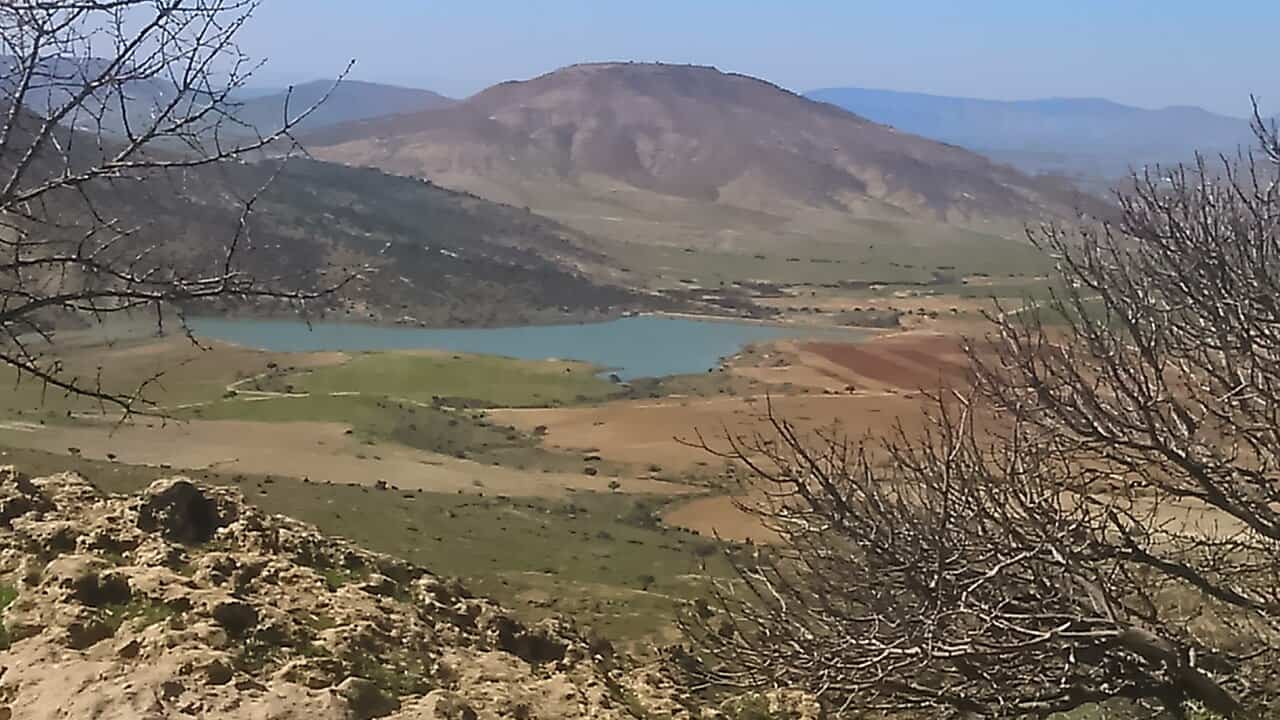
In the winter of 1377, in a hilltop fortress in what is now western Algeria, a scholar put the finishing touches on one of the most ambitious works of intellectual history ever attempted. The text was the Muqaddimah — the celebrated introduction to Ibn Khaldun’s universal history — and the place was Qalʿat Bani Salama, a medieval stronghold near the town of Frenda in Tiaret Province. The connection between Algeria and this canonical work is not incidental. It is geographic, political, and intellectual: this was the place where Ibn Khaldun completed the first draft of the Muqaddimah.
A Datable Milestone in an Algerian Landscape
Ibn Khaldun himself provides the firmest anchor. In the Muqaddimah, he states that he completed the “composition and draft” of its first part in five months, ending in the middle of 779 AH — November 1377 CE. Franz Rosenthal’s introduction and later scholarship place that writing phase at Qalʿat Ibn Salamah, near present-day Frenda, where Ibn Khaldun withdrew with his family under tribal protection.
The site itself sits roughly six kilometres from Frenda. The official culture directorate for Tiaret describes it as a former Qalʿa whose visible remains today are largely five caves, and explicitly connects his residence there with the writing of the introduction to Kitāb al-ʿIbar. A separate archaeological and anthropological study by Zakia Chabane identifies the site as a layered karst and cave complex — a landscape with evidence of prehistoric habitation and protohistoric funerary use long before Ibn Khaldun ever arrived.
That combination — a specific, datable intellectual milestone and a specific Algerian place still known locally through its ruins and caves — makes the connection unusually strong. Algeria is not simply “where he travelled.” It is where the first completed draft of the Muqaddimah was brought into being.
A Fugitive Scholar in the Central Maghreb
The Algerian connection is richer for understanding why Ibn Khaldun was in the interior at all. His arrival at Qalʿat Bani Salama was not a serene academic retreat. It followed years of volatile relations with rulers across the Maghreb and Iberian Peninsula — what he himself described, in his autobiography, as “the morass of politics.”
Translator Franz Rosenthal’s introduction to the Muqaddimah frames the Qalʿat Bani Salama period as a deliberate withdrawal from high-risk court life into a protected rural stronghold. Ibn Khaldun had already moved through several North African centres, including Biskra, amid the unstable politics of the Hafsid, Marinid and Zayyanid realms. In that context, the interior of the central Maghreb offered a plausible refuge for a scholar trying to step back from court life. He arrived under the protection of a local tribal grouping, the Awlad ʿArif, and settled with his family in the fortress in what he called the “land of Tujin.”
The political geography mattered. Algeria’s interior was not a backdrop — it functioned as a refuge zone that made sustained writing possible at a moment when urban court life was dangerous and unstable.
What to Claim, and What Not To
A few versions of this story circulate that deserve some caution.
The claim that Ibn Khaldun “wrote it in a cave” is more fragile than it might appear. Algerian cultural sources often report that only the caves survive and that local oral tradition associates them with his preferred seclusion — but they present this as living memory rather than a documented historical fact about where exactly he worked. The Qalʿa-and-caves complex is the defensible description; “the specific cave where he wrote” is local tradition.
Equally, “the Muqaddimah was written entirely in Algeria” oversimplifies the textual history. Ibn Khaldun’s own account distinguishes between an initial draft and later revisions, which drew on access to libraries elsewhere after he left the Frenda retreat. The Algerian connection is to the first, completed draft — not the entire work as later scholars encountered it.
While some modern admirers call this site the “birthplace of sociology”, that slogan is more celebratory than historical. A more accurate formulation: the Algerian retreat is where Ibn Khaldun completed the first draft of a text that later readers would treat as a foundational work in social and historical analysis.
A Heritage That Algeria Has Not Forgotten
This is not only a medieval story. Algeria’s cultural memory of the connection is formally recognised and institutionally alive.
The site associated with Ibn Khaldun’s stay has long been recognised in Algeria’s heritage landscape. Chabane notes both its protected status and the continued pressures of degradation — a reminder that legal recognition does not by itself guarantee preservation.
More visibly, the region’s flagship public university carries the name Ibn Khaldoun University of Tiaret — a sign of how thoroughly the association has entered local institutional identity.
There is also a less comfortable chapter in the Muqaddimah’s Algerian afterlife. As the historian Abdelmajid Hannoum has shown, French colonial translation and use of Ibn Khaldun fed directly into colonial knowledge production in Algeria, including the hardening of Arab/Berber categories in ways that served administrative and ideological ends. That belongs to the text’s modern reception rather than its medieval origins. But it is part of the Algerian story all the same.
The Simplest Version of a Complex Story
Strip away the overclaims, and what remains is still remarkable: a 14th-century scholar, fleeing the political instability of Maghrebi court life, found refuge in a hilltop fortress in what is now Algeria. In five months, in that landscape, he completed the first draft of the Muqaddimah that later generations would read as a new way of thinking about how societies form, cohere, and collapse.
Qalʿat Bani Salama did not make Ibn Khaldun. But it gave him the conditions — the quiet, the safety, and perhaps the view — to finish something he had been building across a career spent at the centre of Maghrebi political life. That is a connection worth knowing.