

If you have Algerian friends or colleagues, you may know at least one Bouali, Bouazza, or Boumaza. The prefix Bou- is one of the most recognisable features of Algerian surnames — and once you understand what it means and how it got there, you start seeing Algerian history embedded in everyday family names.
What Does “Bou-” Actually Mean?
The short answer is: “father of” or “the one with.” But the longer answer is more interesting, because Bou- sits at the intersection of two ancient linguistic traditions.
In Arabic, the classical word Abū (أبو) means “father of” and forms part of what is called the kunya — a respectful byname traditionally taken when a person becomes a parent. A man with a son named Ali might be known as Abū Ali, “father of Ali.” Over centuries of use in Algerian Arabic, that Abū was reduced in everyday speech to bū or bou — a phonological contraction well documented in Maghrebi linguistics.
At the same time, in Amazigh (Berber) languages — particularly Kabyle — bu- functions as a productive adjectival prefix meaning “the one who has” or “possessor of.” In Kabyle, bu– functions as a productive prefix meaning roughly ‘the one who has/possessor of’ and can attach to a very wide range of nouns, creating descriptive epithets with broad semantic range. In practice, the meaning often depends on region, language context (Arabic/Amazigh), and how the name was recorded.
The result is a striking case in North-African onomastics (the study of names): two distinct morphemes — Arabic abū and Berber bu- — converged on an identical surface form. Both are written Bou- in French-influenced Latin script, and in many surnames, it is often difficult to determine, without local oral history and older documents, which source originally applied.
A Centuries-Long Layering
Algeria’s naming landscape did not spring from a single origin. It accumulated in layers across deep time.
Before Arab-Islamic expansion reached North Africa, Berber communities already used meaningful descriptive identifiers — names that captured a trait, an association, or a social role. This tradition created fertile ground for the kind of epithet-based naming that Bou- would later formalise. When Arabic arrived and with it the kunya tradition, it layered onto this existing system rather than replacing it. The two converged in Maghrebi speech, producing a shared surface prefix that could express “father of X,” “man with X,” “owner of X,” or some historically blurred combination of all three.
The Ottoman period added yet another stratum: Turkish-origin occupational terms and honorifics entered Algerian Arabic in significant numbers, and scholars have traced a distinct set of Algerian surnames of Turkish origin — though Bou– itself is not Ottoman. What the period contributed was a richer, more layered surname ecology in which multiple traditions coexisted.
The Colonial Moment That Froze Everything
For all its linguistic depth, Bou- might have remained a flexible, informal element in Algerian naming — a particle used in everyday address and then set aside — were it not for a single piece of French colonial legislation.
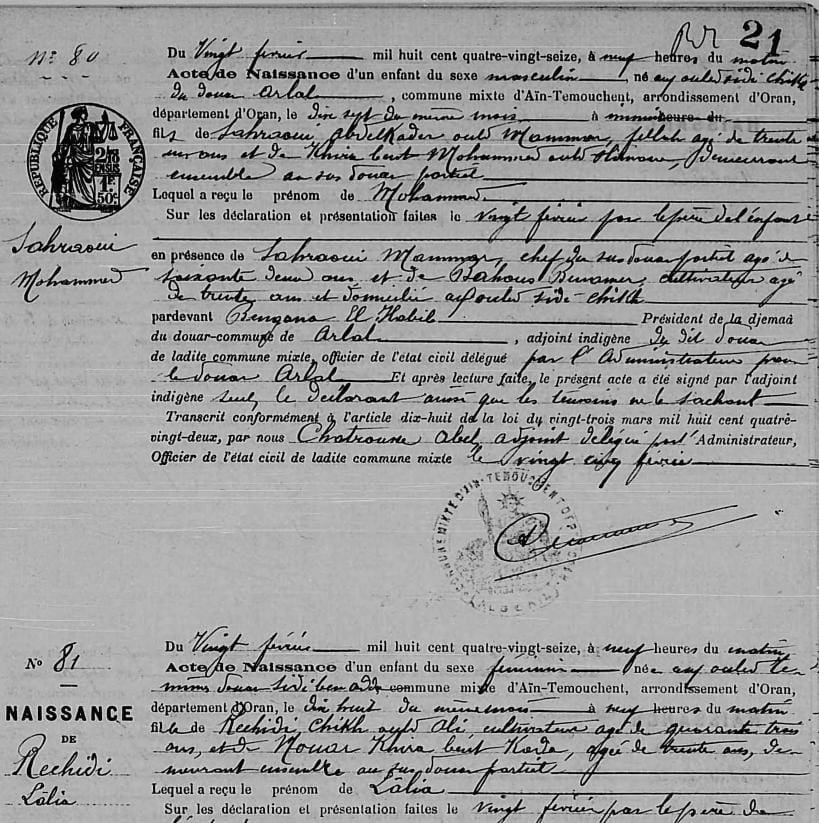
The law of 23 March 1882 formally instituted a civil registry (état civil) for “indigenous Muslim” Algerians, requiring them to register with a fixed, hereditary family name. Before this moment, Algerian naming was flexible and multi-part: a person might be known by a tribal affiliation, a relational identifier, a teknonym, or a descriptive nickname depending on context. The colonial state needed something stable, transmissible, and legible to administrators.
Scholars have described this process as a rupture. Bynames and epithets that had previously functioned as local identifiers — including the countless Bou- formations that described a person’s appearance, their father, their land, or their livestock — were written down by registrars in Latin script, treated as single units, and passed to children as permanent patronyms. A man known in his community as “the one with the horse” (Bouaoud) suddenly had a surname that his grandchildren would carry to the other side of the world.
Algeria’s état civil was introduced earlier than comparable systems in Tunisia (a beylical decree of 1925) and Morocco (a dahir of 1950), which may partly explain why Algerian Bou- surnames feel particularly entrenched and why their French-influenced spellings have proved so durable (though local and partial registrations existed in various forms earlier).
What Bou- Names Actually Say
Onomastic research on Algerian patronyms identifies four broad categories of meaning encoded in Bou- surnames:
Patronymic/teknonymic — “father of X.” This is the kunya logic most directly preserved. Bouali means “father of Ali”; Boukacem traces back to the classical kunya Abū al-Qāsim; Bourezak points to a father of someone named Razzāq or might relate to rizq (‘provision, sustenance’).
Descriptive/epithetic — “the one with X.” These names capture a physical trait, a possession, or a characteristic. Bouakkaz is interpreted as “man with a stick”; Boualit as “big-bellied” (a pejorative that presumably began as a nickname); Bouanani as “man with reins,” sometimes glossed as a skilled rider.
Toponymic/microtoponymic — “owner of / place associated with X.” Bouzeboudjene is analysed as linked to the wild olive or oleaster tree — likely a “field of oleasters” that became associated with a family. These surnames preserve fragments of a now-vanished agricultural and ecological vocabulary.
Occupational or role-based — where Bou- marks a function exercised, sometimes overlapping with the descriptive category.
A small corpus study from Jijel found that roughly 60% of collected surnames in that sample followed a Bou + noun pattern, with subcategories covering animals, objects, body parts, colours, moral traits, and numerals. While this figure should not be extrapolated to all of Algeria — the sample was small and geographically specific — it illustrates how thoroughly Bou- can dominate a local naming tradition.
A Glossary of Common Bou- Surnames
The following examples draw on published onomastic analyses of Algerian corpora, principally from Kabylie and Jijel, and should be understood as regionally attested rather than definitive national entries.
| Surname | Literal gloss | Likely origin |
| Bouali | “Father of Ali” | Arabic patronymic |
| Bouazza | “Father of / associated with Azza” | Arabic patronymic or descriptive |
| Bouaziz | “Father of / associated with Aziz (‘beloved’)” | Arabic patronymic or honorific |
| Bouakkaz | “Man with a stick” | Kabyle/Algerian Arabic descriptive |
| Boualit | “Big-bellied” | Kabyle descriptive (pejorative origin) |
| Bouaoud | “Man with a horse” or “man with wood/stick” | Arabic descriptive |
| Bouanani | “Man with reins” → skilled rider | Arabic descriptive/occupational |
| Bourezg | “Possessor of provision/fortune” → prosperous man | Arabic descriptive |
| Boumaza | “The one with goats” | Arabic dialectal descriptive |
| Boubagra | “The one with cows” | Arabic dialectal descriptive |
| Bouhmar | “The red one” | Arabic dialectal descriptive |
It is worth noting that several of these surnames carry multiple plausible etymologies in the scholarly literature: corpus-based interpretations can vary, and different scholars sometimes gloss the same surname differently. This is a reminder that a fixed Latin spelling can mask considerable oral and historical complexity.
Why the Spelling Varies
If you have browsed Algerian records or consular documents, you will have encountered the same name written as Bou-, Bu-, Abou-, and Abu- — sometimes within the same family. This is not inconsistency for its own sake. It reflects three overlapping pressures.
First, phonology: Algerian Arabic reduces classical Abū toward /bu/, a documented pattern in Maghrebi speech. Second, French orthography: under French spelling conventions, /u/ is written ou, making Bou- the natural francophone rendering of an Arabic /u/ vowel. Third, non-standardised transliteration: empirical research on Arabic personal-name transliteration documents that the same vowel appears as ou, u, or o across different administrative traditions.
In practice, the spelling in a family’s identity documents was often fixed at the moment of registration — dependent on which registrar wrote the name, in which year, under which administrative convention — and has remained that way ever since. Modern Algerian consular procedures allow for rectification of civil-status acts, but the colonial-era spellings remain the practical baseline for most diaspora families.
Bou- in the Diaspora
For Algerians abroad, Bou- surnames carry a particular weight. They often represent the first fixed form in which a family name was written — the moment a fluid oral tradition was made legible to a colonial bureaucracy. The spelling your grandfather registered, or that was registered for him, is now on your passport, your children’s birth certificates, and, quite possibly, the cover of this article.
That is not a lament. It is simply the history embedded in a two-syllable prefix — a reminder that surnames are not neutral labels but archives. Every Bouali and Boumaza carries, compressed into those opening letters, traces of the Arabic kunya, the Berber possessive morpheme, the French registrar’s pen, and the centuries in between.