

Football in Algeria goes beyond sport—it pulses through the nation’s veins as a source of identity and shared memory. From the iconic chant “1, 2, 3, Viva l’Algérie!”1 echoing through packed stadiums to the millions glued to television screens during crucial matches, the beautiful game has woven itself into Algeria’s social fabric in ways that extend far beyond the pitch.
From Colonial Resistance to National Pride
The roots of Algeria’s football obsession stretch back to the late 19th century, when French colonisers introduced the sport. Yet Algerians quickly transformed this colonial import into something distinctly their own. By the early 20th century, many local clubs had emerged along ethnic and nationalist lines, with teams adopting Islamic or nationalist names and playing in green and red—colours loaded with patriotic significance when overt political expression was forbidden.
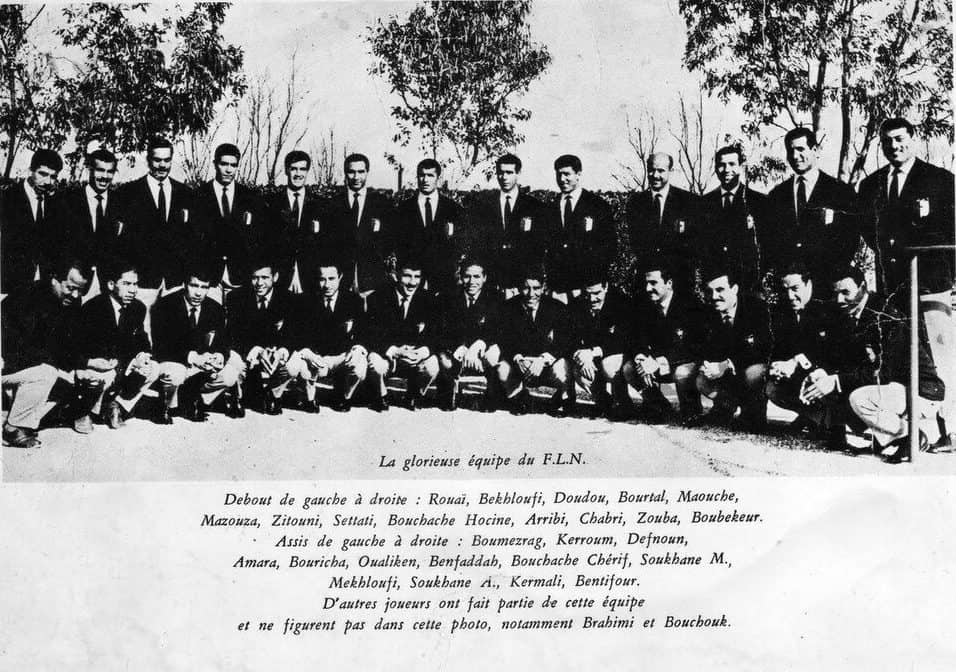
The most remarkable chapter in this history unfolded in 1958, when top Algerian players famously defected from French clubs to form the FLN national team during the War of Independence. This squad toured the world for four years, playing around 90-91 matches and becoming known as the “Onze de l’indépendance” (Eleven of Independence). Their exploits weren’t merely athletic achievements but acts of anti-colonial defiance that rallied international support for Algeria’s liberation cause.
A Nation United by the Screen
Today’s viewing figures reflect football’s unparalleled grip on Algerian attention. When Algeria faced France in a charged 2001 friendly—the first meeting between former colony and coloniser on the pitch—around ten million people watched on television, a massive audience that underscored the match’s historic weight (although the match was abandoned in the 76th minute after a pitch invasion).
More recently, Algeria’s successful 2019 African Cup of Nations campaign demonstrated football’s power to unite the nation. The final against Senegal drew over 90 million viewers across beIN Sports’ markets, with Algeria contributing significantly to that figure. Local public television also broadcast key matches, with virtually everyone who had access to a screen watching that triumphant final.
The global reach of Algerian football was perhaps best illustrated during the 2014 World Cup, when Algeria’s round-of-16 match against Germany was watched by 28.2 million viewers in Germany alone—an 85% audience share that highlighted how competitive Algerian teams captivate worldwide audiences.
Digital Passion and Social Media Fervour
Algerian football fandom has embraced the digital age with characteristic intensity. The national team’s official Instagram account @lesverts.faf has over two million followers, placing it amongst the most-followed African national teams on the platform. When Les Fennecs (‘the Fennec Foxes’, Algeria’s national team) play, hashtags like #LesVerts, #TeamDZ, and #123VivaLAlgerie trend globally, unifying Algerian voices from Algiers to London.
Individual players amplify this digital presence considerably. Superstar Riyad Mahrez commands a massive global following—millions on Instagram alone—with much of his fanbase consisting of proud Algerians. When Mahrez posts about the national team, thousands engage with likes and comments, demonstrating the deep connection between personal pride and sporting achievement.
Stadiums as Fortresses of Passion
The most visceral expression of football’s popularity manifests in Algeria’s stadiums, where supporters create some of Africa’s most electric atmospheres. National team matches are reliably sold out, whether at the 25,000-capacity Mustapha Tchaker Stadium in Blida or the larger Stade 5 Juillet 1962 in Algiers.
Club football generates equally impressive crowds, particularly for local derbies. A recent record was set in December 2023 when arch-rivals USM Alger and MC Alger attracted nearly 80,000 fans—officially 60,000 tickets were sold, but thousands more packed in, creating what was hailed as the largest league attendance in Algerian history.
The passion extends beyond mere numbers. Fans orchestrate elaborate choreographed displays (tifos), bring drums and pyrotechnics, and create an “ultra” supporter culture that rivals anywhere in Europe or Latin America. This intensity occasionally poses challenges—tragically, three fans lost their lives in June 2025 due to to barrier failures.
More Than Sport: Football as Cultural Expression
Perhaps most significantly, football serves as a vessel for broader cultural and political expression. The famous chant “1, 2, 3, Viva l’Algérie!” gained renewed prominence in November 2009 when bloodied Algerian players, after their bus was attacked in Egypt, defiantly sang it on live television. That clip went viral, transforming the chant into a battle cry for unity that extends far beyond football.
During Algeria’s 2019 AFCON triumph, which coincided with the pro-democracy Hirak protest movement, football celebrations intertwined with political aspirations. Many observers described the win as going beyond sport amid the Hirak protest movement, with the popular slogan appearing not just in stadiums but also in street demonstrations.
Ultra groups have played particularly interesting roles in this cultural crossover. During the Hirak protests, supporters from USM Alger collaborated with an expatriate rapper Soolking to produce “La Liberté” (Freedom), which became an anthem of the movement—demonstrating how football culture directly feeds into Algeria’s broader political discourse.
A Continuing Love Affair
From the anti-colonial struggles of the 1950s to today’s digital age celebrations, football in Algeria has proven itself far more than entertainment. It serves as a mirror to society, reflecting hopes, frustrations, and dreams whilst providing a unifying force that transcends political divisions.
When Coach Djamel Belmadi earned the affectionate nickname “Minister of Happiness” following the 2019 AFCON victory, it captured something essential about football’s role in Algerian life. In a nation where strangers dance together after victories and entire neighbourhoods fall silent during crucial matches, the beautiful game continues to beat at the heart of what it means to be Algerian.
- The chant’s origin is debated. Some researchers trace it to independence-era slogans chanted in English to maximise foreign press attention — ‘We want to be free — Viva l’Algérie’ — which later morphed into ‘One, Two, Three’. Others date it to 3 May 1974 at Oran’s Habib-Bouakeul Stadium after a 3–1 win over Sheffield United, or to celebrations at the 1975 Mediterranean Games in Algiers. ↩︎