Watch Algerian politicians or senior business figures speaking French and you will often hear it: a particular rolling quality to the r, the tongue tip vibrating against the ridge behind the upper teeth rather than retreating to the back of the throat in the manner of a Parisian broadcaster. It is immediately recognisable. It is not, however, a mistake.
The rolled French r — technically the apical alveolar trill [r] — has long attracted attention from Algerian sociolinguists who argue that it is better understood as a feature of Algerian French than as imperfect acquisition of a metropolitan norm. The distinction matters because it reveals something larger: how Algeria’s relationship with the French language has been negotiated across generations, and what that negotiation sounds like.
Two Ways to Sound French
To understand why the contrast carries social weight, a brief phonetic note helps. Contemporary metropolitan French most commonly uses a dorsal or uvular r — produced towards the back of the mouth, transcribed as [ʁ] — while the Algerian form is an apical alveolar trill [r], comparable in broad articulatory terms to the familiar rolled r of Spanish or Italian. The distinction is real, audible, and widely recognisable among Algerian francophones.
It is not, critically, simply an Arabic accent bleeding into French. Arabic itself contains an apical r (ر) and a separate uvular fricative (غ), so the relevant back-of-the-mouth articulation is hardly alien to Arabic-speaking Algerians. Dalila Morsly’s foundational 1983 study at the University of Algiers made precisely this point, treating educational level, sex, and age as sociolinguistic variables rather than attributing pronunciation variation simply to inability. The linguist Farouk Bouhadiba later identified the r roulé à l’algérienne (the Algerian-style rolled r) as one of the most widely recognised — and sometimes stigmatised — features of Algerian French. Recognised, not simply tolerated: there is a difference.
A Language That Belongs to Algeria Too
The social charge surrounding French pronunciation is inseparable from the history of French in Algeria. Colonial language and education policies progressively established French as the dominant language of administration and schooling while Arabic-language education and indigenous institutions were increasingly marginalised. After independence in 1962, successive governments pursued Arabisation, yet French remained deeply embedded in administration, higher education, technical fields, and business — even as recent government policy has expanded the use of English in higher education, particularly in scientific and technological fields. As the Algerian sociolinguist Ibtissem Chachou has documented, the official categorisation of French as a “foreign language” has never fully matched the place it occupies within Algeria’s wider linguistic landscape and in Algerians’ everyday linguistic practices.
A 2022 synthesis of Algerian sociolinguistic research published on Algeria’s ASJP platform puts the tension plainly: representations of French in Algeria cannot be reduced to a single positive or negative value. The language evokes colonial coercion and cultural domination while simultaneously functioning as a medium of science, journalism, literary creativity, and social advancement. That ambivalence was not resolved at independence. It was managed. Pronunciation is one of the places where that ambivalence can become audible.
The rolled r offers one small but conspicuous way of negotiating that tension. It makes possible the appropriation of French without complete convergence on the metropolitan norm. French remains French — retaining all its educational and professional capital — but its sound is locally refashioned. Morsly, drawing on earlier Maghrebi research, discussed rolling the r as a sign of belonging to a linguistic milieu whose speakers defended their own pronunciation. Against the backdrop of colonial domination and nationalist resistance, she considered resistance to francisation (assimilation into French linguistic norms) a plausible part of the explanation — an interpretation repeated and elaborated in Algerian scholarship across subsequent decades.
What Amazigh Kateb Said
Some of the most direct evidence for the cultural dimension comes from an unexpected source: the Algerian singer Amazigh Kateb. As reported by the linguist Belkacem Boumedini, Kateb described Algerians as sometimes rolling the French r deliberately in order to distinguish themselves from French speakers — observing that doing so makes speech sound Algerian and gives it a particular masculine quality. Kateb was speaking about music rather than political speech, so the example cannot by itself explain elite pronunciation. What it does establish is that the contrast can be consciously recognised and deployed as something distinctly Algerian.
The masculine association Kateb identified also recurs in the literature. Morsly’s original work discussed an association between the rolled r and virilité (masculinity) among male speakers, and subsequent researchers have returned to the same contrast. A 2026 study by Radhia Haddadi at Batna 2 University, based on an exploratory, non-probabilistic sample of roughly 100 educated participants aged 20 to 50 — including doctors, French teachers, and students — included the contrast between rolled and uvular r among the pronunciation differences respondents cited when discussing male and female speech. Haddadi frames such distinctions as social representations and normative expectations rather than absolute rules: not every Algerian man rolls his r and not every Algerian woman uses the uvular form. The association is cultural, not biological.
The Double Credential
This is where the picture becomes particularly interesting for public figures. An Algerian minister or business leader who speaks highly competent French while retaining an Algerian [r] is not sending a contradictory signal. He may be sending two at once: command of French — with its associations of education, international access, and elite networks — alongside audible membership in the Algerian speech community.
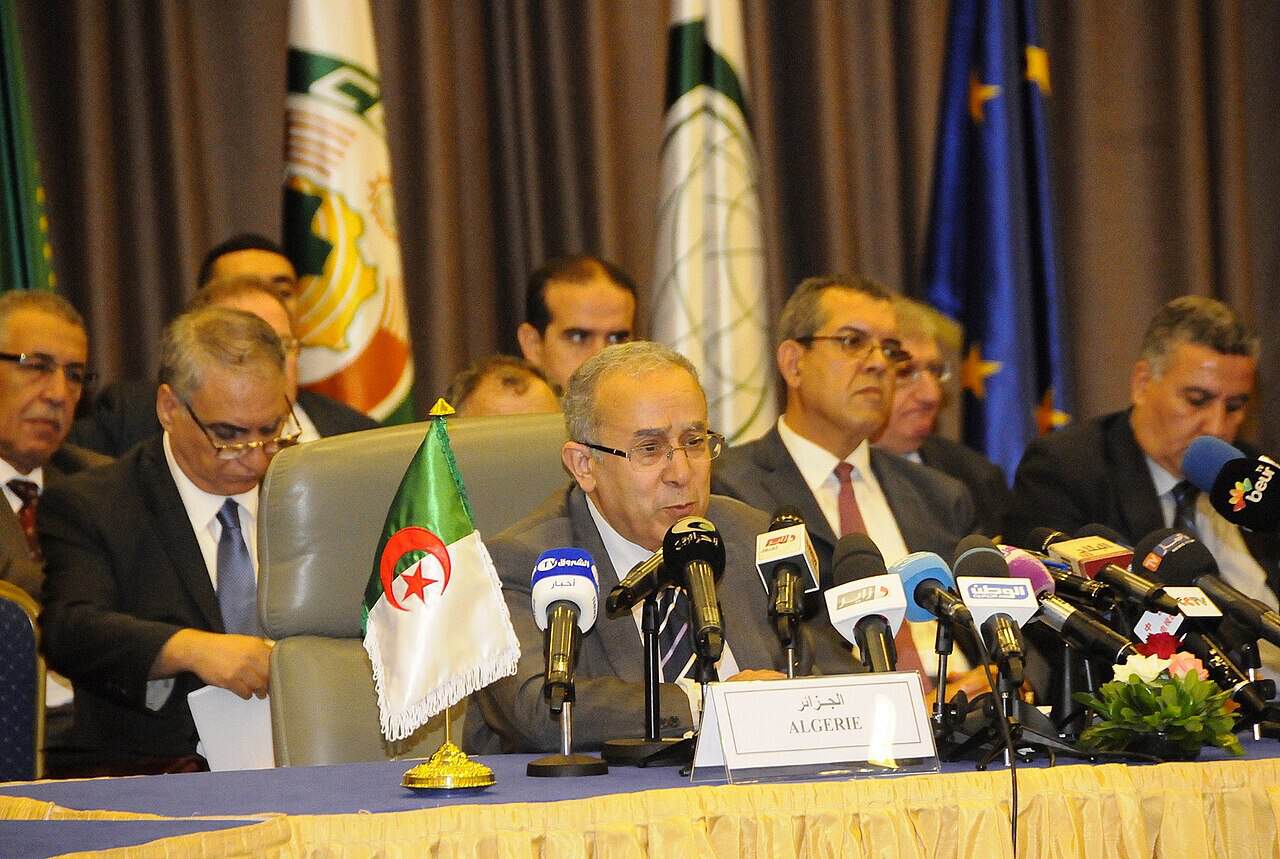
Public interviews help ground the question in the speech of actual Algerian elites. Ramtane Lamamra, the veteran Algerian diplomat and former foreign minister, can be heard speaking at length in French in an interview with France 24 and RFI. On the business side, Dr Abdelouahed Kerrar, a leading figure in Algeria’s pharmaceutical industry and vice-president of the Conseil du renouveau économique algérien (CREA), provides another readily accessible example in a French-language interview with Radio Algérienne. Both are useful illustrations of the kind of elite speech under discussion. They are not, however, controlled linguistic evidence: hearing how Lamamra or Kerrar speaks cannot tell us whether either man consciously manages his pronunciation for a particular audience. Lamamra’s long diplomatic career and Kerrar’s senior role in Algeria’s pharmaceutical industry and business community simply make them particularly clear examples of speakers for whom fluent French and elite status are not in question.
The comedian Fellag offers a particularly vivid illustration of how socially legible the contrast can be. Malika Boussahel’s linguistic analysis of his show Djurdjurassique Bled found that Fellag’s Algerian male character normally speaks an Algerianised French, rolled r included, but switches to the uvular pronunciation when addressing a French woman — a movement towards metropolitan prestige through convergence with his interlocutor. Fellag also uses the uvular r to mark a character as French, or when playing a female character, even an Algerian one. The humour depends partly on the audience recognising the social contrast. That makes Fellag’s performance useful evidence of the meanings Algerian speakers can attach to the two pronunciations.
Whether Algerian politicians consciously manage their r for domestic audiences is a harder question. The studies cited here do not include a controlled acoustic comparison of named Algerian officials speaking to different audiences. The stronger conclusion is structural: many elite speakers emerge from speech communities where the rolled r is already socially available and locally meaningful. Elite public life then creates circumstances in which retaining or suppressing it can matter — without that choice needing to be a deliberate calculation each time.
An Accent Without a Single Meaning
Regional complexity adds a further layer. Kabylia, with its dense history of French schooling, migration, and francophone political organisation, complicates any attempt to equate the use of French with cultural identification with France. A CRASC study of public writing in Tizi-Ouzou found French highly visible in political expression and everyday communication — a language linked to local educational history and, crucially, used as a form of resistance to state Arabisation without necessarily implying identification with France. During the 2017 legislative elections, RCD activists deployed a French-language slogan in a strategically prominent location precisely because French was regarded as capable of reaching local voters on their own terms.
In Kabylia, in other words, French can signal local belonging just as readily as metropolitan aspiration. The broader implication is that the social meaning of the same pronunciation may shift between Tizi-Ouzou, Algiers, and, for example, a Paris television studio. Such meanings are contextual: they depend on region, gender, political orientation, and interlocutor. The rolled r does not map cleanly onto a single allegiance.
Sounding Like Yourself
What the evidence supports, taken together, is a broader process that Algerian linguists have described as the appropriation or Algerianisation of French — the language being claimed, refashioned, and made to sound like its speakers rather than simply reproducing the pronunciation of the former colonial centre. Boussahel, for example, explicitly describes Fellag’s rolled r and other features of his French as carrying symbolic and identity value within this process of algérianisation.
That is the broader significance of what might otherwise seem a merely phonetic detail. For an elite speaker, the result can be a particular kind of possibility: to sound educated without necessarily sounding assimilated; international while remaining audibly local; francophone without presenting oneself as culturally French. Colonial history helped create the social value attached to that contrast. Gender conventions helped make it especially audible among male public figures. And generations of Algerian families, schools, and workplaces transmitted the pronunciation in ways that mean no conscious political decision is required each time for it to acquire social meaning.
The rolled r does not announce a position. It carries a history.