

On 13 February 1960, a blue-tinged fireball erupted over the Algerian Sahara, marking France’s entry into the nuclear age. Code-named Gerboise Bleue after the desert jerboa (a desert rodent), this first French atomic bomb was detonated at a remote site near Reggane, deep in the Tanezrouft region of the central Sahara. The explosion yielded about 70 kilotons of force, around four to five times the power of the Hiroshima bomb.
Over the following six years, France would conduct 17 nuclear tests on Algerian soil, including four atmospheric blasts and 13 underground explosions. The testing programme continued even as Algeria fought for and won its independence in 1962, leaving behind a legacy of contamination, illness, and unresolved grievance that persists to this day.
The Testing Programme: 1960–1966
France’s nuclear ambitions in Algeria unfolded across two primary sites. The first, the Centre Saharien d’Expérimentations Militaires (CSEM) near Reggane, hosted the four atmospheric tests of the Gerboise series between February 1960 and April 1961. These tests were named after colours: Gerboise Bleue, Gerboise Blanche (April 1960), Gerboise Rouge (December 1960), and Gerboise Verte (April 1961).
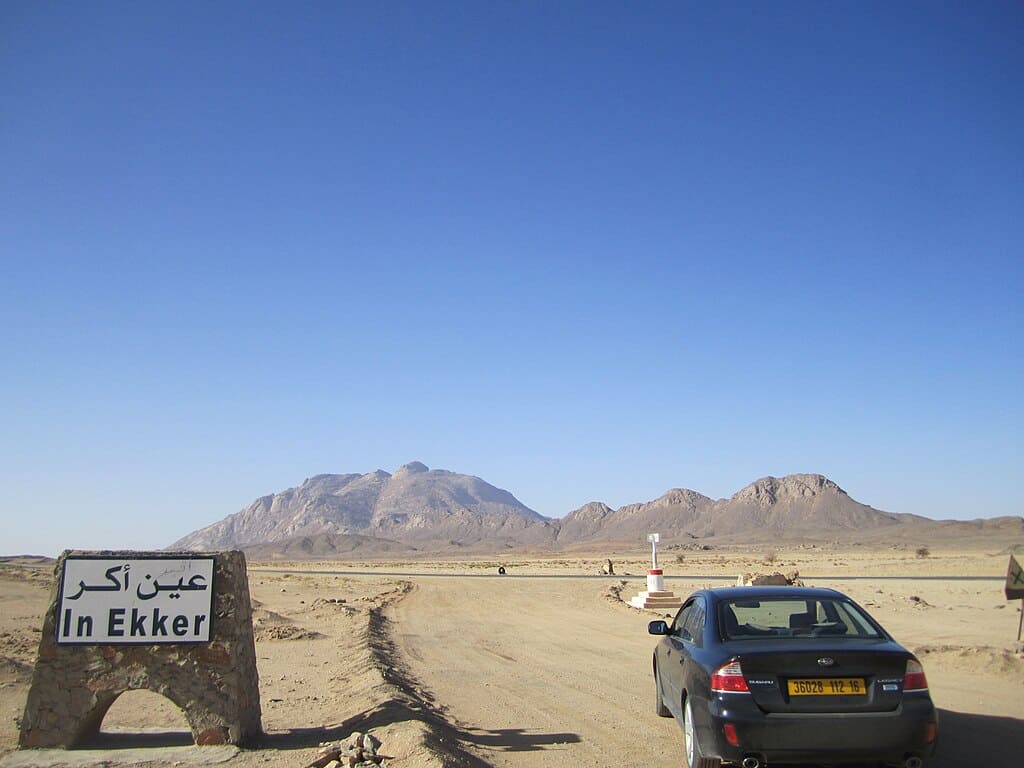
Following international criticism of the radioactive fallout from these atmospheric detonations, France shifted operations to a second location: the Hoggar Mountains near In Ekker in southern Algeria. There, at the Centre d’expérimentation militaire des oasis (CEMO), 13 underground tests were conducted between November 1961 and February 1966. These operations bore the code names of gemstones, including Agate, Beryl, Ruby, and Sapphire. The largest detonation in Algeria is often listed as Saphir (late February 1965), with estimates up to around 127 kilotons.
A striking aspect of this programme is that most tests occurred after Algerian independence. Confidential clauses/annexes within the 1962 Évian Accords, which ended the Algerian War of Independence, granted France continued use of the Saharan test sites for several years. As a result, 11 of the 17 nuclear detonations took place between 1962 and 1966, when Algeria was nominally sovereign.
The Human and Environmental Toll
French authorities initially characterised the test sites as uninhabited wasteland. Colonel Charles Ailleret, who oversaw the programme, justified the choice of the Tanezrouft near Reggane by claiming there was a “total… absence of plant or animal life.” This was demonstrably false. Tens of thousands of people lived in or near these areas, including nomadic communities (Tuareg and other Saharan groups), residents of Reggane itself (then home to around 6,000 people), and thousands of Algerian workers employed at the French facilities.
These populations were exposed to radioactive fallout without informed consent or adequate protection. The atmospheric tests dispersed radioactive dust across vast distances. French data declassified decades later revealed that fallout from Gerboise Bleue alone was detected across Algeria and into neighbouring countries, from southern Libya and Mali to Senegal, Côte d’Ivoire, and Sudan. Reporting based on declassified French material published in the 2010s suggested the plume travelled far beyond southern Algeria, reaching parts of North and West Africa—and, under some conditions, southern Europe.
The underground tests also proved dangerous. On 1 May 1962, the Béryl test at In Ekker failed to contain properly. A fissure in the mountain vented a plume of radioactive dust and gas into the atmosphere, exposing soldiers and visiting officials, including French government ministers, to dangerous radiation levels. They were forced to flee as the cloud burst from the test shaft, an incident kept secret for years.
Health Consequences
The health toll has been severe and enduring. Estimates suggest that between 27,000 and 60,000 Algerians experienced health problems attributable to test radiation. Contemporary surveys describe elevated incidence of leukaemia, breast and thyroid cancers, liver and skin cancers, and congenital deformities in communities downwind of the test sites. Babies have been born with atrophied limbs, neural tube defects, and other malformations that local doctors and families attribute to lingering radiation.
Even decades after the tests, health issues persist. Algerian health authorities observed unusually high cancer rates in the regions surrounding the test sites through the 1970s and 1980s. While some rates have declined, they remain above national averages. A 2012 survey by Algeria’s official press agency APS estimated that at least 30,000 Algerians were directly sickened by the 1960s tests.
Environmental Contamination
The Saharan ecosystem suffered lasting damage. The intense heat of the first bomb fused desert sand into glassy radioactive shards. At In Ekker’s Tan Afella mountain, one mountainside remains littered with radioactive rubble from explosions and subsequent tunnel collapses. Water sources used by nomadic herders were polluted, with traces of radionuclides found in some desert wells long after the tests.
The contamination has proven remarkably mobile. In early 2021, a major wind event swept Saharan dust northwards across the Mediterranean. Monitoring groups in France reported trace caesium-137 in Saharan dust events and noted historic testing as a possible source; other researchers have challenged similar attributions in later dust episodes—underscoring the case for transparent, joint monitoring of the sites.
Why France Tested in Algeria
France’s decision to conduct nuclear tests in colonial Algeria stemmed from both practical and geopolitical considerations. By the late 1950s, Charles de Gaulle’s government was determined to build an independent nuclear deterrent, the force de frappe, to assert France’s status as a great power. Metropolitan France was densely populated and politically sensitive; the remote Sahara offered an alternative.
The Algerian War of Independence was already raging when the first test occurred in 1960, underscoring a stark irony: while fighting Algerian insurgents seeking independence, France was simultaneously detonating atomic bombs on Algerian soil. The programme also served as a geopolitical statement: France’s push for an independent deterrent was pursued in a colonial—and later post-independence—setting whose costs were borne locally.
The tests drew significant international criticism, particularly from newly independent African states. Ghana’s President Kwame Nkrumah publicly condemned the 1960 detonation, and Ghana froze French assets in response. Morocco recalled its ambassador from Paris within days. In Accra, anti-colonial organisers and allied activists increasingly linked opposition to Saharan testing with Pan-African politics—circulating the language of “nuclear imperialism” and urging African governments to treat nuclear testing in Africa as a continental issue.
Aftermath and the Question of Accountability
When France officially withdrew from the Saharan test sites in 1967, it left behind an unremediated radioactive legacy. Rather than conducting thorough cleanup, the departing French military buried large amounts of radioactive scrap and equipment in the desert and abandoned contaminated infrastructure.
Crucially, France refused for decades to hand over full records or maps of the test sites, particularly detailed coordinates of buried radioactive waste. As late as 2020, French authorities had not disclosed the exact locations of all nuclear waste and contaminated materials left in Algeria. This secrecy has hindered Algeria’s ability to secure or remediate the affected areas.
The Compensation Gap
France passed legislation in 2010 (the Morin law) to provide compensation for nuclear test victims, but its criteria proved so restrictive that almost no Algerian victims benefitted. Claimants had to prove presence in defined zones during specific periods and demonstrate one of a list of cancers. By 2021, out of 545 successful compensation claims under France’s programme, only one was by an Algerian victim, with the vast majority of awards going to Polynesian cases.
This disparity has bred resentment. Algerian officials note that France’s nuclear legacy in their soil has been neglected compared to remediation efforts in French Polynesia. In 2020, Le Monde reported President Abdelmadjid Tebboune saying that “the only compensation conceivable is that for the nuclear tests” and adding that “the after-effects remain vivid for some communities, notably those affected by malformations”.
Recent Developments
Algeria’s calls for accountability have intensified in recent years. In December 2025, Algeria’s National Assembly passed a bill declaring French colonisation a ‘crime of state’ and demanding restitution, including fuller disclosure and mapping of nuclear test-site contamination and compensation for victims. While largely symbolic and unenforceable internationally, the legislation reflects the depth of sentiment in Algeria regarding this unresolved chapter.
The issue has also gained traction in international forums. Algeria signed the 2017 Treaty on the Prohibition of Nuclear Weapons (TPNW), which obligates signatories to assist victims of nuclear testing and remediate contaminated environments. Algerian diplomats have used this platform to argue that nuclear-weapons states must acknowledge and address past test damage.
On 29 August 2025, the UN’s International Day Against Nuclear Tests, a coalition of 20 organisations from Europe, Africa, and the Middle East issued a joint declaration specifically addressing the Algerian test legacy. They described the radioactive contamination as a “tragic imprint” on thousands of lives and called for official French acknowledgement, comprehensive compensation, full disclosure of archives, and cooperation in decontaminating affected zones.
Remembrance and the Path Forward
Each year, Algerians commemorate 13 February as a day of remembrance for the victims of Gerboise Bleue and subsequent tests. Survivor associations and human rights groups continue gathering testimonies and pressing for accountability. The Algerian government has established a national agency to rehabilitate former test sites and has begun containment measures, including warning signs and fencing around epicentres.
Under President Emmanuel Macron, France has taken modest steps toward acknowledgement. The 2021 Stora Report, commissioned by Macron on colonial history, recommended joint Franco-Algerian environmental monitoring of the Sahara sites. In early 2023, France agreed in principle to accelerate release of colonial archives and aid in cleaning up the test locations. However, as of late 2025, France has not issued any official apology or compensation programme specifically for Algerian test victims, and tangible cleanup actions have yet to begin in earnest.
The French nuclear tests in Algeria stand as a painful intersection of the atomic age and the end of colonial empires. The radioactive sands of Reggane and In Ekker continue to blow across borders, a haunting reminder that the consequences of these explosions extend far beyond the mushroom clouds that rose over the Sahara more than six decades ago. For the affected communities, for Franco-Algerian relations, and for international efforts to address nuclear test legacies, this remains unfinished business demanding resolution.