

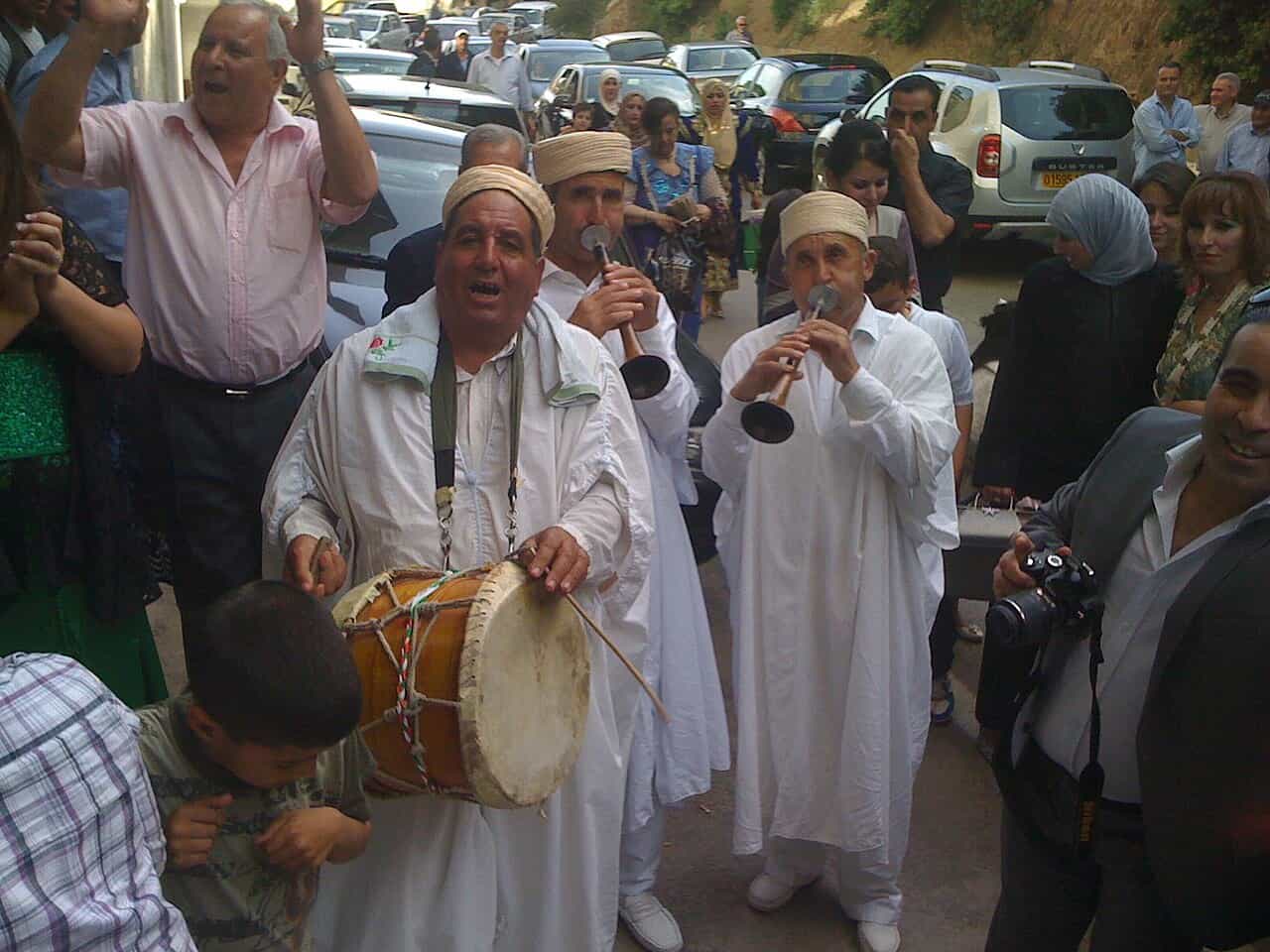
Few sounds in Algerian life carry as much weight as zagharid (زغاريد). The high-pitched, trilling vocal call — often called youyou in everyday francophone Algerian usage — fills the air at weddings, circumcision processions, and national celebrations alike. It is simultaneously a technique, a social signal, and a form of collective expression. To hear zagharid is to know that something important is happening.
What Are Zagharid?
The word zagharid is the Arabic plural of zaghrooda (زغرودة), formed from the Arabic root ز-غ-ر-د, associated with ululation or trilling cries. In practice, it refers to a high-pitched vocalisation produced through rapid tongue movement — and sometimes uvula movement — creating a wavering, fluttering acoustic effect. A standard music reference describes ululation as a high, loud, wavering vocal sound produced with rapid tongue and uvula movement.
Listeners often hear the call as a cascade of “li-li-li” oscillations at considerable volume. Part of what makes zagharid socially striking is that it is often hard to pinpoint its source — carried from courtyards or from behind windows, it can seem to emanate from the fabric of the neighbourhood itself. When multiple women join in, the sound becomes communal, amplifying into a collective wave rather than an individual statement.
In Algeria, the practice goes by several names depending on context and community. In francophone everyday speech, youyou (also written you-you) is a very common term — an onomatopoeia that has crossed back into Arabic-script media. In western Maghrebi contexts, closely related forms and terms have been documented in ethnographic work, though naming and usage vary by locality. In Kabyle — one of the Amazigh (Berber) languages of northern Algeria — the verb slilew appears in Jean-Marie Dallet’s Dictionnaire kabyle-français (1982), based on the At Mangellat variety, where it is glossed as “pousser des youyous”.
A Sound for Charged Moments
In Algeria, zagharid functions as what anthropologists might call a ritual-emotional marker: it punctuates moments when ordinary time is suspended and social relations are publicly transformed. In Algerian and wider Maghrebi practice, zagharid often marks moments of heightened social feeling: weddings above all, but also other occasions of honouring, exhilaration, and in some contexts mourning.
The most detailed Algeria-specific account comes from a master’s thesis by Chaouadi and Si Moussi (2017) on marriage ritual in the Maâtkas region of Kabylie. During wedding sequences, Chaouadi and Si Moussi document women gathering in a circle to sing older praise-poems known as tibuɣarin, accompanied by youyou, explicitly praising the married couple and their family. The call is embedded within the performance itself — not a reaction to it, but part of its texture.
Processional moments receive particular attention. The movement of the bride’s trousseau from one household to another is accompanied by youyous, tying the vocalisation to visible social transitions — passing thresholds, moving objects that carry the weight of the bride’s relocation, and signalling to the wider community that a transformation is underway. In this sense, zagharid do not merely express emotion; they announce social fact.
The Maâtkas sequence, as Chaouadi and Si Moussi reconstruct it, unfolds through several stages: the henna preparation gathering, the henna ritual itself (where tibuɣarin are performed with youyou), the departure procession, the movement of the trousseau accompanied by zagharid, and the rites at the threshold of the new household. Each stage is sonically punctuated.
A Collective Female Voice
Across the material used here, zagharid appears above all as a women’s collective practice. In the contexts documented for western Algeria, it is made exclusively by women when gathered together, with a notable feature: the sound is often produced anonymously, with faces veiled or turned aside, limiting individual identification even when the call is loud.
This is not a minor detail. It helps explain how zagharid can function as a powerful form of public female participation in settings where women’s physical visibility is socially constrained. The sonic presence is undeniable — the visual source, deliberately obscured. It is a form of voice that does not require a face.
Beyond the Household: Football, Cinema, and National Life
Zagharid are not confined to domestic ritual. During Algeria’s 2019 Africa Cup of Nations victory celebrations, Le Monde reported that the streets of Algiers filled with flags, horns, fireworks — and youyous. The sound migrated effortlessly from courtyard to public square, carrying its emotional charge into collective national exhilaration.
The sound also has a place in cultural memory of the independence struggle. A scholarly analysis of gender and sound in cinematic representations of the War of Independence notes how, in Gillo Pontecorvo’s The Battle of Algiers, the film’s soundscape of the city is characterised by “shrill collective feminine ululation,” linking women’s vocalisation to collective political affect. Whether or not this mirrors every historical moment of the liberation struggle, its prominence in the film shows how readily ululation could function in cultural memory as a sonic sign of Algerian collectivity — and of women’s presence within it.
A Practice With Many Names, One Spirit
One of the challenges in writing about zagharid is resisting the urge to flatten them into a single, tidy definition. Ululation is widely attested across many societies, but its forms and meanings vary by region, language, and setting. Within Algeria, the most clearly documented cases are regionally anchored — Kabylie and western Algeria, for example — and it would be a stretch to assume that every region from Oran to the Aurès to the Saharan south follows identical norms of timing, technique, or meaning. Algeria is internally diverse, and zagharid likely reflect that diversity.
Within Algeria, the most concretely documented cases are regionally anchored — Kabylie, western Algeria — and it would be a stretch to assume that every region from Oran to the Aurès to the Saharan south follows identical norms of timing, technique, or meaning. Algeria is internally diverse, and zagharid likely reflects that diversity.
What the available evidence does suggest across the documented Algerian contexts is a recurring pattern: ululation is largely a women’s collective practice; it is skilled and learnable rather than random noise; it belongs to emotionally charged transitional moments; and it can operate both as intimate ritual and public announcement.
Crucially, it also travels. From the henna circle in Maâtkas to the celebrating streets of Algiers in July 2019, zagharid moves across the boundaries that tend to separate domestic life from national life, private emotion from public statement. In that mobility lies much of its power.