

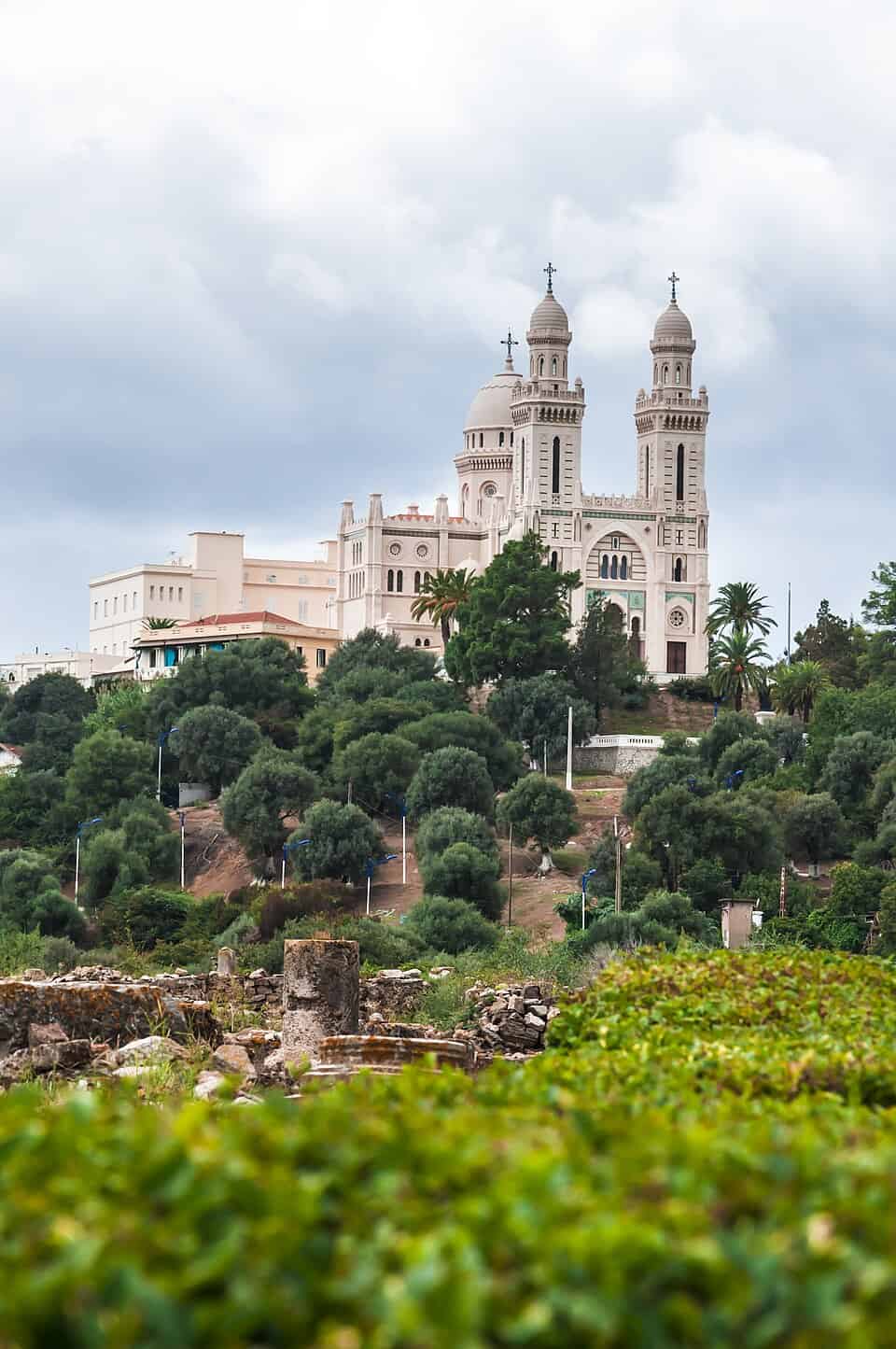
In the summer of 430, as Vandal forces laid siege to a North African port city, one of antiquity’s most influential thinkers lay dying inside its walls. Augustine, bishop of Hippo Regius for more than three decades, had spent the better part of his life in this city. He was not a visitor passing through, nor a figure whose connection to the land is symbolic or approximate. He was born, educated, ordained, and first buried in towns that lie within modern Algeria — and that geography, after centuries of dispute and political use, is now being formally framed by the Algerian state as part of the country’s national heritage.
Born in Numidia, Made in North Africa
Augustine was born on 13 November 354 in Thagaste, a market town in the Numidian interior that corresponds today to Souk Ahras, in north-eastern Algeria. As a young man, he crossed south to Madauros (modern M’daourouch) for schooling, a town known in late antiquity for its grammar and rhetoric masters. Both places lie in modern Algeria and now appear in Algeria’s official Augustinian heritage itinerary.
His decisive turn northward came around 391. Visiting Hippo Regius — the prosperous Roman port that would become modern Annaba — Augustine was compelled by popular acclamation into holy orders by local congregants who pressed him to accept ordination as a priest. The episode is recorded by his friend and near-contemporary biographer Possidius in the Vita Augustini, one of the most reliable early sources for the North African context of his ministry. By 395, Augustine had succeeded the ageing bishop Valerius, beginning a thirty-five-year episcopate that would end only with his death in the same city.
These are unusually strong historical connections. They are anchored in primary testimony, confirmed by major reference scholarship — including Serge Lancel’s entry in the Encyclopédie berbère — and are now embedded in Algeria’s UNESCO Tentative List dossier, submitted on 28 April 2025 under the title Itinéraires Augustiniens en Algérie.
Hippo → Bône → Annaba: A City That Carries Its History in Its Name
One of the more remarkable things about Augustine’s Algerian footprint is that it is not merely documentary — it is physical and toponymic (preserved in the city’s name). The place-name lineage from ancient Hippone to colonial Bône to post-independence Bouna to modern Annaba represents, as the Encyclopédie berbère entry on the city puts it, an “evident” chain of continuity over two millennia. Whether the modern name Annaba derives directly from the Arabic ‘unnāb (jujube) or reflects more complex phonetic continuity is debated; the continuity of settlement on the site is much less so.
What makes the Hippo–Annaba link unusually strong for a site of this antiquity is that much of the archaeological zone survived as a legible archaeological zone. The ancient city’s ruins — forum, theatre, baths, and a Christian quarter — were not swallowed by the medieval or modern town, leaving an excavated landscape that is legible today. The site covers around 40 hectares, has been classified as national heritage since 1992, and is managed by Algeria’s Office for Protected Cultural Property. Adjacent to the ruins stands the Basilique Saint-Augustin, a 19th-century structure built on the hill above Hippone, known locally by the affectionate name Lalla Bouna. Restored in the early 2010s with Algerian state backing and Augustinian involvement, it functions simultaneously as a monument, a minority religious site, and a recognised landmark in Annaba.
One important caution for visitors and writers: do not assume that any specific excavated church on the site was “where Augustine preached.” A specialist archaeological reassessment by Jean-Pierre Laporte (2015) has argued convincingly that the mid-20th-century identification of a particular church as the Basilica of Peace — where Augustine officiated — rests on flimsy grounds. The accumulated objections make that identification effectively untenable without stronger archaeological and inscriptional evidence. The physical landscape of Augustine’s Hippo is present; the precise attribution of individual structures is not.
What Should and Should Not Be Said
A frequently recurring temptation in writing about Augustine and Algeria is to call him “Algerian” — and this is where careful wording matters. Algeria did not exist as a nation-state in the fifth century; calling Augustine “Algerian” in the modern national sense is anachronistic. The more defensible formulation, used in Algeria’s own official heritage framing, is that he was “born in Thagaste (Souk Ahras) and bishop of Hippone (Annaba)” — towns that lie in modern Algeria.
Similarly, his ethnic or linguistic identity is sometimes presented as settled when it is not. That Augustine grew up in a Romano-African provincial milieu, probably with some exposure to Punic — the Semitic language that persisted in North African communities long after Roman conquest — is documented in his own writings and debated in scholarship. Whether he was ethnically Amazigh (Berber) is a hypothesis that some scholars find plausible; it is not a settled fact, and the scholarship that foregrounds his “Africanity” is careful to stress the limits of what can be proven. Algerian academic Mohamed EL-Hadi Hareche has examined how a single textual fragment — in which Augustine mentions peasants identifying as “Canaanites” using Punic — has been interpreted and misinterpreted across different identity narratives, including by some colonial-era historians. It is a reminder that the textual evidence rewards care.
A Figure Claimed, Rejected, and Reclaimed
Augustine’s place in Algerian cultural memory has never been stable, and understanding why is essential to understanding what the current heritage project means.
In the early decades of French colonisation, Catholic bishops and missionaries explicitly mobilised Augustine to ground their presence in an ancient Christian North Africa. A pivotal moment came in 1842, when Bishop Antoine-Adolphe Dupuch travelled to Pavia, obtained a relic identified as part of Augustine’s right forearm, and staged its ceremonial return to Bône — framing it as bringing Augustine back to his “former see.” Bonnie Effros (2022) has documented how this relic translation, and the pilgrimage activity it generated, formed part of a broader entanglement of archaeology, missionary work, and colonial administration in French Algeria.
By the late 19th and early 20th century, these tendencies hardened into what scholars have termed “Latin Africa” narratives: the idea that Roman antiquity was naturally continuous with Algérie française, and that the Arab-Islamic period represented a rupture to be overcome. In colonial scholarship and ecclesiastical discourse, Augustine could become an emblem of a supposedly ‘Latin Africa’. That framing often obscured an obvious fact: Augustine was also a product of a North African society with its own linguistic, social, and religious complexity.
Post-independence Algerian discourse responded with marked ambivalence. A nationalism grounded in Arabic-Islamic identity could treat Roman antiquity — and Augustine within it — as incompatible with the national project, or even recast the ancient Donatist controversy as a form of indigenous resistance to Roman authority (a reading that scholarship has flagged as historically inaccurate). Claudia Gronemann (2021) has mapped these shifting symbolic uses of Augustine from the 19th century through to the post-independence period, showing how the same historical figure can be inscribed into radically different cultural and political projects.
From the late 1990s, however, a different current emerged. In April 2001, a major international colloquium — Saint Augustin: africanité et universalité — was held in Algiers and Annaba under the patronage of President Abdelaziz Bouteflika. Algerian press coverage at the time framed Augustine explicitly as a “great figure of Algerian heritage,” describing bilingual Arabic/French exhibitions and planned “pilgrimage” visits to Souk Ahras and M’daourouch. Notably, the event was co-organised with the High Islamic Council — a deliberate signal that Augustine’s heritage was being positioned not as a Christian or European memory, but as part of Algeria’s plural, pre-Islamic past. Gronemann connects this reactivation to Bouteflika’s reconciliation politics and a broader “reconciliation” with pre-Islamic history as a legitimising resource.
That political tradition continues. In remarks published by Algerian official media on 13 April 2026, President Abdelmadjid Tebboune described Algeria as the land that gave birth to Saint Augustine, identifying him through Thagaste and Hippone and folding him into a broader millennial national history. The UNESCO Itinéraires Augustiniens bid formalises this framing, presenting the Algerian sites not simply as archaeological remnants but as a coherent national itinerary linked to a figure of intercultural exchange and “living together.”
What Survives, and Why It Matters
What Algeria is formalising through its UNESCO bid is something that has long been true but rarely stated plainly: that the physical landscape of Augustine’s intellectual and pastoral life — the towns where he was schooled, ordained, and buried — is located in north-eastern Algeria. The heritage science work of Gheris et al. (2023) situates the Hippo site within a longue durée sequence spanning Punic, Numidian, Roman, Christian, and Islamic phases, and documents what currently survives on the ground.
That layered sequence is itself part of the story. Augustine’s Hippo was not a single-culture site even in his own lifetime; it was a port city where Latin, Punic, Greek, and local North African languages and identities overlapped. His letters and sermons are repeatedly used by scholars to reconstruct the social texture of North African life — linguistic mediation, pastoral conflict, economic networks — in ways that illuminate not just theology but the lived complexity of a late-antique Algerian city.
The most defensible way to frame Augustine’s relationship to Algeria is not “Augustine the Algerian” but Augustine in Algeria: a global thinker whose most important institutional base, and whose death-site, are located in today’s Algeria, with an archaeological footprint that the Algerian state is actively curating and a memory politics that reflects the genuine complexity of the country’s layered past.