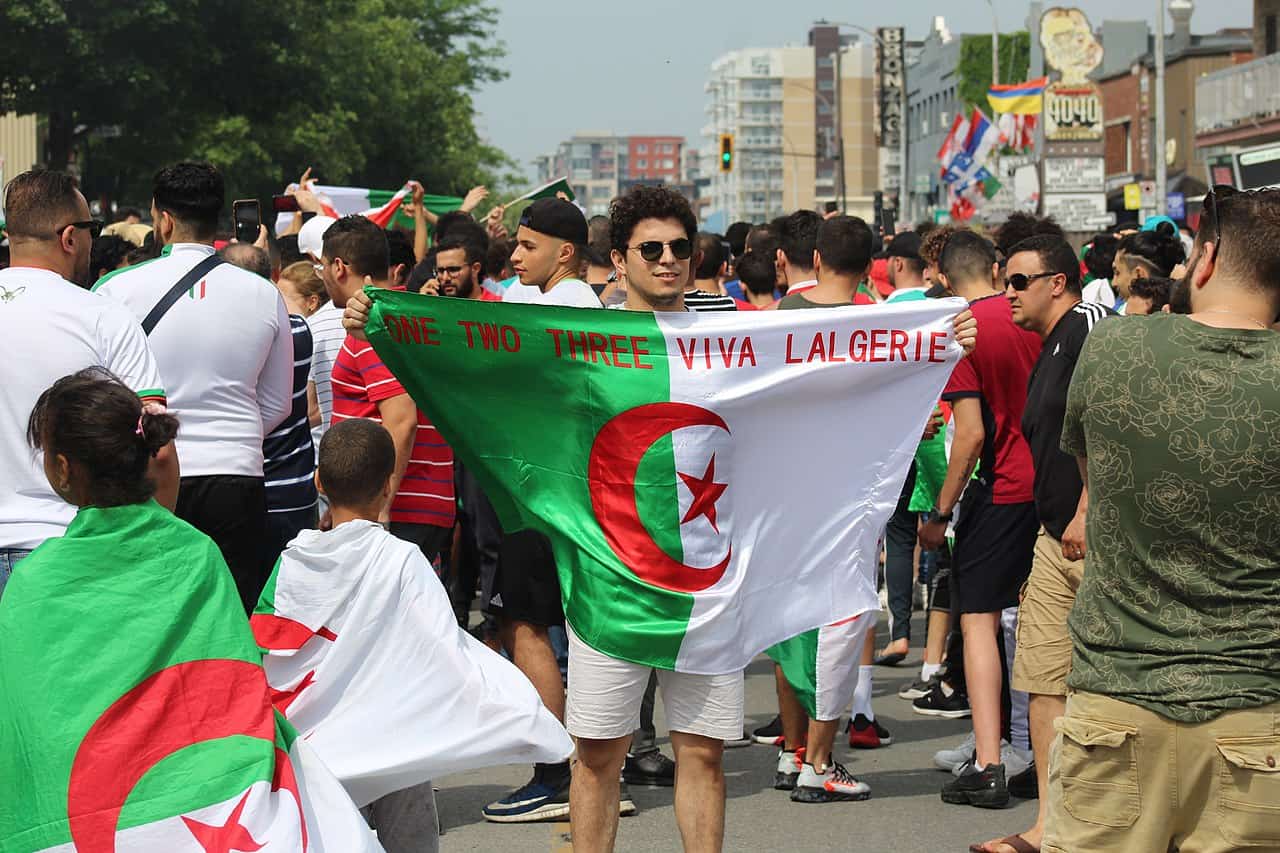
Few national sporting cultures are as musically layered as Algeria’s. The songs that accompany Les Verts — Algeria’s men’s national football team — are not the disposable anthems that many countries commission before a tournament and forget the moment the final whistle blows. They are a living archive: politically charged, amplified by the diaspora, and built to move from the stadium to the street and back again. To understand them is to understand something important about how Algerians, both at home and abroad, articulate collective identity.
A Repertoire, Not an Anthem
The first thing to understand about Algerian football music is that there is no single official song. What exists instead is a layered repertoire that has shifted with each media era, each political moment, and each major tournament. At its centre sits the chant “One, Two, Three, Viva l’Algérie” — a portable rallying cry whose precise origin remains disputed among historians and cultural commentators, with competing explanations placing it variously in the anti-colonial era, in 1970s football culture, or around the 1975 Mediterranean Games. Around it grew an older patriotic songbook associated with singer Rabah Driassa, then a commercially recorded rai-pop wave tied to the World Cup cycles of 2009–14, and finally a stadium-to-street repertoire led by Ouled El Bahdja and Soolking during Algeria’s Africa Cup of Nations (AFCON)-winning run in 2019.
That the chant’s origin cannot be pinned down has not diminished it. If anything, the ambiguity has made it more available as a national symbol: supporters and commentators can attach it to whichever historical memory matters most — anti-colonial struggle, 1970s sporting pride, or simply the feeling of being Algerian in a crowd. Musically, its strength lies in economy. It requires no instrumental backing, only pulse, crowd timing, and repetition. Linguistically, it is already hybrid — English counting, a Spanish-style exclamation, and the French country name pronounced in an Algerian way — which makes it a compressed reflection of the multilingual world Algerian football supporters actually inhabit.
The Broadcast Era: Rabah Driassa and Patriotic Chanson
The oldest securely documented layer in the repertoire belongs to Rabah Driassa, the singer most closely associated with the classical Les Verts era. His song “Mabrouk Alina” — “Congratulations to us” — is widely remembered as the soundtrack to Algeria’s qualification for the 1986 FIFA World Cup in Mexico. The digital record complicates this, however: Spotify places the track in 1989, and some syndications reflect later reissues. The safest formulation is that Mabrouk Alina is remembered and claimed in Algerian cultural memory as a mid-1980s football song, especially around Mexico 1986, even though streaming-platform metadata often reflects later album issues, catalogue uploads or re-releases rather than the original moment of composition. His second major football-era title, “Haya ya Djazair” (“Come on, Algeria”), is catalogued by Apple Music in 1989.
These were songs built for a specific media ecology: state television, patriotic commissioning, broadcast nationalism. They sounded less like terrace chants and more like national songs that happened to mention football — a distinction that would dissolve entirely in the decades that followed.
The Rai-Pop Wave: 2009–2014
The transformation began in earnest with the high-stakes 2009 World Cup qualifying campaign. The soundtrack is dense and well-documented because it belongs to the satellite-TV and early YouTube era. On 14 November 2009 — in the same week as the dramatic Algeria–Egypt play-off — the compilation Viva l’Algérie was released, bundling Mahfoud & Sonia’s “Viva L’Algérie”, G.Univers/Groupe Palermo’s “Allez les Verts”, and Amine & Lyes’s “Rayhine La Coupe Du Monde” (“We’re Going to the World Cup”). That last title is worth pausing on: it is not retrospective celebration but anticipatory self-suggestion, the musical counterpart of a nation trying to sing qualification into existence before the result was confirmed.
A 2018 scholarly study of Algerian “sport songs” divided the repertoire into patriotic and popular songs, noting that younger listeners valued them because they spoke to lived social realities. That framework fits the 2009–14 material well: it is patriotic in function, but popular in sound and distribution. Many of these songs drew on the commercial sound-world of Algerian popular music — especially rai-pop and weddings, local radio and online platforms — rather than on formal patriotic chanson alone. Rai is the genre UNESCO describes as a vehicle for speaking social reality without taboo: historically youth-oriented, expressive, and rebellious.
By 2013, the sound had become more polished and competition-specific. Groupe Milano’s releases that November — “Allez les verts”, “Brazilia”, and “Nhab dzayer” (“I Love Algeria”) — were squarely designed for the post-qualification mood ahead of Brazil 2014. The title “Brazilia” left no ambiguity about its purpose. Together, this family of songs was built to circulate in cars, on local radio, on YouTube, and at watch-parties — less a single canonical anthem than a playlist that moved with a generation.
That tournament justified the enthusiasm. FIFA records Algeria’s 2014 run as their most successful World Cup to date, reaching the Round of 16 for the first time and pushing eventual champions Germany to extra time. For many supporters, the Brazil 2014 songbook became inseparable from that achievement in collective memory.
The Ultras Turn: La Casa del Mouradia and Liberté
The fourth and most consequential phase began in April 2018, when Ouled El Bahdja released “La Casa del Mouradia” — and dramatically expanded the public meaning of Algerian football music.
The song was born from club-terrace culture, not a national-team campaign. A close analysis published in Cahiers de Littérature Orale shows it was collectively authored in Algerian vernacular Arabic (derja) with some French and Spanish borrowings, its refrain and two rhymed verses designed for easy memorisation and crowd repetition. The title repurposed the imagery of the Spanish television series La Casa de Papel to criticise the ruling circle associated with the presidential palace in El Mouradia. The opening lines evoked insomnia, drugs, and exhaustion; the verses counted through Abdelaziz Bouteflika’s presidential mandates and voiced accusations of corruption, patronage, and political decay. Describing its sound, the same analysis identifies a combination of the poetic sensibility of chaâbi with African sonorities and Arabic-Andalusian rhythms.
The song first sounded in the stadiums, then gained traction among internet users, then travelled across social media into national debate and mass protest — chanted throughout the country and in the diaspora. By 2019, commentators widely described it as one of the defining sounds of the Hirak protests.
Then came “Liberté”. Released on 14 March 2019 by Soolking featuring Ouled El Bahdja, it brought lyrics associated with the Hirak protests into a far larger transnational pop network. Apple Music’s editorial on Soolking describes Ouled El Bahdja as a group that rallies support for Algerian football teams, and notes that “Liberté” became an unofficial anthem of the 2019 protests. Musically distinct from “La Casa” — polished rap-pop, centred on a star artist based in France — it still relied on the ultras repertoire (ultras are organised, highly vocal football supporter groups known for chants, banners and choreographed displays) for its credibility and chorus logic. It did not replace terrace culture; it amplified it.
Algeria’s AFCON 2019 run then returned both songs to the football arena. Reporting from Asharq Al-Awsat described travelling fans chanting verses from “La Casa” during the semi-final against Nigeria, and singing “La Liberté” around the team’s training session. By the final — a 1–0 victory over Senegal in Cairo on 19 July 2019 — the protest songs had become, improbably, victory songs. FIFA confirmed the title win; reporting described approximately 10,000 Algeria fans in Cairo and widespread celebrations in Paris and across Europe, all to the familiar chant.
The Diaspora as Amplifier
The French diaspora is not peripheral to this story — it is central. The pattern was visible as early as the 2001 France–Algeria friendly at the Stade de France, a politically charged match remembered as much for the crowd and its symbolism as for the football itself. During AFCON 2019, Euronews described fans across France and Europe celebrating Algeria’s victory while shouting the same chant.
Soolking’s role makes this dynamic explicit. As an Algerian artist with a major Franco-Algerian audience, he turned a terrace-protest idiom into a diasporic pop event without stripping it of its football associations. The official YouTube clip for “Liberté” has accumulated roughly 446 million views, while the official Ouled El Bahdja upload of “La Casa del Mouradia” stands at approximately 14 million. The SunClair upload of Mahfoud et Sonia’s “Viva L’Algérie” sits near 27 million views. These figures — snapshots rather than permanent totals — nonetheless confirm that Algerian football songs can reach mass audiences far beyond any stadium.
Politics in the Chorus
A chapter published by Oxford University Press argues that, since the era of indigenous football clubs, Algerian supporters have used chants to express political opinion, and that football culture was later adopted by the Hirak protests. A 2021 study on football chants and youth political behaviour reaches a similar conclusion, identifying a transition from support songs to messages of rejection, resistance, and social critique.
That history explains why “One, Two, Three, Viva l’Algérie” carries more than sporting excitement. Its durability comes from how easily it fuses football pride with a broader politics of liberation and dignity. It explains, too, why “La Casa del Mouradia” did not stop being a football song when it became a protest anthem. It kept the chorus logic, crowd address, and rhythmic simplicity that made it work in the first place. In Algeria, football music does not stop being football music when it becomes political; it simply acquires another register.
An Archive Still Being Written
Algeria have qualified for the 2026 FIFA World Cup, their first appearance since Brazil 2014, after securing top spot in CAF qualifying Group G. It remains to be seen which songs from this campaign endure, and which older ones it reactivates. But the pattern is already established: each major tournament has produced a different sound, and each sound has carried meaning beyond the result.
That is what makes this repertoire worth taking seriously — not as a curiosity of match-day folklore, but as a durable public language through which Algerians celebrate victory, absorb defeat, stage national feeling, negotiate diaspora identity, and, at key political moments, give voice to public frustration and demands for change. The next chapter is already being written in training grounds, recording studios, and football terraces from Algiers to Paris.