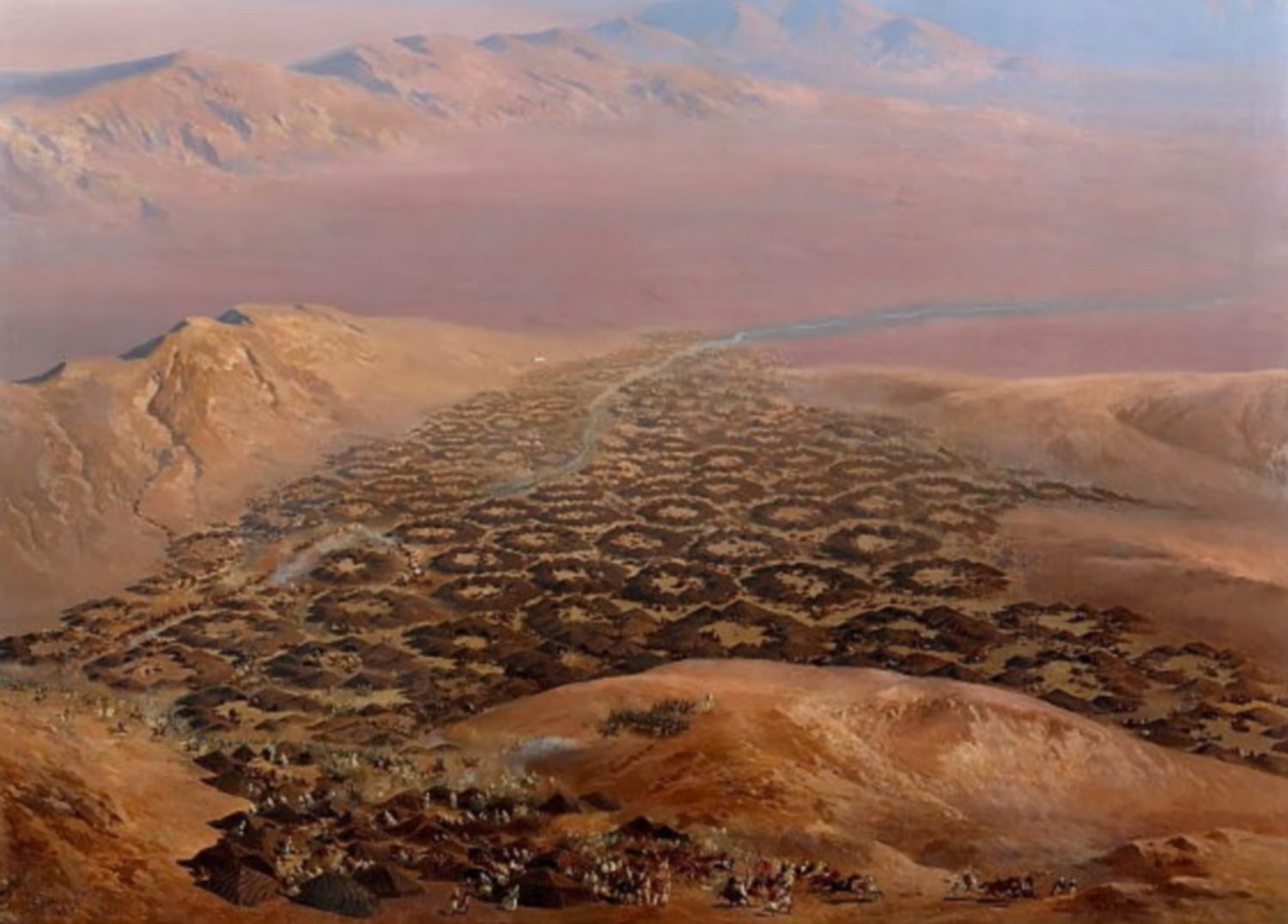
In the spring of 1843, tens of thousands of people — families, artisans, merchants and soldiers — moved across the high plains of Algeria. They travelled with their herds, their workshops, their treasury and their administration. They were not simply refugees. They belonged to the Zmala (an entourage or encampment; Arabic: زمالة), pronounced Zméla in Algerian Arabic and widely known by its French spelling, Smala. Together they formed something that had no neat European equivalent: a mobile wartime polity that made sovereignty portable when fixed territory could no longer be held.
The Zmala is often described as a “tent city” or “mobile capital”. Neither phrase is quite sufficient. At its height, it was simultaneously a refuge for families, a travelling administration, a treasury, a market, a workshop complex, a means of maintaining political alliances, a military support base and the most visible embodiment of Abdelkader’s authority. It is one of the more remarkable — and misunderstood — institutions to emerge from the 19th-century Franco-Algerian war.
Who was Emir Abdelkader?
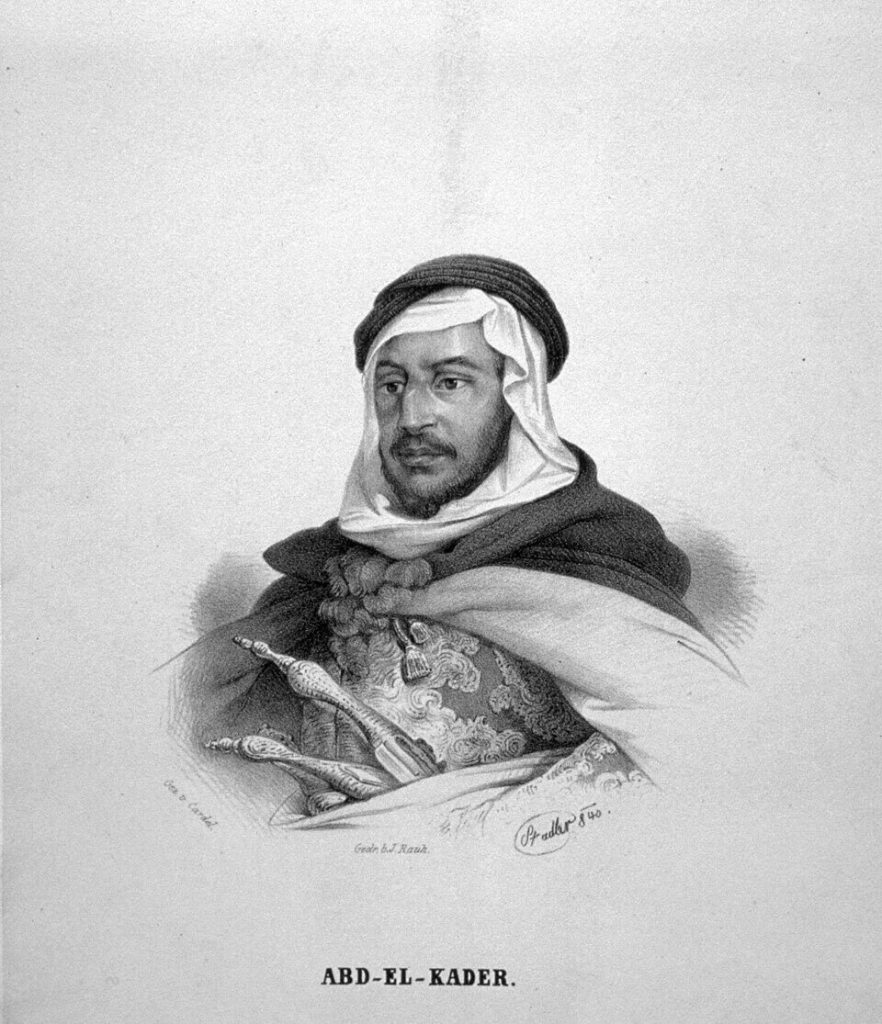
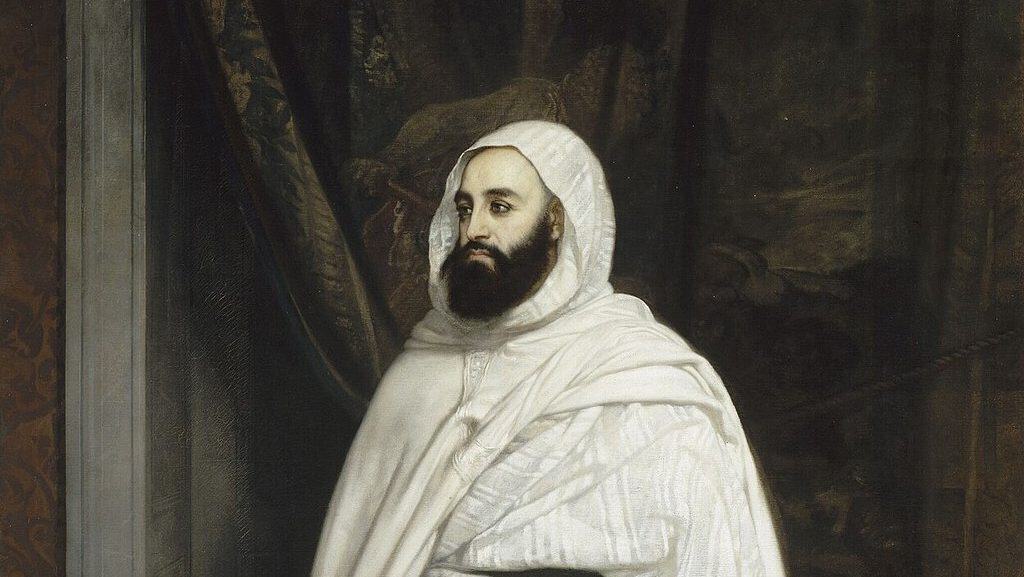
Emir Abdelkader (1808–1883), also known as ʿAbd al-Qadir ibn Muhyi al-Din, emerged from a respected religious family in western Algeria and was proclaimed emir in 1832. His movement combined armed resistance with political construction: alliances, taxation, judicial authority, provincial deputies, regular troops and an administrative apparatus all helped extend his authority beyond his original regional base. An Algerian study of Abdelkader’s state-building examines his efforts to establish political institutions under the pressure of French conquest, while historian Masouda Yahiaoui’s research focuses on the Zmala as the mobile organisational centre of his resistance.
Agreements with France, particularly the Treaty of Desmichels in 1834 and the Treaty of Tafna in 1837, temporarily gave Abdelkader room to consolidate his position. But by the early 1840s, the strategic balance had shifted. The French increasingly used fast-moving columns to penetrate the interior and attack the material foundations of resistance — settlements, stores, herds, crops, tribal encampments and communications. As French forces destroyed or occupied bases such as Tagdemt, Saïda and other centres, Abdelkader’s people, wealth, administration and military support functions had to become mobile.
The Zmala was born of that necessity.
Not an army camp — a society on the move
It is important to understand what the Zmala was not. It was not originally conceived as a giant army camp. Charles Henry Churchill, whose 1867 biography was based on months of personal interviews with Abdelkader in Damascus, described it as an aggregation of private households containing tribal families, property, herds, the elderly, the sick, women and children, organised into large sections and protected by regular and tribal forces. Contemporary French accounts often emphasised its military character, but Churchill’s later account, informed by Abdelkader himself, reveals a more complex social institution.
Churchill’s account reveals a more human origin story. Tribes attached to Abdelkader sent valuables, herds, women, children, old people and the sick to this moving place of relative protection. In that sense, it functioned somewhat like a vast evacuation community. But the institution evolved beyond that initial protective purpose: once the families and property of important tribes and officeholders were gathered around Abdelkader’s political centre, their presence also reinforced loyalty. Churchill explicitly recognised this double character — sanctuary and political instrument.
The word itself requires care. French 19th-century texts alternate among smala, smalah and zmala. In North African usage, the term could refer broadly to an important leader’s entourage or encampment. Abdelkader’s institution became so famous that, in French, the word smala eventually acquired the colloquial sense of a large family or sprawling entourage — a linguistic afterlife in which the original Algerian institution’s political significance was largely forgotten.
A population in the tens of thousands
How many people lived in the Zmala? The honest answer is that its exact population cannot be stated as a single number. Estimates from different sources vary considerably:
Churchill speaks of more than 20,000 people. A near-contemporary French intelligence-derived description, published in L’Illustration (The Illustration) in July 1843, counted 368 douars (tent-based residential groupings) and used a rough formula that implied more than 30,000. Abdelkader himself, recalling the Zmala to Churchill in 1859–60, said the population at the time of the 1843 attack could not have been less than 60,000, although this included groups dispersed across a wide area extending from Taguin towards Djebel Amour.
These are not compatible census results — they count different things, use different assumptions, and may refer variously to the core encampment or to the much wider population attached to it. The safest conclusion is “tens of thousands”, although the number assembled at any one location remains uncertain.
What is clear, however, is that this was a community made up predominantly of civilians. The 1843 French description placed approximately 450 regular infantry and artillery personnel immediately with the Zmala, alongside other armed tribal groups; Churchill specifically lists women, children, old people, the sick, property and livestock as part of what the tribes entrusted to it.
How the Zmala was organised
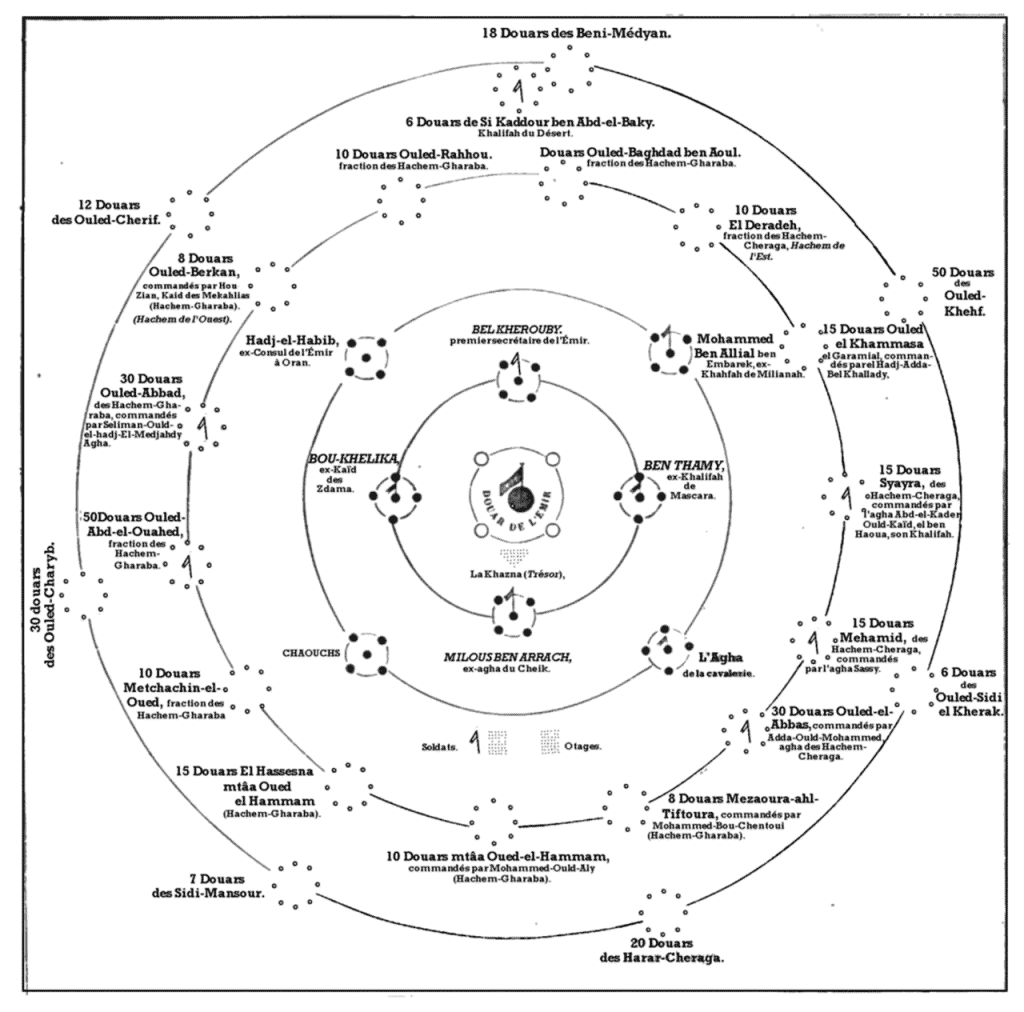
The best surviving schematic representation divides the Zmala into four major groupings or enclosures, based on a plan derived from French intelligence and published in L’Illustration. The historian Xavier Yacono, working from French National Archives records, cautioned that the published drawing was too regular and too schematic, though he considered it valuable for showing the relative position of leaders, families and principal groups. It should be read as an intelligence diagram of social and political organisation, not as a surveyed street plan.
At the centre was the Emir’s own douar and the tents associated with senior figures in his government and household. French descriptions name men including Mustapha ben Thami, Abdelkader’s brother-in-law and a former khalifa (provincial deputy or governor) of Mascara, as well as important counsellors and secretaries such as Miloud ben Arrache and Bel Kharoubi. A second grouping included the household and standard of Mohammed ben Allal ben Embarek, formerly khalifa of Miliana, together with other officers and guards.
A third major area was identified with Abdelkader’s Hachem tribal constituency, divided into the Hachem Cheraga (eastern branch) and Hachem Gharaba (western branch). The fourth grouping consisted broadly of tribes from the southern or desert regions attached to Abdelkader.
An additional perspective comes from the Arabic history written by Abdelkader’s son, Muhammad, and published in 1903. He described a deliberately organised encampment, with spaces allocated to the Emir’s household, military workshops, stores and assemblies, while traders and market activities occupied a separate area. Although written decades after the events and shaped by family loyalties, his account reinforces the picture of a planned political and social institution rather than an improvised military camp.
Daily life: markets, crafts and the challenge of water
The Zmala supported a remarkable range of trades. Both French intelligence and Abdelkader’s own later recollections mention armourers or gunsmiths, farriers, saddlers and tailors; the French description adds jewellers. Abdelkader told Churchill that virtually every trade necessary to the community could be found there and described the Zmala as hosting a large market or fair frequented by people from the Tell (the fertile northern cultivated belt).
Markets were crucial because a moving population of tens of thousands could not live solely from what it carried. Abdelkader recalled grain, including barley, arriving from, or being procured among, northern tribes. French observers similarly reported active markets and regular arrivals of outsiders — chiefs with entourages, couriers, traders and people seeking news. The movement of information was almost as important as the movement of grain: the Zmala served as an intelligence and communications node linking Abdelkader’s dispersed coalition.
There are revealing fragments about social organisation. Churchill notes that women taken prisoner during the conflict were normally sent to the Zmala under the supervision of Abdelkader’s mother, showing that senior women of the Emir’s household exercised at least some responsibilities within its domestic sphere.
Another episode, preserved in the later Arabic history written by Abdelkader’s son, offers a glimpse of women’s influence during periods of crisis. Following a subsequent engagement, rumours spread that the Emir had been killed. His sister, Lalla Khadija (Lady Khadija), reportedly reassured his distressed followers, urged them to protect his family and encouraged them to remain steadfast. Although retrospective, the account suggests that women of the Emir’s household could exercise responsibilities extending beyond domestic life. These details, however, are isolated: we do not possess comparable evidence explaining women’s work, childcare, food preparation, property management or household authority in systematic detail.
Water management may have been the hardest recurring problem. Abdelkader later said that wells and streams could be exhausted and that policing was necessary to stop people muddying or wasting water. He claimed deaths from thirst occurred despite such precautions. For a community containing thousands of horses, pack animals and livestock in addition to tens of thousands of human beings, a water source adequate for a normal caravan could be depleted rapidly.
The animal population was correspondingly diverse. Churchill names camels and dromedaries, horses, mules, oxen and sheep amid the chaos of the 1843 raid. Horses provided fighting mobility and elite transport; camels and mules carried loads; sheep and cattle represented food, wealth and transferable capital.
The raid at Taguin: spectacle versus substance
On 16 May 1843, at Taguin, a French-led force commanded by the 21-year-old Henri d’Orléans, duc d’Aumale, surprised a major concentration of the Zmala while Abdelkader was absent. The French pursuit depended heavily on local intelligence. According to Abdelkader’s son’s Arabic history, Omar al-Ayyadi tracked the Zmala’s movements, while Yacono’s archival research identifies Ahmeur ben Ferhat of the Ouled Ayad among those who provided information to the French. Approximately 500 cavalrymen, including locally recruited spahis (cavalry soldiers serving under French command), took part in the decisive attack. The camp was overrun, thousands fled, and large quantities of animals, money, property, manuscripts and symbols of authority were seized.
The human consequences extended well beyond the raid itself. Yacono’s examination of French administrative records identifies approximately 3,600 prisoners taken to Algiers, most of them women and children. The authorities separated politically important captives from the wider population, detained them in different locations and subsequently transferred some to France, including Île Sainte-Marguerite. His research reveals how the raid became not only a military operation but also an episode of displacement, detention and family separation.
The raid was more politically and psychologically important than the heroic French “battle” legend suggests. It did not destroy Abdelkader’s army, because he and many combatants were elsewhere. Nor did it immediately end the Zmala’s existence. The Arabic history written by his son describes its subsequent movements through western Algeria and towards the Moroccan frontier. Nevertheless, the community never fully recovered its former scale and influence. Abdelkader continued the war for more than four years and even experienced a significant resurgence in 1845. Yet Taguin damaged his ability to protect allied families and property, encouraged defections, removed resources and punctured the aura of security on which his coalition depended.
Churchill, drawing heavily on Abdelkader, regarded the moral effects as severe. Tribes had seen that Abdelkader could no longer guarantee the security of families and property entrusted to him, and defections accelerated. The raid also removed money, animals, political hostages, senior families and administrative resources. Its military significance lay less in destroying fighting troops than in damaging the coalition infrastructure that made continued resistance possible.
Taguin should therefore be understood as a major stage in the erosion of Abdelkader’s political system, not the decisive battlefield in which his resistance ended. He ultimately surrendered in December 1847.
Horace Vernet’s 21-metre painting: how conquest became spectacle
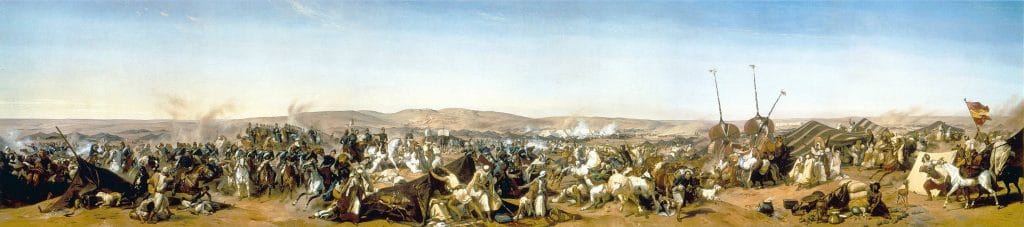
The most famous visual representation of the Zmala’s capture is Horace Vernet’s monumental Prise de la smalah d’Abd-El-Kader à Taguin, 16 mai 1843 (The Capture of Abdelkader’s Smala at Taguin, 16 May 1843), painted for Louis-Philippe’s Versailles historical programme. The canvas is astonishingly large — about 4.89 metres high by 21.39 metres wide — and was designed to dominate an entire room.
It is magnificent evidence for French memory of the raid, but dangerous evidence for the raid itself. The official French Histoire par l’image (History through Images) analysis explicitly interprets the picture as royal propaganda: it magnifies the young prince’s courage, crowds the canvas with dramatic encounters, and helps create an impression that the conquest was a series of heroic accomplishments by Louis-Philippe’s sons. The same analysis notes that the military importance of the episode was relatively limited compared with the visual importance later bestowed on it.
In 19th-century French representations of the conquest, “the taking of the Smala” became an iconic Algerian victory scene. Vernet’s enormous Versailles panorama is largely responsible. Its physical scale converts a fast cavalry raid against an encampment into an imperial epic, and the prominence of Aumale links conquest directly to the Orléans monarchy. A smaller 1847 painting by Hippolyte Bellangé, now at the Musée Condé at Chantilly, shows how quickly the subject became a repeatable icon of French military painting.
The 21-metre painting is itself part of the historical evidence — not principally evidence of what happened, but evidence of how conquest was turned into spectacle.
The Zmala’s place in Algerian memory
In Algerian national memory, Abdelkader came to occupy a far larger place than the Zmala alone. His image was repeatedly reinterpreted under colonial rule and by anticolonial nationalists. Algerian scholars have examined both the portrayal of Abdelkader in French colonial historiography and the construction of his image through literature and art. His transformation into a national hero was neither automatic nor free from competing interpretations. The Zmala sits within that broader narrative as evidence that Abdelkader did more than command guerrilla bands: he maintained an organised society and political apparatus under the pressure of conquest.
Globally, the Zmala itself has had a narrower legacy than Abdelkader, who later became internationally known for dimensions of his life that extended well beyond the Algerian war — including his protection of Christians during the 1860 Damascus massacres. The broader significance of the Zmala today is therefore analytical: it is an unusually clear example of how a 19th-century anti-colonial polity could make people, administration, commerce and military support mobile when sustained control over fixed administrative centres became increasingly difficult.
What we still do not know
The greatest social-history gaps concern women, children and ordinary labour. We know they were numerous, that senior women could hold responsibilities, that pregnancy and childhood made movement particularly dangerous, and that the camp contained specialised trades. We do not know enough about household divisions of work, marriage and kinship inside the moving camp, how schooling and medical care were provided, birth and death practices, pricing in its markets, or how ordinary residents experienced life within the Zmala.
The documentary record is structurally unbalanced. French officers, Arab Affairs officials, newspapers, artists and archives generated abundant documentation immediately after the victory. Algerian voices survive much less evenly: Abdelkader’s own detailed recollections were recorded later through European intermediaries; Arabic family histories, including that written by his son Muhammad, are retrospective; the experiences of ordinary women, children, artisans and pastoral families were scarcely written down at the time. Muhammad’s account provides an important perspective from within Abdelkader’s household, although it was compiled decades later and also drew on European historical material.
There is no symmetrical archive in which an ordinary Hachem woman, an armourer, a camel driver, a child or a southern tribal family left a day-by-day account comparable to French officers’ reports. That does not make French sources unusable, but it means their abundance must not be confused with neutrality.
The greatest opportunity for future research lies in a critical study that systematically juxtaposes Arabic family histories, surviving correspondence, Algerian oral traditions and French operational archives. On present evidence, the best concise description of the Zmala is therefore not “Abdelkader’s army camp” or simply “his capital”, but a mobile wartime polity: tens of thousands of people sustaining a threatened political order as they moved across the Algerian landscape.