

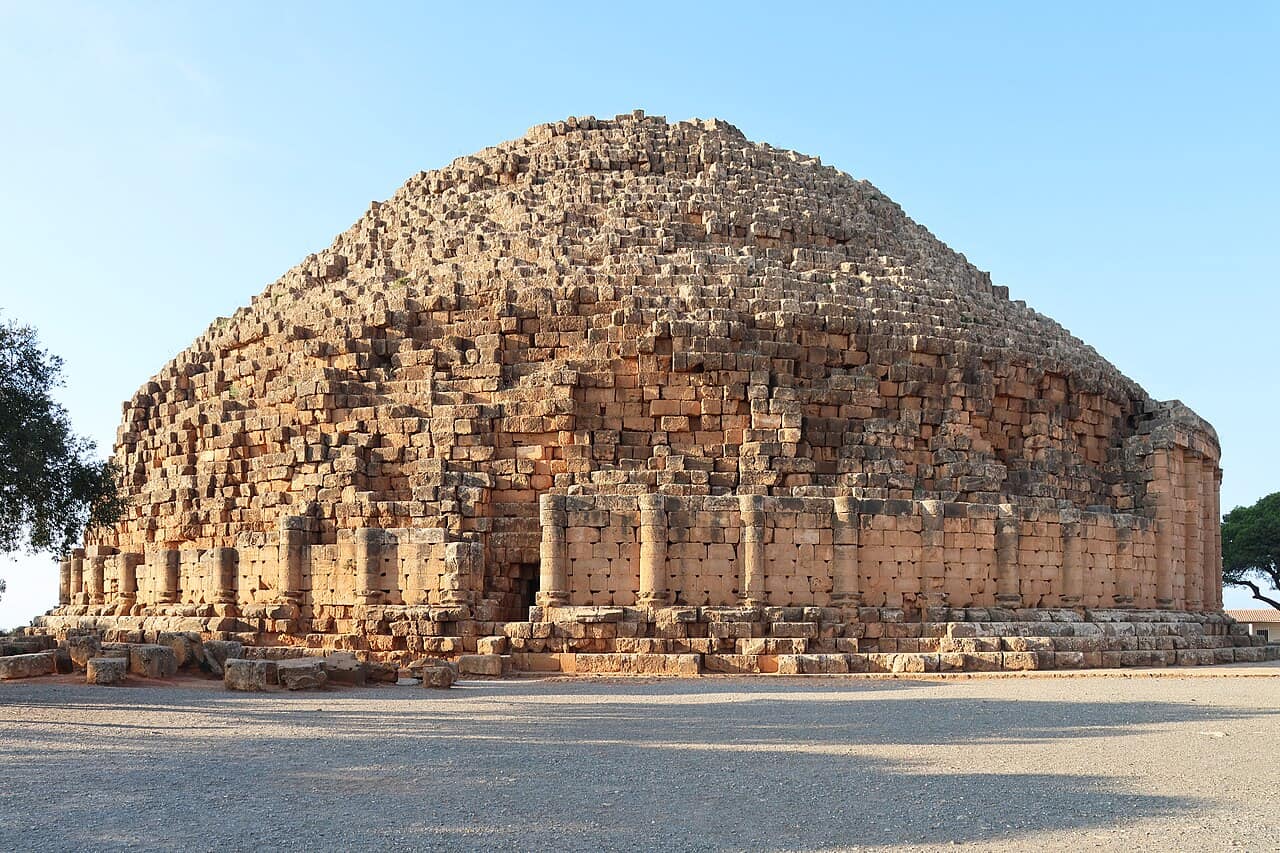
On a hilltop plateau about 70 kilometres west of Algiers, there is a circular stone tomb the size of a small stadium. It has been standing for roughly two thousand years. Scholars have argued about who built it, and who is buried inside, for almost as long as they have known it existed. No consensus has ever held for long.
This is the Royal Mausoleum of Mauretania — known in French as the Tombeau de la Chrétienne, and in Arabic as قبر الرومية (qabr al-rūmiyya). It sits near the commune of Sidi Rached, about 11-13 kilometres south-east of the ancient coastal town of Tipasa, and forms part of the UNESCO World Heritage property of Tipasa (which includes indigenous monuments such as the mausoleum). From the road below, and even from the sea, you can see it clearly on the skyline — which is exactly how it was meant to be seen.
Built to Last, Built to Be Seen
The mausoleum is a genuinely imposing structure. Its circular base spans around 60 metres across. Above the base, 60 engaged Ionic columns ring the drum. Above those, a stepped cone of 37 steps rises to approximately 32 metres — topped by a platform that once may have held a pyramid or a sculpture. The whole thing sits on a square stone platform roughly 63 metres per side, on a hilltop over 250 metres above sea level.
Four false doors face the four cardinal directions. Their stone mouldings form what looks like a large cross — which is where one of the monument’s popular names comes from.
The building draws on multiple architectural traditions at once: the stepped tumulus form used by ancient North African royal tombs, combined with Hellenistic stylistic touches. UNESCO describes it as a product of “indigenous civilizations” in contact with the broader Mediterranean world — not a Roman monument, not a Greek one, but something that belongs specifically to this region and this moment in history.
What’s Inside
The entrance to the tomb was unidentified — concealed beneath the eastern false door — and it stayed hidden until 1865, when the French archivist and archaeologist Adrien Berbrugger finally cleared it open. The event was treated as a major occasion: the Governor-General of Algeria attended, and dignitaries descended into the tomb together for the first time in living memory.
What Berbrugger found inside was a network of low corridors fitted with heavy stone doors, raised by a mechanism he compared to a portcullis. The passages wind for around 150–170 metres in total, leading eventually to a central vaulted chamber.
The most memorable feature along the way is a carved lintel showing a lion and a lioness — the only prominent sculptural feature consistently recorded inside the entire tomb, and the feature that gave the inner chamber its name: the Caveau des Lions, the Lion Chamber. Berbrugger noted that some of his contemporaries speculated the paired animals might be a reference to Cleopatra Selene, but he was careful to present this as just that; speculation.
The Name Problem
The monument has three names, and all three are slightly misleading.
The Arabic qabr al-rūmiyya translates roughly as “tomb of the Roman woman” or “tomb of the Christian woman.” In classical Arabic, rūm referred to Romans, then Byzantines, and eventually Christians more broadly — so the name probably reflects how later communities made sense of a mysterious ancient monument, not any verified history about a Christian burial. The French Tombeau de la Chrétienne appears to be a colonial-era translation of this Arabic name rather than an independent historical claim.
The official name — Royal Mausoleum of Mauretania, Mausolée royal de Maurétanie — is the one used by UNESCO and Algerian heritage authorities. Mauretania here refers not to the modern country of Mauritania, but to the ancient Amazigh (Berber) kingdom that once covered much of north-western Africa.
So Who Is Actually Buried Here?
This is the question everyone asks, and the answer is genuinely uncertain.
The most popular theory links the tomb to Juba II and Cleopatra Selene II — the king and queen of Mauretania, whose court was closely tied to Rome and whose capital was at Caesarea Julia, the city now known as Cherchell. During Berbrugger’s excavation, workers found a bronze coin bearing the name “REX IVBA” — King Juba — in debris that appeared to date from the tomb’s construction. It is one of the most tangible pieces of evidence connecting the monument to that royal couple.
But scholars have pushed back. The Encyclopédie berbère, a major reference work on North African history and culture, argues that the tomb’s architectural style points to an earlier date than Juba II’s reign — probably the 1st century BCE, making it more likely the burial place of the Amazigh kings who came before Juba, before 25 BCE. The entry concludes plainly: “the question remains open”.
The Roman geographer Pomponius Mela, writing in the 1st century CE, called it the monumentum commune regiae gentis — the “communal tomb of the royal family” — without naming anyone specifically. Which tells us it was considered a royal monument, and not much else.
What most specialists emphasise is that the monument’s core form belongs to an indigenous North African royal funerary tradition. The core form — a large circular stepped mound — belongs to an Amazigh royal funerary tradition that existed before Rome arrived in the region. Whatever outside influences shaped the details, the mausoleum belongs first and foremost to the people who were already here.
Two Thousand Years of Damage
The monument has survived, but not without taking a battering.
A particularly destructive episode is reported for the late 17th century, when the exterior stone was systematically dismantled to recover the lead clamps holding the facing together, which was then melted down for bullets. Lower sections of the structure largely escaped because they were harder to strip without demolishing everything. The removal of those clamps weakened the masonry significantly and contributed to later collapses. An earlier episode, from the mid-16th century, involved treasure-seeking during the Ottoman period.
The monument was classified as a historic site in Algerian heritage registers in 1900 and again in 1959 and has been part of the UNESCO World Heritage property of Tipasa since 1982. In 2002, Tipasa was placed on UNESCO’s List of World Heritage in Danger due to urban development pressures, unregulated tourism, and conservation problems. It was removed from that list in 2006 after Algeria committed to a series of remediation measures.
UNESCO’s 2024 State of Conservation entry notes ongoing issues including vandalism, rubbish accumulation, vegetation, and illegal construction pressures. The response has included reinforced fencing, solar lighting, anti-intrusion systems, and new visitor infrastructure — trails, turnstiles, an audio guide. Significantly, a project is currently underway to open the mausoleum itself to the public, meaning interior access that has long been restricted may soon be available.
Still Standing
There is something quietly striking about the fact that this monument has been here for around two thousand years, and we still cannot say with confidence whose tomb it is. The coin, the lion carving, the architectural clues — all of it suggestive, none of it conclusive.
What is clear is that someone, at some point in the late 1st century BCE, had the vision and the resources to build something this large, this carefully considered, and this durable on a hilltop above the Mediterranean. That it was a royal monument is not in doubt. That it belongs to the long history of Amazigh North Africa is not in doubt either.
The name we call it by may be a colonial translation of an Arabic phrase that was itself a guess. The identity of whoever is buried inside remains open. But the monument itself is not going anywhere — and for now, that feels like enough.