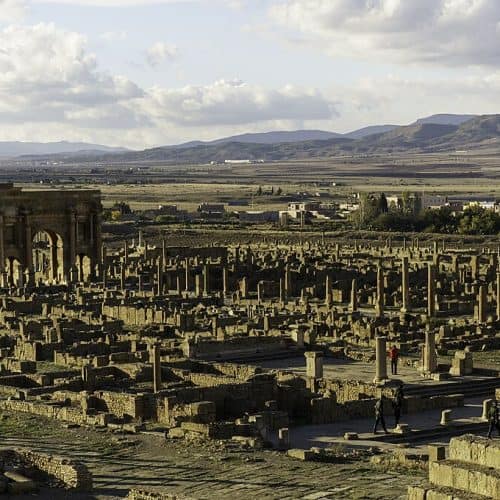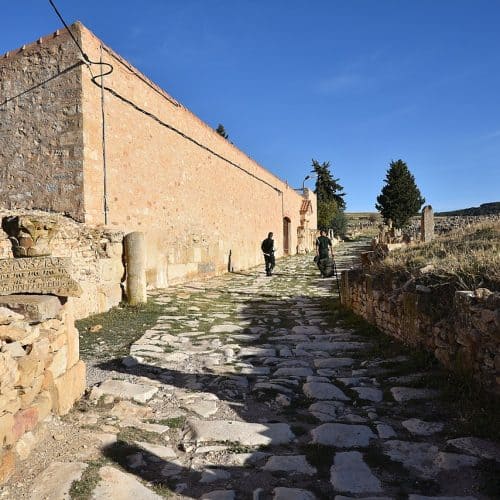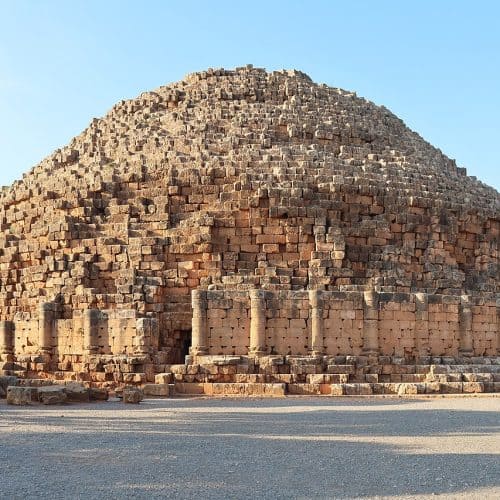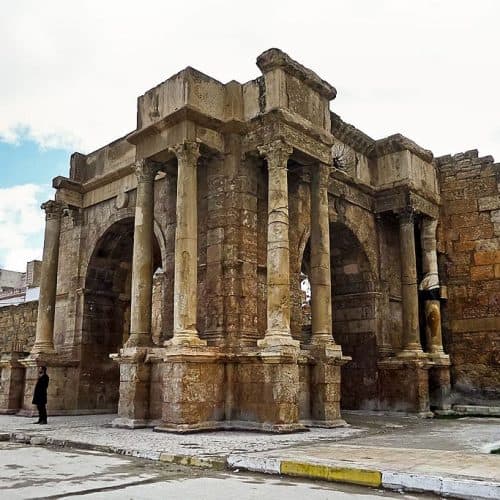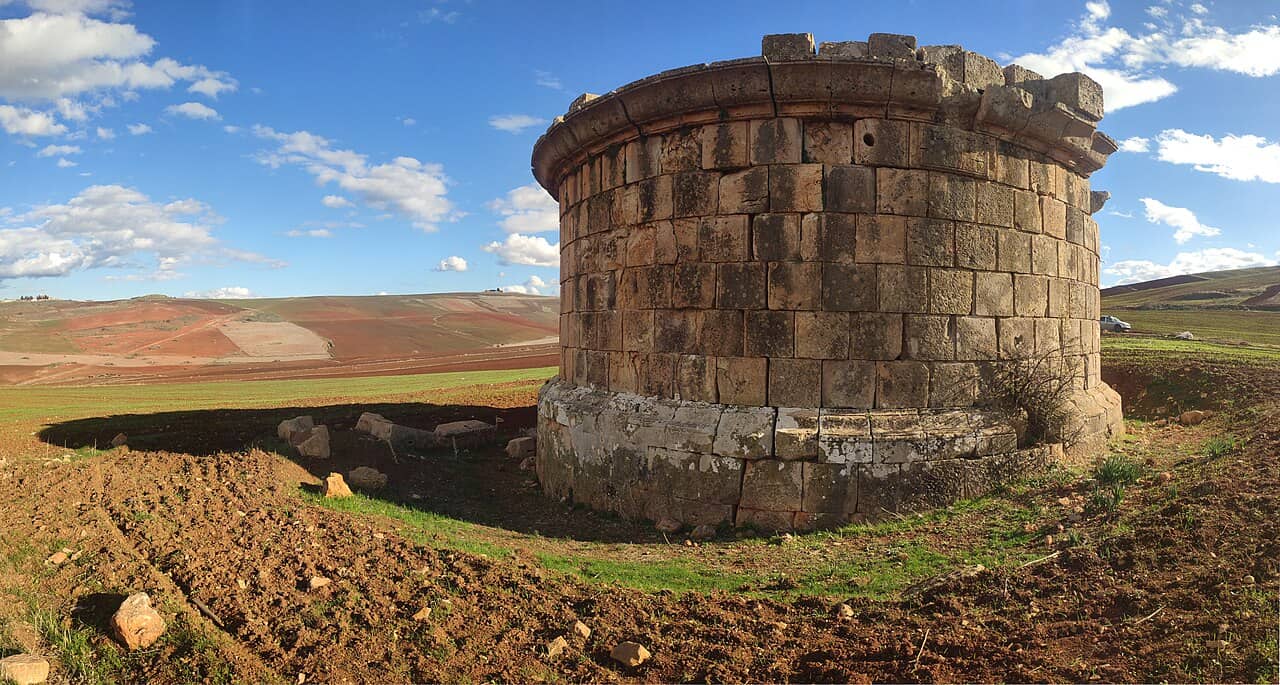
A few kilometres from the ruins of ancient Tiddis, a fortified settlement perched above the gorges of the Khreneg in what is now north-eastern Algeria, a cylindrical stone monument has stood for nearly two millennia. Known as the mausoleum of Lollius Urbicus, it commemorates the family of a man who rose from the Roman provinces to command one of the empire’s most strategically important frontiers, and whose name is carved into the archaeology of Scotland more than 2,000 kilometres away.
Quintus Lollius Urbicus is among the most striking examples of social and geographical mobility in the ancient Mediterranean. Born probably shortly after 100 CE in the territory of Cirta — modern Constantine — he climbed the ranks of the Roman state to become consul, governor of Britain, and ultimately praefectus urbi (prefect of Rome itself): one of the most powerful offices a senator could hold. His career inscription, discovered at Tiddis, reads like an ancient CV. His family monument, recognised as protected Algerian cultural heritage, still stands near the site where it was erected. And in central Scotland, building inscriptions from the Antonine Wall — now part of a UNESCO World Heritage Site — name him explicitly as the governor under whose authority sections of that frontier were constructed.
His story connects two edges of the Roman world. It also raises important questions about identity, belonging and what it meant to be both provincial and powerful in the ancient Mediterranean.
A family from the Cirtan hinterland
Urbicus’s homeland lay within the orbit of Cirta, a former capital of the Numidian kingdom and one of the most important cities in Roman North Africa. Tiddis, formally known as Castellum Tidditanorum, was a fortified settlement within a distinctive civic system that modern scholars call the Cirtan Confederation: a network of colonies and dependent towns with a rich epigraphic culture and a local elite increasingly integrated into the institutions of imperial power. The region produced jurists, senators, generals and public intellectuals; among the most celebrated of Urbicus’s near-contemporaries was the rhetorician Marcus Cornelius Fronto, tutor to emperors Marcus Aurelius and Lucius Verus. Research on the Cirtan elite reveals a network of influential North African families whose wealth, political connections and imperial patronage helped them reach the highest levels of Roman government.
Archaeology at Tiddis reveals a site of layered complexity: indigenous Libyan inscriptions and symbols, local pottery traditions, Roman-style urban structures and substantial funerary monuments. Algerian archaeological research documents the persistence of indigenous cultural elements alongside Roman-period development. It is a particularly good illustration of why “Romanisation” should not be imagined as the instant replacement of one culture by another.
The family inscription CIL VIII 6705, commissioned by Urbicus himself while serving as prefect of Rome, names his father as Marcus Lollius Senecio, his mother as Grania Honorata, his brothers as Marcus Lollius Honoratus and Lucius Lollius Senex, and his maternal uncle as Publius Granius Paulus. No member of the family is known to have held senatorial rank before him. In Roman terms, this made Urbicus a novus homo (new man) — the first member of his family to reach the senatorial elite. His advancement was exceptional, although success in Roman public life depended not only on ability and service but also on wealth, influential connections and imperial favour.
A separate inscription, CIL VIII 6706, records his career. Erected at public expense by decision of the town council of Tiddis, it honoured Urbicus as the community’s patronus (patron). This tells its own story. His connection to the region was not merely a matter of birthplace or family background: the community publicly celebrated its association with a man who had reached the highest levels of imperial government.
Climbing the imperial ladder
Urbicus’s rise under the emperor Hadrian was steady and marked at each stage by institutional endorsement. He served as a junior magistrate responsible for maintaining Rome’s streets (quattuorvir viarum curandarum), then as military tribune with Legio XXII Primigenia at Mogontiacum, modern Mainz. After further appointments as quaestor and legate to the proconsul of Asia, he received imperial backing for the tribunate of the plebs and the praetorship — a visible sign of powerful support for his advancement.
He then took command of Legio X Gemina at Vindobona (modern Vienna) and served as an imperial legate during the Bar Kokhba revolt of 132–135 CE, a major Jewish uprising against Roman rule in Judaea that was suppressed with devastating consequences. His Tiddis career inscription records that he was rewarded with a hasta pura (ceremonial spear) and a corona aurea (golden crown) for his service. He became consul around 135–136 CE and subsequently served as governor of Germania Inferior (Lower Germany).
Britain: war, conquest and a new frontier
Urbicus arrived in Britain very soon after Hadrian’s death in July 138, appointed by the new emperor Antoninus Pius. Building inscriptions at Corbridge, south of Hadrian’s Wall, securely date his governorship to 139 and 140. Further epigraphic evidence from High Rochester, north of the wall, provides evidence of Roman military activity farther north along the Dere Street corridor — consistent with a governor pushing into territory Rome had previously withdrawn from, rather than merely administering a static border.
The Historia Augusta, a late Roman biographical compilation, compresses the entire operation into a single sentence: Antoninus “defeated the Britons through Lollius Urbicus, and another wall of turf was built after the opposing peoples had been pushed back” (Life of Antoninus Pius, 5.4). The compilation is late and sometimes unreliable on detail, but its central claim — victory and construction of a turf wall — is independently supported by inscriptions and archaeology.
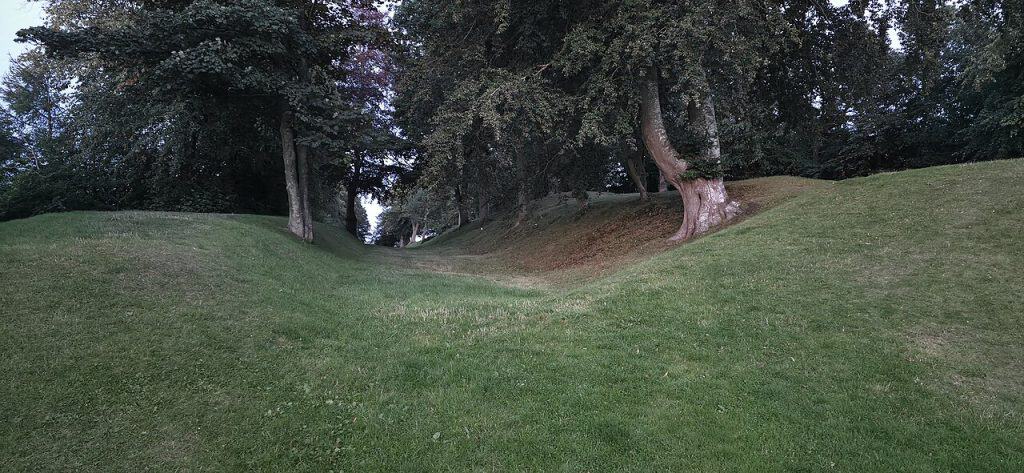
By around 142, Roman forces had reached the Forth–Clyde isthmus, and construction began on the Antonine Wall: a roughly 60-kilometre frontier stretching from Bridgeness, near Bo’ness on the Forth, to Old Kilpatrick on the Clyde. Its principal barrier was a turf rampart built on a stone foundation, accompanied by forts, fortlets, a large ditch and a military road. Inscriptions from Balmuildy name Legio II Augusta as constructing part of the frontier “under Quintus Lollius Urbicus, imperial propraetorian legate”.
Antoninus Pius took the title imperator (victorious commander) for a second time in recognition of the victory, and a series of coins depicted the personification of Britannia — celebrating not Urbicus by name, but the emperor’s British achievement. One such coin is preserved in the British Museum. This was standard Roman practice: imperial propaganda concentrated credit upward. Fronto, the Cirtan-born rhetorician, praised Antoninus for the British war despite acknowledging that the emperor had directed operations from Rome. His praise is known through a later Roman panegyric, which preserves an account of Fronto’s argument. Urbicus was the commander on the ground; the glory, officially, was Antoninus’s. The campaign may also have served the new emperor’s political interests: as the Scottish Archaeological Research Framework explains, Antoninus lacked the military experience and reputation of his predecessor.
It is worth noting what the Antonine Wall was and was not. It was not a personal monument to Urbicus. It was a military frontier built by the Roman army under imperial orders, following campaigns that brought territory inhabited by peoples outside Roman rule under imperial occupation. Its design changed during construction. Historic Environment Scotland describes it as Rome’s most northerly frontier, occupied for only about a generation before the main line shifted back to Hadrian’s Wall. Militarily, Urbicus succeeded in pushing Roman power farther north; strategically, the conquest did not endure. Within roughly two decades, Roman military priorities had shifted and Hadrian’s Wall again became the principal frontier.
Return to Rome and the urban prefecture
After leaving Britain, probably shortly after the victory of 142, Urbicus attained the urban prefecture at Rome, perhaps beginning around 146. This was the pinnacle of a senatorial career: the prefect held major judicial and policing authority over the imperial capital, making him one of the most powerful officials in Rome.
Two literary sources preserve glimpses of Urbicus in this role, and they could hardly be more different. In his Second Apology, the Christian writer Justin Martyr describes proceedings “under Urbicus” in which a Christian teacher named Ptolemaeus was condemned and executed after acknowledging his faith. Justin portrays the judgement as an injustice and uses the case to criticise the persecution of Christians. The North African writer Apuleius, writing from a quite different perspective, invokes a judgement by Lollius Urbicus in a legal dispute. In his Apology, a defence against accusations of practising magic, Apuleius recalls how Urbicus had previously upheld the authenticity of a contested will, rejecting an allegation made by one of Apuleius’s accusers. He presents the prefect’s earlier judgement as an authoritative precedent supporting his own defence.
The two accounts are not necessarily contradictory. They reflect how the same Roman official could appear from different vantage points — an instrument of persecution in Justin’s account, an authoritative judicial figure in Apuleius’s. Neither provides a complete or impartial picture of his character.
Urbicus was certainly alive and active around 150 CE. A damaged entry in the Fasti Ostienses (Ostian records of magistrates and public events) has been conjecturally restored as recording his death in 160, but the identification is uncertain. No surviving evidence securely identifies a wife, children or descendants. His exact death date, like his exact birth date, remains unknown.
The question of identity
Popular accounts sometimes describe Urbicus as “Berber”, “Amazigh” or “Algerian”. Each of these labels carries modern connotations that the ancient evidence cannot fully support.
“North African” is secure geographically. “Roman” is secure politically and civically. “Numidian” is reasonable in the broad ancient-geographical sense. “Algerian” is useful for modern readers so long as it is recognised as retrospective — Algeria as a modern nation did not exist in the second century. Calling Urbicus Amazigh (Berber) is more complicated. Indigenous populations and Libyan (Libyco-Berber) language traditions formed an important part of ancient Numidian society, and Tiddis preserves clear pre-Roman and indigenous cultural traces. But no surviving source establishes Urbicus’s individual ethnic ancestry, records how he personally identified, or tells us what language he spoke at home. His thoroughly Latin nomenclature — shared by provincial families of varied backgrounds after receiving Roman citizenship — cannot settle the question either way. As the historian Mary Beard has cautioned, Berber ancestry is possible, but cannot be treated as certain.
Two countries, two memories
Urbicus occupies a distinctive place in modern memory precisely because his traces survive at both ends of the Roman world.
In Algeria, the cylindrical family mausoleum near Tiddis and the inscriptions associated with it form one of the most tangible links between the ancient Cirtan region and the summit of imperial power. The monument has also prompted questions about its original purpose. Although traditionally described as a mausoleum, Algerian archaeological research has suggested that it may have functioned as a cenotaph (a memorial without the remains of those commemorated) rather than an actual burial place. The monument’s internal structure and the inscriptions honouring Urbicus’s relatives support this interpretation, although its precise function remains uncertain. Recognised as part of Algeria’s protected cultural heritage, it represents not merely Roman imperial history but also the country’s own archaeological patrimony.
In Scotland, his most enduring monument is the Antonine Wall itself. Historic Environment Scotland names Urbicus as the governor responsible for the campaigns that preceded its construction and uses his story to illustrate the diversity of people who served in Roman Britain. Its research on African connections to the Antonine frontier also discusses North African-style pottery and other evidence suggesting the possible presence of people with links to North Africa. The Balmuildy inscriptions and other archaeological objects connecting his name to the construction programme are held in museum collections.
His modern memory differs between the two countries. In Scotland, the archaeological record places him within the history of Roman military expansion and the Antonine frontier. In Algeria, he is presented as the extraordinarily successful son of the Tiddis and Cirta region — a local figure who reached the highest levels of imperial government. Both perspectives are valid, but partial. His full significance lies precisely in connecting those worlds.
What the evidence allows us to say
The surviving record of Quintus Lollius Urbicus is both unusually rich and sharply limited. We know his parents and brothers but not what language he spoke at home. We know his military decorations but not his thoughts about the wars he fought. We know he governed Britain but not what he made of the place. We know a statue was erected in his honour at Tiddis because its inscribed pedestal survives, but the statue itself is lost, leaving no securely identified portrait of the man.
His career can be traced across an empire. The man behind it remains largely elusive.