

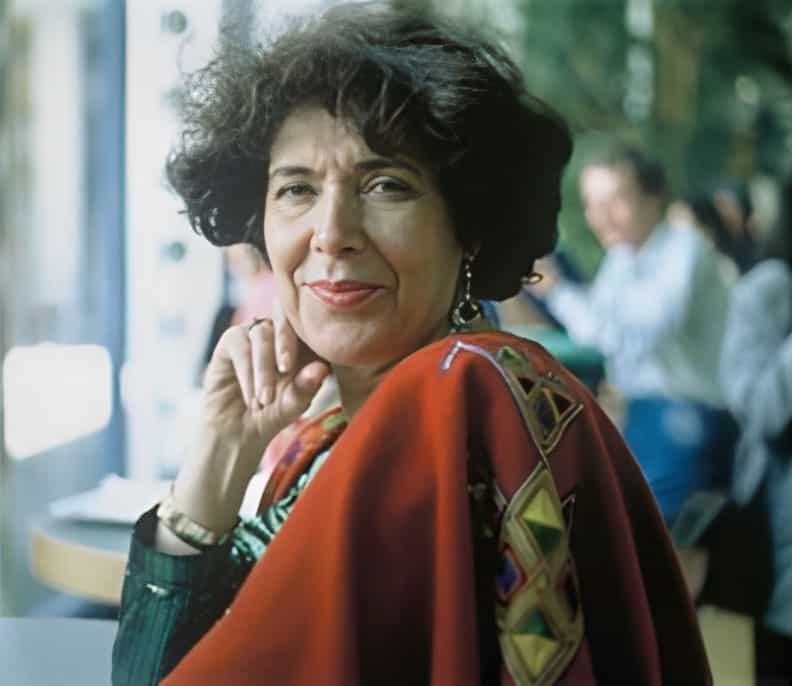
She wrote in French, the language of colonial power, to recover what colonial rule tried to erase. For six decades, Assia Djebar wove together women’s whispered testimonies, buried archives, and her own memories to build a body of work that changed how the world reads Algerian history.
A girl from Cherchell in the halls of French power
Fatma-Zohra Imalhayène — the name Assia Djebar would come later — was born on 30 June 1936 in Cherchell, a coastal town west of Algiers whose history reaches back to the ancient city of Iol, later Caesarea, capital of Mauretania. She grew up navigating two worlds: Qur’anic schooling and French colonial education, a duality that would mark everything she wrote.
Her trajectory was extraordinary for its time. In 1955, she became the first Algerian and the first Muslim woman admitted to the École Normale Supérieure de Sèvres near Paris. Two years later, at just 20, she published her debut novel, La Soif (1957), under the pen name Assia Djebar — a gesture of both reinvention and protection in a society where a young woman writing about desire courted controversy.
What followed was a six-decade career across novels, essays, short fiction, and film, during which Djebar became one of the most internationally recognised Algerian writers of her generation.
Writing against silence
Djebar’s great subject was absence — specifically, the absence of women’s voices from the official record. Colonial archives documented conquest from the conqueror’s perspective. Post-independence public narratives often celebrated women symbolically while leaving many of their lived experiences and voices at the margins. Djebar’s response was to build an alternative: a layered, polyphonic literature that placed women’s spoken memories alongside (and against) the written record.
Her most celebrated novel, L’Amour, la fantasia (1985), demonstrates this method at full stretch. The book interweaves accounts of the French conquest of Algiers beginning in 1830 with the semi-autobiographical story of an Algerian girl’s formation within the colonial school system, and with oral testimonies from women who lived through the war of independence. The result is not a conventional historical novel but something closer to a collage — fragments of military dispatches, personal memory, and voices recorded from the Chenoua region stitched into a fabric that exposes what each source alone cannot say.
This polyphonic approach — staging multiple voices, registers, and time periods within a single text — became Djebar’s signature. In the short-story collection Femmes d’Alger dans leur appartement (1980), she reworks the cultural iconography of Delacroix’s famous painting to ask a pointed post-independence question: what freedom did women actually gain? In Le Blanc de l’Algérie (1995–1996), she mourns friends and intellectuals killed during the violence of the 1990s, turning personal grief into a collective act of memory against forgetting.
The camera as a different kind of pen
Djebar did not limit herself to the page. In the late 1970s, she turned to filmmaking as a way to explore voice, silence, and memory through image and sound.
Her film La Nouba des femmes du Mont Chenoua (1978) centres on women’s memories of the war of independence in the Chenoua mountains west of Algiers. It won the FIPRESCI critics’ prize at Venice in 1979 — a significant achievement for any filmmaker, and especially for an Algerian woman working in a film culture where women directors were still exceptionally rare.The film’s interplay of spoken testimony, archival footage, and silence fed directly back into her later prose, giving it a montage-like rhythm that critics have noted as distinctly cinematic.
The paradox of language
A question shadows Djebar’s entire career: why write in French?
For an Algerian writer born under colonial rule, French was never a neutral instrument. It was the language of the occupier, the language in which conquest was justified and administered. Yet it was also, for Djebar, the language in which she had been educated, the language through which she could reach international audiences, and — crucially — a space in which she could preserve women’s testimonies that risked slipping out of both official public narratives and the colonial written record.
Djebar addressed this tension directly in her essays, notably in Ces voix qui m’assiègent (1999), a collection of lectures on writing, language, and what it means to work within and against “Francophonie” from its margins. Translation scholars have shown that this linguistic tension is not merely thematic but structural: a study of the English translation of Loin de Médine (1991) found that Djebar’s deliberate feminisation of Arabic terms for women transmitters of knowledge — her coinage rawiyate — was flattened in the English edition, stripping away a layer of gendered meaning built into the French text itself.
Yet Djebar’s work cannot be reduced to a simple opposition between French and “authentic” Algerian identity. Again and again, it returns to oral memory, women’s speech, and Amazigh and Arabic inheritances, reflecting the layered multilingual reality of Algeria itself.
Honours and international recognition
Djebar accumulated a string of major literary honours that reflected her standing across linguistic and national boundaries.
In 1996, she received the Neustadt International Prize for Literature, a major international award administered from the United States. In 2000, she was awarded the Peace Prize of the German Book Trade, with the ceremony held at St Paul’s Church (Paulskirche) in Frankfurt am Main on 22 October 2000.
The most symbolically charged honour came on 16 June 2005, when Djebar was elected to the Académie française — the institution that has served as the guardian of the French language since 1635. She took Fauteuil 5, the seat previously held by the jurist Georges Vedel. The election placed a postcolonial Algerian writer who had spent her career interrogating French as a colonial language within the symbolic heart of French linguistic authority. It was, depending on one’s reading, an act of recognition, an act of institutional absorption, or both.
Her academic career was equally distinguished, with teaching and research posts in North Africa, Louisiana State University, and later New York University, where she served as Silver Professor of Francophone Literature.
Her legacy has also been recognised in Algeria itself. Since 2015, the Grand Prix Assia Djebar du roman, awarded in Arabic, Tamazight, and French, has honoured fiction in the languages that shape Algeria’s literary life today. It is a reminder that Djebar’s place in Algerian culture is not only a matter of international prestige, but of national literary memory as well.
A guide to Djebar’s major works
For readers approaching Djebar’s writing for the first time, the landscape can feel daunting — over a dozen major titles published across nearly 50 years, with uneven English availability. Here is a selective guide to the key works, organised roughly by period.
Early fiction (1957–1967)
Djebar’s first novels — La Soif (1957), Les Impatients (1958), Les Enfants du nouveau monde (1962), and Les Alouettes naïves (1967) — move from psychological explorations of young women’s desire and social constraint toward broader narratives of community life during the independence struggle. Of these, Les Enfants du nouveau monde is the most accessible in English, published as Children of the New World by the Feminist Press in a translation by Marjolijn de Jager.
The “Algerian Quartet” and experimental mid-career (1980–1995)
The works most discussed in Anglophone scholarship cluster here. Djebar conceived a four-volume autobiographical-historical project — often called the “Algerian Quartet” by Anglophone critics — of which three volumes were published: L’Amour, la fantasia (1985), Ombre sultane (1987), and Vaste est la prison (1995). A fourth volume was never completed.
These are not memoirs in any conventional sense. Mildred Mortimer, the Anglophone scholar most closely associated with this framing, describes them as fragmented autobiography — a compositional strategy that keeps the speaking “I” in tension with collective memory and the weight of the historical record. Vaste est la prison, available in English as So Vast the Prison (Seven Stories Press, translated by Betsy Wing), is particularly ambitious, weaving personal narrative with reflections on language, Amazigh script, and the encroaching violence of the 1990s.
Also from this period: Women of Algiers in Their Apartment (University Press of Virginia), a short-story collection that remains one of the most widely taught Djebar texts in English-language university courses.
A legacy of method
Assia Djebar died on 6 February 2015 in Paris. She was 78.
Her influence on subsequent writing from the Maghreb and the wider postcolonial world lies less in any particular novel than in the method she pioneered: a practice of writing that is simultaneously archival and anti-archival, citing official records while exposing what they leave out, and embedding women’s speech where state and colonial histories render women silent or merely symbolic.
For many Algerian readers and critics, her work poses a question that remains unresolved — whether the colonial language can truly serve as a vehicle for cultural recovery, or whether something is always lost in that transaction. For readers everywhere, she demonstrated that history is not only what is written down but also what is spoken, whispered, remembered, and stubbornly passed between generations of women who were never asked to testify.