

A second-century writer born at Madauros — modern M’Daourouch in Souk Ahras Province — not only called himself “half Numidian, half Gaetulian” in his own defence speech, but smuggled his hometown into the closing pages of his novel when a god dispatches a man from Madauros into the plot. His name was Apuleius, and his Metamorphoses (better known as The Golden Ass) is the only Latin novel from antiquity to survive complete.
That survival matters. The tale of a young man accidentally turned into a donkey, wandering through misadventure before his rescue by Isis, had a long afterlife in European literary culture. Yet its author did not come from Italy or Greece, as readers often assume of ‘classical’ writers. He was a Latin-writing intellectual from Roman North Africa, born in what is now eastern Algeria — and he never let his audiences forget it.
A frontier town with a precise modern address
Apuleius was born around 125 CE in Madauros, a Roman veteran colony near the border of Numidia and Gaetulia. The ruins of Madauros lie close to the present-day town of M’Daourouch in Souk Ahras Province, roughly 30 km south of the ancient city of Thagaste. The colony’s formal name, Colonia Flavia Augusta Veteranorum Madaurensium, reflects its refounding under Emperor Nerva in the late first century as a settlement for retired soldiers.
What makes Apuleius unusual among ancient writers is the specificity with which he describes his origins. In his Apologia — a courtroom defence speech delivered around 158 CE, when he was accused of using magic to seduce a wealthy widow — he states that his homeland lay on the boundary between Numidia and Gaetulia. He had publicly described himself, he said, as Seminumida and Semigaetulus: half Numidian, half Gaetulian. He adds that his town was once a settlement of King Syphax, later passed to Masinissa, and was eventually refounded as a veteran colony. His father held the office of duumvir, the colony’s highest civic post.
For a general reader, this amounts to a remarkably clear self-portrait: geography (a frontier zone between settled territory and the semi-arid lands to the south), political standing (a leading family in a military colony), and an identity vocabulary. For modern readers in Algeria, that vocabulary can resonate with contemporary discussions of Amazigh heritage, though the categories Apuleius used belonged to a very different ancient world.
The novel itself: Greece-set, Algeria-signed
A fair account of the Algeria connection requires an honest negative. Almost none of the plot geography in The Golden Ass is Algerian. The action unfolds in Thessaly and Corinth in Greece, then shifts toward a Roman religious setting in the final book. Claiming the novel is “set in Algeria” — a phrase sometimes encountered on social media — has no support in the text.
This makes the Algeria link more interesting, not less. The compelling story is how a writer from a Numidian frontier town produced a Mediterranean literary sensation whose imaginative landscape was elsewhere entirely. He studied in Carthage, Athens, and Rome, and later built a distinguished public career in Roman Africa. Ancient and later sources associate him with high civic and religious standing, including a provincial priesthood.
The most direct Algerian “pin” in the novel comes near the end. In Book 11, Chapter 27, a priest of Osiris reports a dream in which the god announces the arrival of a Madaurensem — a man from Madauros — who is to be initiated into the mysteries. The character described is ostensibly Lucius, the novel’s protagonist. But the demonym points unmistakably to the author. Scholars interpret this as a deliberate piece of self-insertion, a moment where Apuleius drops the fictional mask and signs his own name into the narrative.
Two layers should be kept distinct here. The hard fact is that the text contains a Madauros-derived place name, directly linking the novel’s closing movement to a town in what is now Algeria. The interpretation — widely accepted among scholars but still a literary argument — is that the line functions as an authorial signature, fusing the hero’s spiritual journey with the author’s own identity.
What you can still see at Madauros
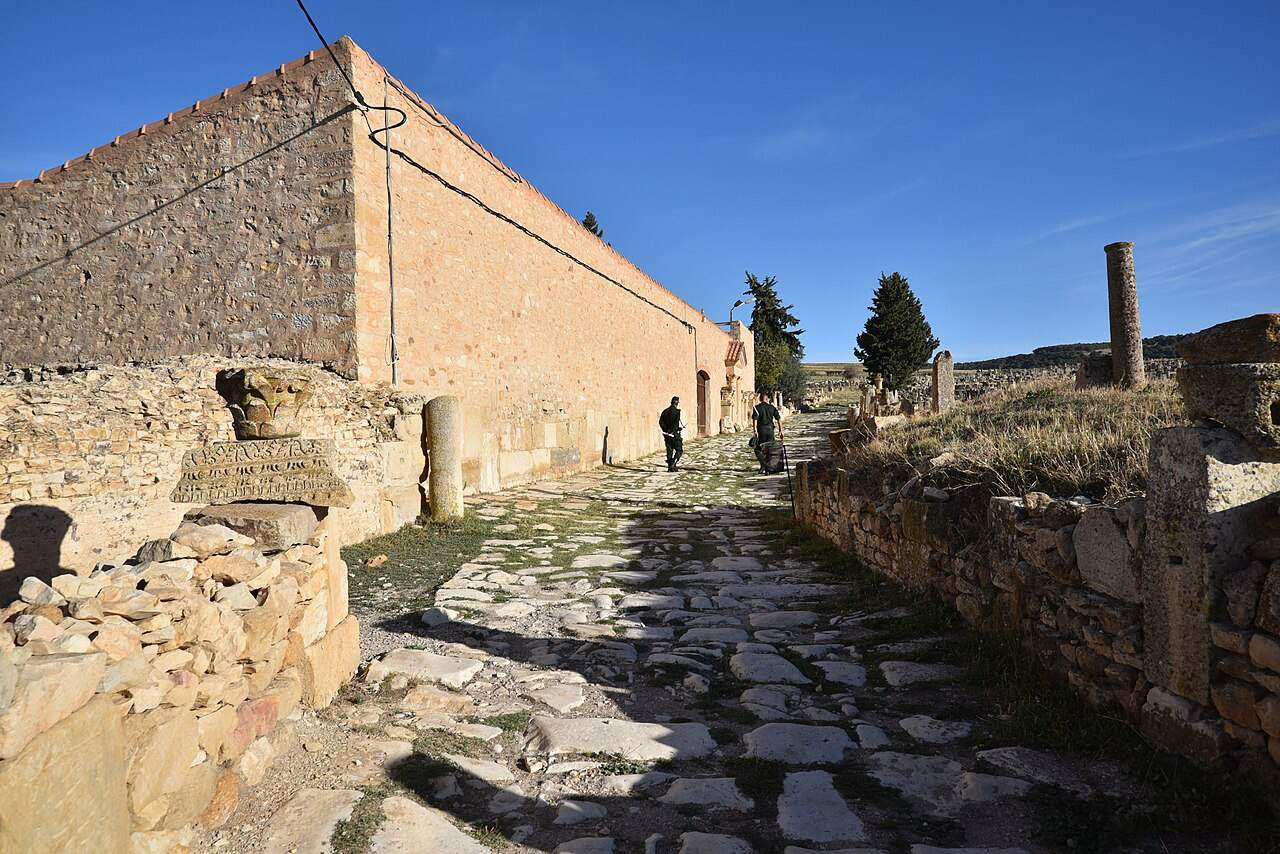
The ruins of Madauros cover a large area, though only a fraction has been excavated. Visitors can see a Roman mausoleum, a theatre (reduced in size by a later Byzantine fortification built in 535 CE), small thermae, a Byzantine-era basilica with three surviving rows of columns, and numerous Latin inscriptions. Oil-production installations point to the agricultural economy that sustained the colony.
The site’s most discussed artefact in Apuleius scholarship is a damaged statue base honouring a “Platonic philosopher.” Most scholars cautiously identify this as a reference to Apuleius, since he was precisely the famous Platonic thinker associated with the town. However, the inscription is damaged and its date cannot be fixed securely, so it works best as evidence that Madauros celebrated its philosophical celebrity rather than as a tool for pinning down exact dates.
The town later entered Christian intellectual history too: Augustine of Hippo, born in nearby Thagaste (modern Souk Ahras), studied at Madauros in his youth before moving on to Carthage.
From Augustine to the Apuleius Prize: a long chain of reception
Apuleius never quite disappeared from North African cultural memory. In the late fourth and early fifth centuries, Augustine discussed him repeatedly — sometimes as a philosophical authority, sometimes as a suspect practitioner of magic. Augustine’s engagement is revealing: he treats Apuleius not as an obscure provincial but as a well-known North African intellectual whose reputation still carried weight centuries after his death.
Institutional commemoration has been notable. The Bibliothèque nationale d’Algérie organised an “Apuleius Prize” (Prix Apulée de Madaure) for debut novels, open to works in Arabic, Tamazight, and French — explicitly using Apuleius’ name to symbolise Algeria’s multilingual literary field. Separately, Mohamed Cherif Messaadia University in Souk Ahras publishes a peer-reviewed academic journal called Apuleius, positioning him as a banner for scholarly identity in the region associated with Madauros.
The outsider who mastered the centre
What makes Apuleius compelling for an Algerian cultural narrative is not a simple claim of ownership. It is the shape of his story. What makes Apuleius compelling for an Algerian cultural narrative is not a simple claim of ownership, but the shape of his career. A writer from Roman North Africa used the prestige languages of his age to produce a work that outlasted the empire that gave those languages power. Some modern scholars, especially those working through postcolonial and provincial-identity frameworks, have found this dynamic especially revealing.
Nearly nineteen centuries after his birth, the ruins of his hometown still stand in the hills of eastern Algeria. The theatre where performances were once staged has lost some of its seating to a Byzantine fortress. The forum where a statue once honoured a “Platonic philosopher” is open to the sky. But the novel — that improbable, bawdy, mystical tale of a man turned into a donkey — survives complete. It is, fittingly, the only one of its kind.