

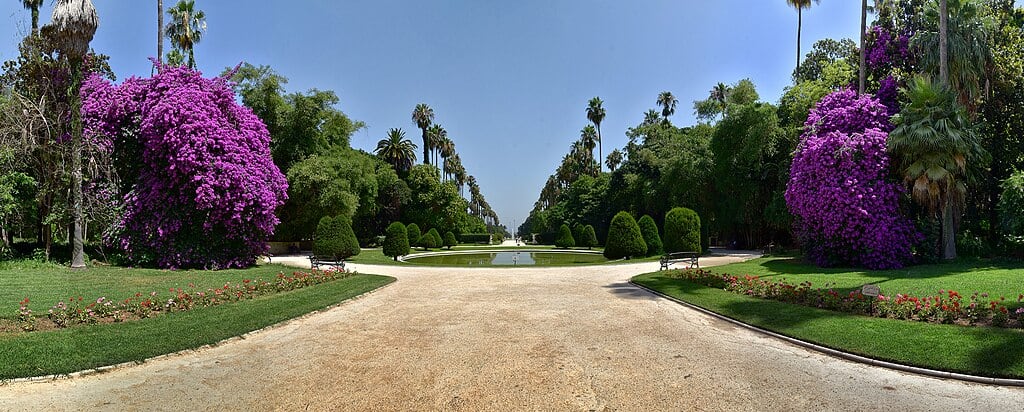
The Jardin d’Essai du Hamma — also known as El Hamma Botanical Garden or simply Jardin d’Essai — is one of Algiers’ most distinctive public spaces. Spread across roughly 32 hectares in the capital’s El Hamma district, it combines a formal terraced landscape with something closer to a jungle, a working zoo with historic greenhouses, and a colonial-era nursery with a very contemporary civic identity. In 2023, it drew nearly 2.4 million visitors across the botanical garden and zoo, making it far more than a niche botanical attraction — it is a venue of everyday urban life in Algiers.
From Swamp to Nursery: The Garden’s Colonial Origins
The garden’s story begins not with landscaping but with drainage. In the early 1830s, French colonial administrators were reclaiming marshy ground in the El Hamma area, and what emerged was an experimental nursery intended for introducing and testing plants moved through French imperial networks. Modern sources regularly cite 1832 as the creation date, crediting the initiative to Pierre Genty de Bussy alongside Antoine Avisard.
Under Auguste Hardy, often cited as director from the 1840s, the scope broadened considerably. This was the era of mass plant introductions, structured avenues, and horticultural trials at scale. The signature tree-lined routes that still define the garden today — plane trees, dragon trees (dragonniers), ficus, bamboo — are repeatedly linked to this period in both historical and contemporary descriptions.
Two Gardens in One
What makes the Jardin d’Essai unusual — and what shapes the experience of walking through it — is its design in two contrasting halves, often described in terms of ‘French’ and ‘English’ landscape styles.
The French Garden
The western sector is a formal, terraced composition built around a central axis lined with Washingtonia palms. The perspective opens towards the sea, with stepped terraces framing long views. This is the garden at its most geometric — a grand promenade designed to impress. The terraced layout is widely attributed to architects Régnier and Guion, who began the redesign around 1913–1914.
The English Garden
The eastern sector could hardly be more different. Here, winding paths thread through heavy shade and exuberant vegetation, with a small lake as a focal point. Visitors and journalists regularly describe this half as feeling almost tropical — a labyrinth where the canopy closes overhead and the air grows noticeably humid. One of the best-known trees here is a huge ficus sometimes nicknamed the “Tarzan tree”. A long-running local story links it to jungle-film imagery — and a 2017 feature in Le Point even claims that some scenes from the 1932 Tarzan the Ape Man were filmed here — though this remains difficult to verify from primary film records.
The Named Avenues
The garden’s identity is strongly tied to its allées, each corresponding to a plant grouping: dragon trees, plane trees, ficus, bamboo. These are not merely decorative features. They are living remnants of the original acclimatisation mission — testing which species could thrive in Algerian conditions, then propagating them at scale. Walking down the dragon tree avenue, often dated to 1847, is to walk through a piece of applied botanical history.
War, Independence, and Revival
The garden experienced periods of disruption and deterioration in the mid-20th century, followed by post-war restoration and reopening. An official classification date of 24 October 1947 appears in the Ministry of Culture and Arts’ register of protected cultural properties, placing the garden firmly within Algeria’s national heritage inventory.
After independence, the site navigated a tension familiar to many post-colonial institutions: balancing its role as a public park against research and institutional priorities. Multiple sources describe periods of decline. The major turning point came in the 2000s, when a rehabilitation programme — developed through decentralised cooperation between the Mairie de Paris and the Wilaya of Algiers — addressed infrastructure, water networks, paths, signage, and the restoration of historic greenhouses.
The rehabilitation work on the greenhouses deserves particular note. Technical documentation describes two historic exhibition greenhouses — early 20th-century structures with traditional glazing and metal architecture — that were restored “like-for-like” as part of the programme. These are often described as among the most significant historic greenhouse structures in Algeria, combining heritage value with ongoing horticultural function.
In 2017, the garden was reorganised as an EPIC (Établissement public à caractère industriel et commercial) under provincial authority, a structural change that gave it a more defined governance framework for managing visitors, programming, and safety.
A Living Civic Space
The visitor numbers tell part of the story. Official reporting attributed to Algérie Presse Service described attendance as over two million in 2022 and nearly 2.4 million in 2023 — record levels that include both the botanical garden and the zoo. These are figures that place the Jardin d’Essai among the most-visited public green spaces in North Africa, though direct comparisons are difficult given inconsistent data across the region.
Beyond raw attendance, the garden has increasingly positioned itself as a venue for education and family programming. Recent activity reporting references workshops, environmental education centre activity, and library use by students — consistent with a botanical garden trying to serve both leisure and learning roles.
The site also sits within a broader cultural corridor. The hilltop Maqam Echahid memorial is visible from within the garden, and the National Museum of Fine Arts of Algiers is nearby. Metro and cable car connections link these landmarks, and official transport materials explicitly present the area as a cluster of city attractions accessible from the Jardin d’Essai metro station.
An Artistic Legacy
The garden’s cultural footprint extends well beyond Algiers. Pierre-Auguste Renoir painted here during his time in Algeria, and the garden appears in imagery associated with his Algiers-period work — a connection documented in major art-market cataloguing. Long-form reportage has linked the dense English Garden to cinematic “jungle” imagery, an association that continues to circulate in Algerian culture and conversation.