

In Algeria’s north-east, close to the Tunisian border, sits a city that rarely gets the attention its stones deserve. Tébessa carries a Numidian past, the Roman name Theveste, a major role in early Christian North Africa, a Byzantine fortress phase, and centuries of Islamic, Ottoman and French colonial rule layered on top. Few Algerian cities make these transitions so visible within such a compact urban footprint.
On 28 April 2025, Algeria submitted the Archaeological Heritage of the City of Tébessa for inclusion on UNESCO’s World Heritage Tentative List. The proposal covers six principal archaeological sites noted for their state of preservation. Tentative List status is a preliminary national step, however, and does not constitute UNESCO World Heritage inscription.
Modern Tébessa is no ruin frozen in time. It is a working provincial capital, with an estimated 253,826 residents at the end of 2023, and the seat of Tébessa wilaya — a city shaped as much by agriculture, commerce and the wider phosphate economy as by its Roman temple and Byzantine wall.
A city on the high plateaux
Tébessa sits on Algeria’s eastern high plateaux, where steppe uplands meet the northern edge of the Saharan Atlas, roughly 650 kilometres from Algiers and around 900 metres above sea level. Its proximity to Tunisia helps explain why the city has mattered strategically in almost every era of its history.
The regional administrative map changed in April 2026, when Algerian law created the new wilaya of Bir El Ater from Bir El Ater, Negrine, El Ogla El Melha and Ferkane, previously administered as part of Tébessa. The transfer of administrative responsibilities is scheduled to continue through the end of 2026.
The climate is that of a high, semi-arid plateau: hot, dry summers and cold, windy winters. Rainfall is modest and variable, with most precipitation falling outside midsummer. For visitors interested in walking the archaeological circuit, spring and autumn are generally the more comfortable seasons.
From Numidian settlement to Roman colonia
Tébessa’s origins remain only partly understood. Ancient references and later archaeological scholarship point to roots that pre-date Roman control. The Italian Treccani encyclopaedia notes that the settlement was known in written sources by the third century BCE, while Algeria’s Tentative List submission traces the city’s beginnings to a Numidian or protohistoric past. The scale and character of that earlier settlement remain genuine research questions rather than settled facts.
Roman influence expanded across Numidian territory over the following centuries, and Theveste grew into a significant military and civic centre. The Third Augustan Legion (Legio III Augusta) moved there from Ammaedara, at modern Haïdra in Tunisia, during the Flavian period before transferring to Lambaesis, at modern Tazoult near Batna, in the early second century. The city is generally understood to have become a colonia under the emperor Trajan.
The city’s best-known monuments date from the following two centuries. The Temple of Minerva, dedicated to the Roman goddess and dated to the second century CE, is compact by comparison with grander imperial temples elsewhere — about 15 metres long, nine metres wide and nine metres high — but preserves an unusually rich programme of carved friezes and pilasters, with motifs of ram and bull heads, owls, serpents, olive branches and fruit. Algeria’s Tentative List submission describes it as one of the best-preserved Roman temples in Algeria and North Africa. Converted into a museum in 1892, it continues to house archaeological objects connected with the city and region.
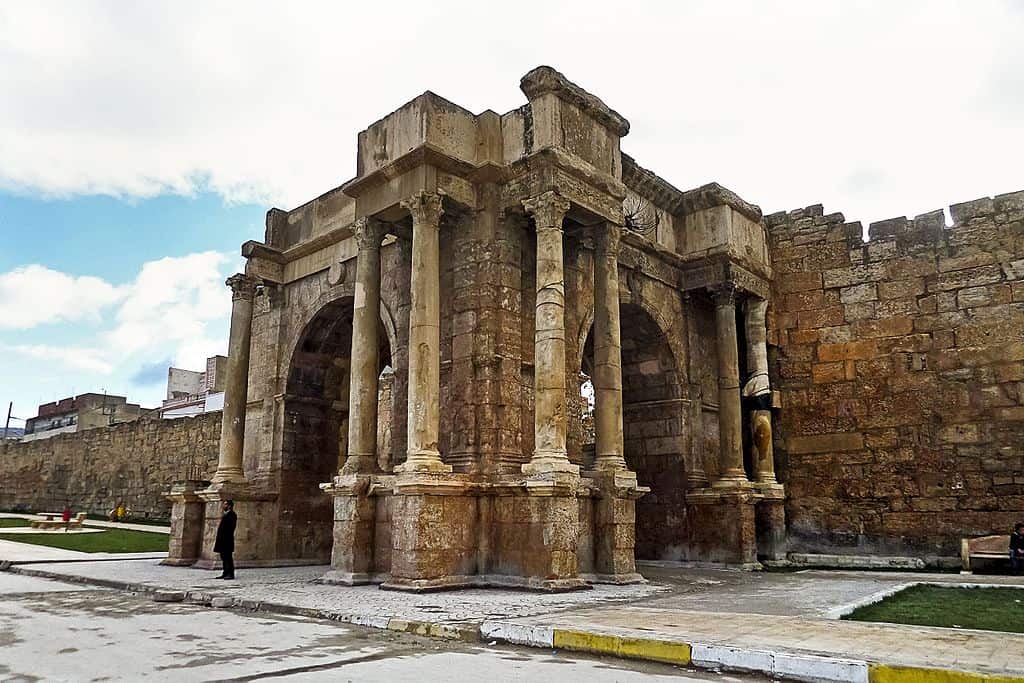
Nearby stands the Arch of Caracalla, a monumental quadrifrons arch — four near-identical façades on a square plan of about 10.94 metres per side — erected in 213 CE. The Algerian submission highlights its rare four-sided form, drawing comparisons with Leptis Magna in Libya and the Arch of Janus in Rome. It also notes that consolidation work undertaken in the early 2000s introduced support materials around the base, partially affecting the monument’s authenticity — a reminder that even well-loved monuments carry the marks of their conservation history.
Christian Theveste and the Byzantine wall
By the third to fifth centuries CE, Theveste had become a prominent centre of North African Christianity. It was associated with Crispina, a Numidian Christian woman martyred at Theveste in 304 CE. Just outside the Roman walls stands the great basilica complex, which Algeria’s Tentative List submission presents as one of the largest Christian basilicas in North Africa, with surviving columns, foundations and mosaics.
The complex developed through several late-antique phases. Archaeological reports describe a salle tréflée — a trefoil-shaped hall — and other Christian annexes beside the basilica. These additions offer evidence of successive liturgical and funerary alterations and of the complex’s development as a place of pilgrimage, although the precise functions of individual spaces remain open to interpretation.
Theveste remained occupied under Vandal rule before the Byzantines extensively refortified it in the sixth century, building the great Byzantine wall around a rectangle of roughly 320 metres by 280 metres. Rather than simply preserving the Roman-era monuments within its perimeter, the Byzantine city absorbed them into a new defensive logic: the Arch of Caracalla was repurposed as a city gate. It is one of Tébessa’s more striking lessons in how ancient cities were edited and reused rather than simply abandoned.
An amphitheatre, described in Algeria’s submission as roughly 80 metres by 70 metres, with an estimated capacity of around 7,000 spectators, was investigated during archaeological campaigns in the 1960s. It should not be confused with the remains of the city’s separate Roman theatre: the two served related but distinct forms of public entertainment.
The less-documented medieval and Ottoman periods
The early Islamic period is the least clearly documented phase of Tébessa’s history. Older reference works portrayed the city as having largely disappeared from the historical record following the early Islamic conquests of the Maghreb. Treccani, by contrast, argues that continuity of occupation was never entirely broken, although the city gradually lost importance. The disagreement reflects how much work remains to be done on this period.
During the Ottoman period, surviving accounts present Tébessa as a relatively modest garrison and regional settlement rather than a major provincial capital. This phase remains much less extensively studied than the city’s Roman and late-antique history.
French forces occupied Tébessa in 1851. Colonial rule brought military control and the beginnings of organised archaeological excavation and restoration, associated with figures such as Albert Ballu and Stéphane Gsell. Their documentation remains valuable and still underpins much of what is published about the site, but it was produced within a colonial system and should not be treated as a neutral or complete account of Algerian history. The Temple of Minerva was converted into a museum during this period.
Since Algerian independence in 1962, Tébessa has developed as a provincial capital, university city, and transport and commercial centre, with its archaeological heritage remaining central to local identity. A recent milestone was Algeria’s 2025 decision to place the archaeological ensemble on its UNESCO Tentative List.
Culture, craft and everyday life
Tébessa forms part of eastern Algeria’s wider Aurès and Nemencha cultural landscape. Chaoui — or Tacawit — heritage remains important across the region, alongside strongly Arabophone urban communities and families whose linguistic and cultural identities overlap. Research on the region’s sociolinguistic landscape describes the coexistence of Arabic, Chaoui and French, with language use varying considerably by locality, generation and urban or rural setting.
The provincial Directorate of Tourism and Handicrafts highlights craft traditions including hand-woven rugs and natural-wool textiles, the men’s burnous, the women’s melhfa, and silverwork associated with the wider Aurès region.
Everyday Arabic in and around Tébessa belongs broadly to the eastern Algerian Darja continuum. It has been shaped by the city’s border position, its proximity to Tunisia and its long contact with Chaoui-speaking communities, producing recognisable local vocabulary, pronunciation and turns of phrase.
Learn the language
Eastern Algerian DarjaA free ten-lesson email course for complete beginners — the greetings, everyday phrases and essential vocabulary of the region, with audio recorded by a native speaker.
Local cuisine draws on grains, olive oil, seasonal vegetables, hot peppers and dried fruit. Couscous, masfouf and berkoukes are among the dishes highlighted by the tourism directorate’s account of traditional Tebsi cooking, alongside the use of dried plums, nuts and dates, particularly in winter dishes.
The city’s airport and university are named for Cheikh Larbi Tebessi, a reformist scholar and anti-colonial figure born in the region. He disappeared after being abducted in Algiers in 1957 during French colonial rule, and his fate remains unknown. The University of Tébessa adopted his name in recognition of his scholarship and intellectual struggle.
An economy beyond the ruins
Phosphate mining shapes the wider Tébessa–Bir El Ater economic corridor. Bled El Hadba and Djebel Onk lie south of Tébessa in the newly created wilaya of Bir El Ater. The eastern mining railway project is intended to connect these deposits through Tébessa, Souk Ahras and Guelma to processing and export infrastructure around Annaba. Work continued during 2026, although development and commissioning schedules remain subject to change.
Agriculture and livestock also remain important locally, and the city functions as a convergence point for several national road corridors. Cheikh Larbi Tébessi Airport lies just north of the city, although travellers should confirm current routes and schedules directly with the airline before making plans.
Why it matters
What makes Tébessa distinctive is not any single monument but the way its history remains legible in sequence, above ground, within a single walkable core: a temple that predates the arch that became a gate in a wall, standing near a basilica associated with a martyr’s memory. It is a city repeatedly reshaped rather than simply erased, with traces of its Numidian, Roman, late-antique Christian, Byzantine, medieval Islamic, Ottoman and French-colonial periods preserved within the modern urban landscape.
For readers encountering Tébessa for the first time, that is perhaps the point: this is a place whose importance lies not in a single “best-preserved” claim, but in how much of its long, layered story can still be read directly from its stones — provided one takes the time, and the care, to look.