

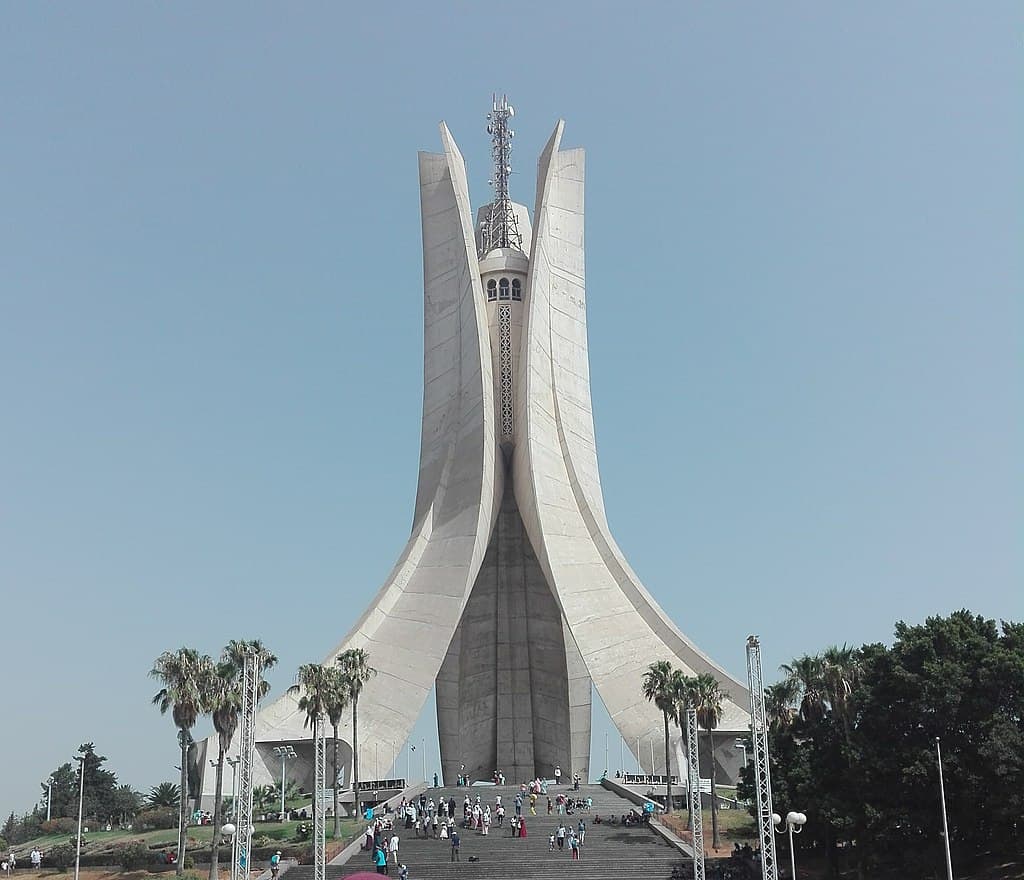
The Maqam Echahid (Martyrs’ Memorial) stands as Algeria’s most iconic monument, commemorating those who died in the struggle for independence. Built between 1981-1982, this striking concrete structure rises 92 meters above Algiers, visible from across the city.
Created through collaboration between painter Bachir Yellès and several Algerian artists, the monument features three concrete arches that curve upward. These three arches carry deep symbolic meaning with several possible interpretations. Some view them as representing the union of agriculture, culture, and industry essential for post-independence development, whilst others see them as embodying the three pillars of the Algerian Revolution: political, military, and social. However, they likely represent the distinct stages of Algeria’s independence struggle. Three soldier statues at the base of each arch reinforce this interpretation, representing the Popular Resistance (1830–1954), the National Liberation Army (1954–1962), and the National People’s Army. This layered symbolism allows the monument to resonate across different aspects of Algerian national consciousness.
The memorial complex includes an underground museum displaying artifacts from the liberation struggle, weapons used by freedom fighters, and personal belongings of fallen heroes. The site attracts thousands of visitors annually, serving both as a tourist destination and a place of national pilgrimage.
Located in the Riadh El-Feth complex, the monument overlooks the Mediterranean Sea and offers panoramic views of Algiers. For Algerians worldwide, Maqam Echahid represents the ultimate symbol of sacrifice, independence, and national pride – a towering reminder of the price of freedom.