

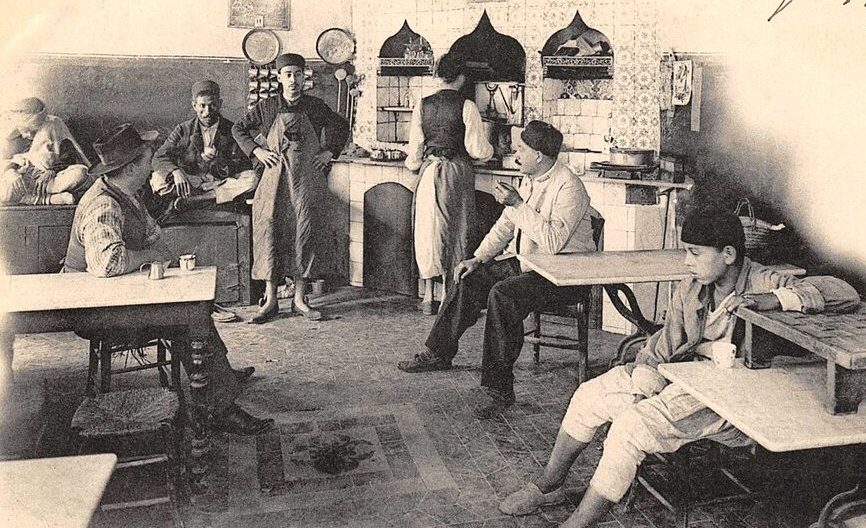
Few public spaces in Algeria carry as much social weight as the coffee house. From the traditional café maure (a traditional North African-style café/tea room, often serving coffee, mint tea, and syrups) of the Ottoman era to the espresso bars and pastry-led salons de thé of today’s cities, coffee houses have served as gathering points where community bonds are formed, information circulates, and daily life takes shape. They are not merely places to drink coffee — they are, as the sociologist and historian Omar Carlier has argued, among the most continuously used public places in the country, functioning as persistent channels of social exchange.
A tradition older than colonialism
Algeria’s coffeehouse tradition sits within the wider Ottoman Mediterranean pattern, in which coffeehouses emerged as recognisable venues for sociability and discussion. Scholarly research indicates that coffee was already widespread in Algeria by the early 17th century (around 1633), well before French colonisation — which matters because it places the café firmly within Algerian life rather than treating it as a European import.
From the outset, these were not simply retail outlets. They were spaces where presence, conversation, and observation organised neighbourhood life — what Carlier described as a kind of regulator for social pressures, particularly in contrast to domestic space, which was more private and tightly controlled.
Colonial cafés: separated worlds under one city
The French colonial period (1830–1962) reshaped the café landscape along the same lines that divided everything else. European cafés and Algerian cafés were often socially and spatially segregated, and the divide carried a telling asymmetry: Algerians increasingly entered European cafés, but Europeans almost never set foot in the café maure — with the notable exceptions of tourists and artists.
Colonial authorities often viewed cafés with suspicion. The gathering of Algerian men outside formal colonial institutions made cafés legible as potential sites of organisation, and during certain periods, colonial defenders argued for their closure outright.
Perhaps most striking is how far the café network reached. By the late 1940s, the café had expanded well beyond the cities. According to research, colonial-era counts suggested that by 1948, rural cafés — the café des champs — outnumbered those in urban centres. The coffeehouse was not merely a metropolitan amenity; it was a form of connective tissue binding small-town and rural Algeria together.
Independence and after: the café endures
Following independence in 1962, the café persisted even as its political context transformed. The café’s rhythms were synchronised not only with prayer times but also with transport schedules, work patterns, markets, weather, and unemployment. It was flexible enough to outlive regime transitions.
The café also remained a gendered space. Many historians of modern Algeria note that the traditional café was widely understood as a male social space, while European-style cafés often followed different mixed-gender social conventions. This did not mean Algerian women were absent from public coffee consumption. Rather, the norms governing which venues were socially permissible, and at what times, were structured by deeply rooted gendered expectations — expectations that, as we shall see, are now being partially renegotiated.
Today’s café landscape: many formats, one impulse
Walk through any Algerian city today and the diversity is immediately visible. The traditional café maure — tea, coffee, syrups, cheap seats, and long hours — still anchors neighbourhood life across the country. But alongside it has emerged an ecosystem of espresso-focused cafés, dessert-led salons de thé, branded roasting ventures, and even street vendors whose sidewalk operations create their own micro-gatherings.
What connects these formats is the same impulse that has driven Algerian café culture for centuries: the need for accessible public space. Algeria has a youthful demographic profile, with a median age of roughly 29-30. In a society with a large youth cohort, cafés substitute for limited formal leisure infrastructure — offering inexpensive seating, predictable social scripts, and peer visibility.
What has changed is the segmentation. Traditional cafés continue to function as intergenerational male spaces. Newer cafés, meanwhile, have become youth-oriented spaces marked by fashion, taste performance, and social media visibility — a shift accelerated by Algeria’s high internet penetration, which reached approximately 76.9% (some 36.2 million users) at the start of 2025, with around 25.6 million social media user identities (accounts/identities, not necessarily unique people). Discovery is increasingly platform-mediated, and that favours cafés that invest in photogenic interiors and branded experiences.
The rise of family-friendly pastry cafés and modern venues with mixed-gender seating represents a partial renegotiation of the historically male-coded cafe space — not a disappearance of older norms, but a widening of who can linger, and where.
The economics of a cup: imports, price controls, and thin margins
Behind every cup of coffee served in an Algerian café lies a structurally import-dependent supply chain. Algeria imported roughly US$230 million of coffee in 2024, with the vast majority arriving as green beans destined for domestic roasting. In 2024, Algeria’s largest coffee import origins by value included Côte d’Ivoire, Brazil, Uganda, and Indonesia (OEC). This mix suggests a strong role for robusta alongside arabica in mass-market blends.
The state treats coffee as a socially sensitive good. Executive Decree No. 24-279 (August 2024) sets consumer price ceilings — 1,250 DA per kilogramme for arabica and 1,000 DA per kilogramme for robusta — and caps margins at every stage from import to retail. A state-budget compensation mechanism helps keep prices at or below these ceilings.
For café owners, the practical consequence is that profitability is often made around coffee rather than on coffee. Pastries, soft drinks, ambience, and customer throughput are where the margin lives. This economic reality helps explain why contemporary cafés increasingly differentiate through food menus, interior design, and experience rather than through the price of a cup.
What lies ahead
Algeria’s café landscape faces pressures from both directions. Global coffee price volatility is an ongoing concern for an import-dependent market, and capped margins — while stabilising consumer costs — can constrain investment in quality upgrading. At the same time, the dominance of green coffee imports creates genuine opportunity for value capture through improved local roasting, blending, and branding.
But perhaps the most important thing about Algerian coffee houses is simply that they endure. Empires, wars, independence, economic crises, digital revolutions — through all of it, Algerians have continued to pull up a chair, order a coffee, and sit. The formats change. The impulse does not. In a country where public space has always been contested — politically, socially, and between genders — the café remains one of the most democratic things going: a place where, for the price of a cup, you can claim a seat in public life.