

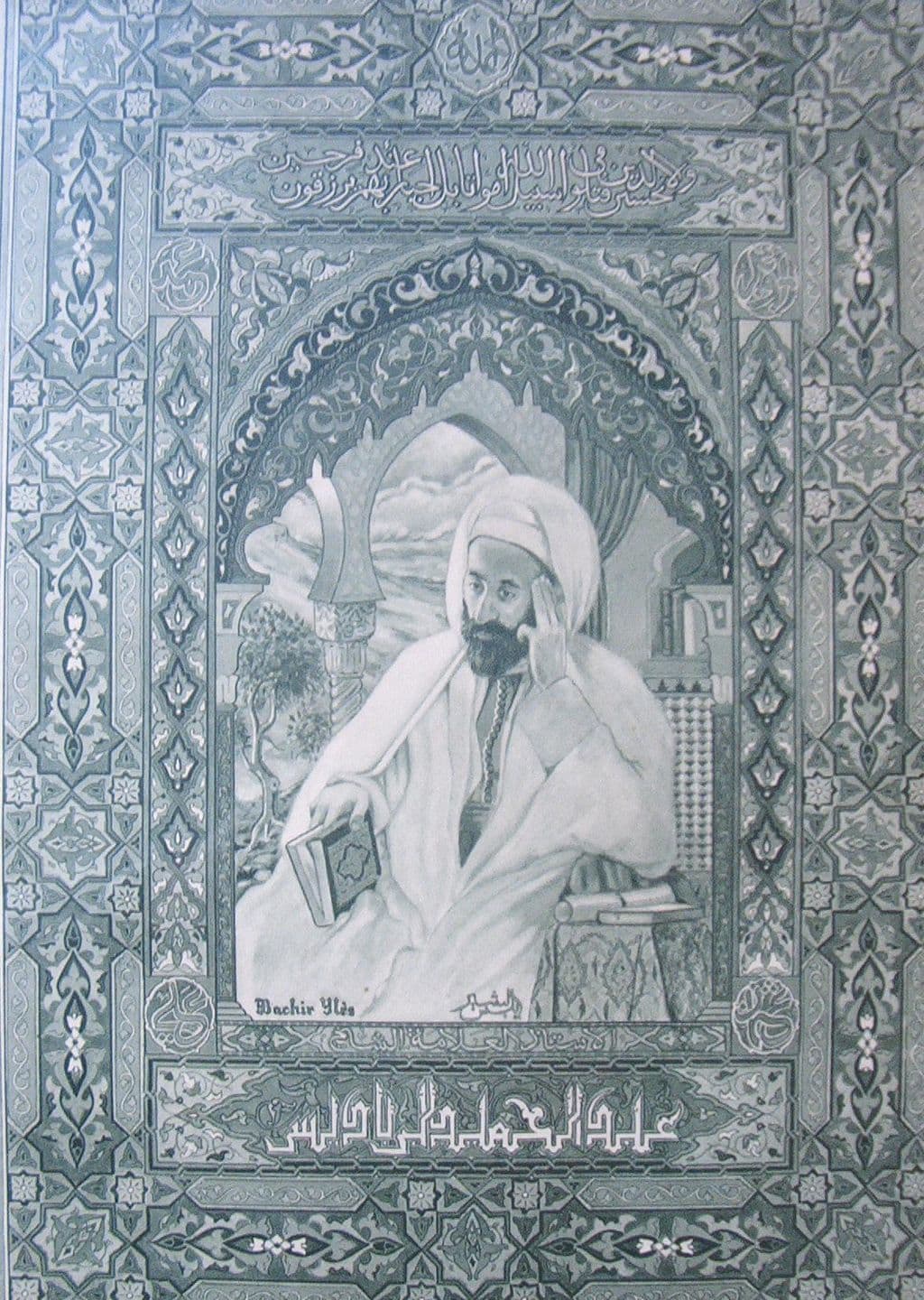
Abdelhamid Ben Badis (1889–1940) stands as one of the most influential figures in Algeria’s modern history—not as a military leader or politician, but as a scholar whose pen proved mightier than any sword. At a time when many Algerians experienced policies that curtailed Arabic and Islamic education under French colonial rule, Ben Badis led a cultural and religious revival that helped forge the very concept of an Algerian nation.
Born on 4 December 1889 in Constantine, the intellectual heart of eastern Algeria, Ben Badis came from a distinguished family that traced its lineage to the medieval Zirid dynasty. Yet despite his family’s accommodation with colonial authority, young Abdelhamid chose a different path. Under the guidance of Sheikh Hamdân Lounissi, who, according to later accounts, urged him to “never take any position in the French government”, Ben Badis dedicated himself to Islamic scholarship and the preservation of Algerian identity.
A Scholar’s Formation
Ben Badis’s intellectual journey took him beyond Algeria’s borders. In 1908, he travelled to Tunis to study at the al-Zaytuna University, then among the most prestigious centres of Islamic learning in North Africa. There, he absorbed the ideas of reform-minded scholars like Sheikh Muhammad al-Taher Ben Achour, who nurtured his profound attachment to the Arabic language.
After earning his diploma in 1911, Ben Badis undertook the pilgrimage to Mecca and travelled extensively through the Middle East. In Medina, he met fellow Algerian scholar Muhammad al-Bashir al-Ibrahimi, forging a partnership that would shape Algeria’s future. Influenced by modernist thinkers such as Muhammad Abduh and Rashid Rida, Ben Badis returned to Constantine in 1913 with a mission: to revive Islam and education among his compatriots.
The Reform Movement
By the 1920s, Ben Badis had emerged as the leading voice of Islamic reform in Algeria. His movement, known as Islah, sought to purge Islam of what reformers saw as accumulated superstitions and colonial neglect, whilst reopening Algerian minds to science and modern knowledge. It was a delicate balance—promoting religious renewal without rejecting intellectual progress.
Starting in 1925, Ben Badis and his colleagues built a nationwide network of free Islamic schools (madaris) independent of the French state system. These schools taught Arabic, Quranic studies, and Arab-Islamic history to thousands of Algerian children, directly countering colonial policies that promoted French-only education. The reformists also travelled across cities and villages, preaching moral and spiritual renewal—often criticising government-appointed clerics and some Sufi practices; others within Sufi networks also pursued renewal, underscoring the diversity of religious life at the time.
Such criticism provoked fierce resistance. When Ben Badis and fellow scholars established the Association of Algerian Muslim ʿUlamāʾ in 1931, with Ben Badis as its first president, colonial authorities took notice. By the early 1930s he faced restrictions on preaching in official mosques. Undeterred, the Association continued its work through private mosques, schools, and publications.
Pens as Weapons
Ben Badis understood that ideas required platforms. In July 1925, he launched al-Muntaqid (The Critic), a weekly Arabic newspaper advocating religious renewal and defending Algeria’s Muslim community.
In 1926, he began publishing al-Shihāb (The Meteor), a review that became the reform movement’s principal voice for more than a decade, carrying Qurʾānic commentary, historical essays and cultural analysis, until wartime censorship ended its run in 1939.
“Algeria is Our Fatherland”
Though primarily a religious scholar, Ben Badis became increasingly involved in political debates during the 1930s. His most famous intervention came in 1936, when Ferhat Abbas—then an assimilationist elected notable—wrote in L’Entente: ‘Si j’avais découvert la nation algérienne, je serais nationaliste… Je n’ai pas trouvé cette nation’ (‘If I had discovered the Algerian nation, I would be a nationalist… I did not find that nation’). He later revised this view: in 1943 he issued the Manifeste du peuple algérien, recognising an Algerian nation and calling for political rights and self-government.
Ben Badis’s response was unequivocal: “We, too, have searched history and the present and have determined that an Algerian nation was formed and exists… This Muslim Algerian nation is not France, cannot be France, and does not wish to be France”.
He distilled this vision into a slogan that would echo through generations: “Islam is our religion; Arabic is our language; Algeria is our Fatherland”; «الإسلام ديننا، العربية لغتنا، الجزائر وطننا» (al-islām dīnuna; al-ʿarabiyya lughatuna; al-Jazāʾir waṭanuna). This credo, recited by students in Ben Badis’s schools, became a defining motto of independent Algeria.
A Legacy That Endures
Ben Badis died on 16 April 1940, two months before France’s defeat by Nazi Germany. His funeral in Constantine drew mourners from across Algerian society. Though he did not live to see his country’s independence, his impact was profound.
French historian Jacques Berque observed that it was due mainly to the efforts of Ben Badis and his followers that Algerians came to see themselves as an Arab-Muslim nation, distinct from France. Many of Ben Badis’s disciples later supported or joined the National Liberation Front (FLN) during the liberation struggle of 1954–1962.
Today, Algeria commemorates Ben Badis’s legacy each year on 16 April, celebrated as Yawm al-ʿIlm (Youm al-Ilm / Journée du Savoir), National Knowledge Day. The University of Mostaganem, Abdelhamid Ibn Badis, and the grand Abdelhamid Ben Badis Mosque in Oran bear his name. His portrait appears on postage stamps, and streets throughout Constantine honour his memory.
More significantly, the ideals he championed—Islamic values, the Arabic language, and Algerian patriotism—remain cornerstones of the modern Algerian state. After independence, Arabic was restored as the national language, and Islam enshrined as a fundamental component of national identity, reflecting much of the vision Ben Badis articulated. Since 2002 and 2016, respectively, Tamazight has been recognised as a national and then an official language—underscoring Algeria’s plural linguistic heritage alongside Ben Badis’s Arab-Islamic emphasis.
Ben Badis is remembered not as a politician or revolutionary, but as the scholarly architect of Algerian nationalism—a man who demonstrated that defending one’s culture and faith is itself a profound form of patriotism. His life embodied a principle that resonates far beyond Algeria: that education, cultural pride, and intellectual rigour can be the most powerful tools in reclaiming a nation’s soul.