

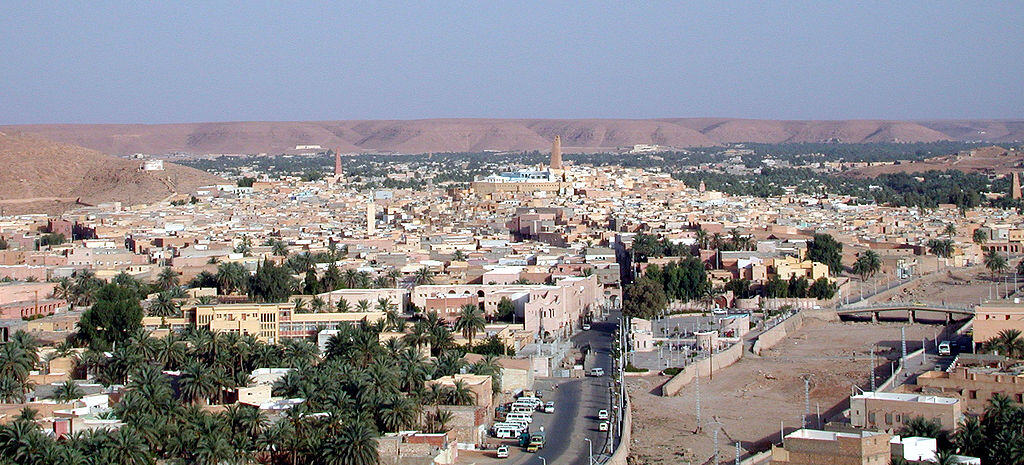
Ghardaia is the principal town of the M’Zab Valley, a cluster of five fortified hilltop settlements rising from the rocky plateau of Algeria’s northern Sahara. Founded by Ibadi communities—ancestors of today’s Mozabites—from the early 11th century, it remains the spiritual and commercial heart of one of the most remarkable urban landscapes in North Africa—a UNESCO World Heritage Site since 1982 that has conserved many aspects of its way of life and building techniques since the 11th century.
Origins in Exile
The story of Ghardaia begins with a collapse. When the Rustamid Imamate fell in 909 CE, its Ibadi population were pushed into new settlements. These were followers of a distinct branch of Islam, neither Sunni nor Shia, whose emphasis on piety, equality and communal welfare had shaped their kingdom at Tahert for over a century. Driven southward, they eventually settled in the inhospitable Wadi M’Zab, where the harsh terrain offered protection from persecution.
Ghardaia’s foundation is typically dated to around 1048 or 1053 AD, when Mozabite refugees established a fortified ksar in the valley. It soon became the chief settlement of the M’Zab pentapolis—the five fortified towns of El Atteuf, Beni Isguen, Melika, Bounoura and Ghardaia itself, built between the 11th and 14th centuries.
After France annexed the region in 1882, Mozabite institutions retained significant autonomy in local religious and social affairs, even as colonial administration expanded.
A Society Shaped by Faith
The Mozabites who built Ghardaia were, and remain, Ibadi Muslims—a conservative branch often described as a third major current distinct from Sunni and Shi’a traditions. Ibadi teachings emphasise piety, egalitarianism and community welfare, principles that have profoundly shaped every aspect of local society.
The community speaks Tumẓabt, a Zenati dialect of Tamazight (Amazigh), while Arabic is widely used in public and written life. Religious governance and social regulation have traditionally been led by the ʿazzāba (councils of religious scholars) within each ksar; at times, these bodies coordinate across the valley through the Majlis ʿAmmī Saʿīd. Community rules have included limits on dowry gold and wedding practices, enforced historically through sanctions such as tebria (temporary ostracism/excommunication) and, in some accounts, exile.
From birth, a Mozabite child is supported by the entire community. The touiza—volunteer work parties—help build houses, while appointed ouamanas (trustees) and the Azzabas assembly of elders oversee city affairs and dispute resolution. Ethnographic accounts emphasise strong mutual-aid norms and community support systems that can reduce visible destitution.
Social life has traditionally been community-centred, with strong norms around marriage and public conduct. Marriages were traditionally endogamous, and women’s roles remain sequestered in many respects. House terraces are designed so that women may observe the outside world without being seen. Yet Ghardaia has historically been more open than its neighbours: unlike Beni Isguen, often described as restricting access to non-Mozabites, while Ghardaia historically hosted a wider range of residents and traders. Europeans, Jews and Arabs were permitted to settle there, making it the most cosmopolitan of the five citadels.
Architecture as Philosophy
The urban fabric of Ghardaia is its most celebrated legacy. Each ksar is a miniature citadel: a clustered walled village on a rocky outcrop, dominated by a fortress-like mosque whose minaret doubled as a watchtower.
Around each mosque, concentric rings of houses descend in terraces, all built to a largely uniform, cubic vernacular that reflects the community’s egalitarian ethos. No home rises above another; no family displays greater wealth through architecture. In Ghardaia’s case, this layout adapts to the steep hill, with the central mosque sitting at the summit and the urban fabric cascading downward.
The winding alleyways, often vaulted or roofed, provide shade in the fierce Saharan heat. Houses are oriented to admit morning light—local proverb holds that “the house where sun comes in will never see a doctor”—and chimneys are positioned so smoke does not disturb neighbours. Materials were entirely local: stone foundations with adobe-brick walls and gypsum-plastered exteriors painted in pale ochre, white and pink hues. Windows are small and elevated, ensuring privacy (particularly for women) and natural climate control.
Defences were woven into daily life. High perimeter walls ring each village, and gateways could be sealed against attack. The communal mosque itself contained granaries and armouries, serving as a last refuge if needed.
This vernacular Ibadi architecture remained remarkably resilient over centuries—a rarity in an era of rapid modernisation. UNESCO recognises the site as “an exceptional testimony of Ibadi culture”. The M’Zab’s abstract geometry and communal planning attracted the attention of Le Corbusier and other modernist architects, who studied Ghardaia’s solutions to desert habitation.
Life in the Desert
Ghardaia lies some 600 km south of Algiers on the Mzab plateau, a brown rocky expanse about 300–800 metres in altitude. The town itself is built along the Wadi M’Zab—an intermittent riverbed that rarely flows. The name “Ghardaia” is often linked to Daia, associated with a cave in the area near the wadi.
The climate is unforgiving. Summer temperatures regularly exceed 45°C; winters are mild but nights can approach freezing. Rainfall is very low (research describes <90mm/year), and episodic downpours can trigger flash floods. When heavy downpours do occur—flash floods struck in 1991, 1994, 2004 and 2008—they can cause significant damage.
Yet the Mozabites have not merely survived in this environment; they have thrived. The key lies in locally developed systems for capturing floodwater and distributing it through regulated irrigation networks that sustain the palm groves around each ksar. This ingenious network, in use for centuries, ensures that each garden receives its share of water while protecting the town from wadi inundations.
Ghardaïa (M’Zab) had about 1.22 million date palms in 2013, according to official statistics compiled from ONS and the Ministry of Agriculture (MADR), making it one of Algeria’s significant date-producing regions. Farmers cultivate Deglet Nour and other varieties, while the fertile land along the wadi yields cereals and vegetables for local markets. Even dead palm trunks find use—reused as timber for house roofs and furniture.
Commerce and Craft
Beyond agriculture, Ghardaia is known for its handicrafts and commercial networks. Textile arts—hand-woven carpets, traditional burnous cloaks and embroidered dresses—employ many artisans. The famous M’Zab carpet designs are produced by specialised loom weavers. Leatherwork, silversmithing and metalworking (copper and brass teapots, lamps) are practised in the souk.
Mozabites have also established themselves far beyond the valley. A modern industrial zone on Ghardaia’s outskirts produces steel and metal goods, and Mozabite families run hardware and wholesale businesses across Algeria. This commercial diaspora—maintaining deep ties to the M’Zab while operating nationally—reflects a pattern of entrepreneurship that has defined the community for generations.
A Living Heritage
Ghardaia stands among Algeria’s most significant cultural tourism destinations, though “most” foreign arrivals to Algeria remain members of the diaspora rather than international tourists, as National Geographic notes. Those who do visit encounter something rare: an almost unchanged medieval townscape still inhabited, still functioning according to principles laid down a millennium ago.
The UNESCO inscription of 1982 recognised the M’Zab Valley as an example of “traditional human habitat [that is] simple, functional and perfectly adapted to the environment”. Local sources proudly affirm the designation, and ongoing conservation projects—often with UNESCO support—work to restore mosques, mausoleums and ksar walls.
Yet Ghardaia is more than a museum. Its residents continue to speak Tumẓabt, observe Ibadi religious practices, and maintain the communal institutions that have governed their society for centuries. The touiza still builds houses; the council of elders still adjudicates disputes. In a world of rapid change, the M’Zab remains what its founders intended: a refuge where a distinct way of life could survive, adapt and endure.