
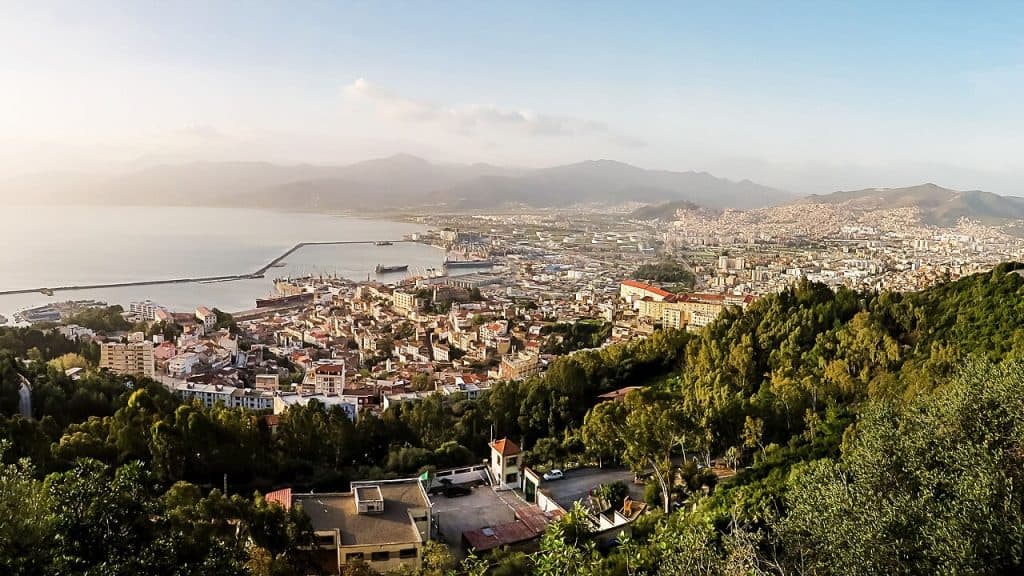
Algeria is the largest country in Africa, the tenth largest in the world, and one of the least understood by English-speaking readers. Its coastline faces Marseille and Barcelona; its southern border reaches deep into the Sahel. Its people speak Arabic, Tamazight, and French, often in the same sentence. Its history runs from some of the oldest stone tools ever found to a war of independence that reshaped the twentieth century. This page is Algeria Connect’s gateway to the country: an introduction to its geography, its long history, its people, its society, its diaspora, and its place in the world, with signposts throughout to the magazine’s fuller features. For the arts, the food, the music, and the rites of daily life, the companion Algerian Culture pillar page goes deeper; this page is about the country that produced them.
On this page
Where Algeria Is: Geography and Landscape
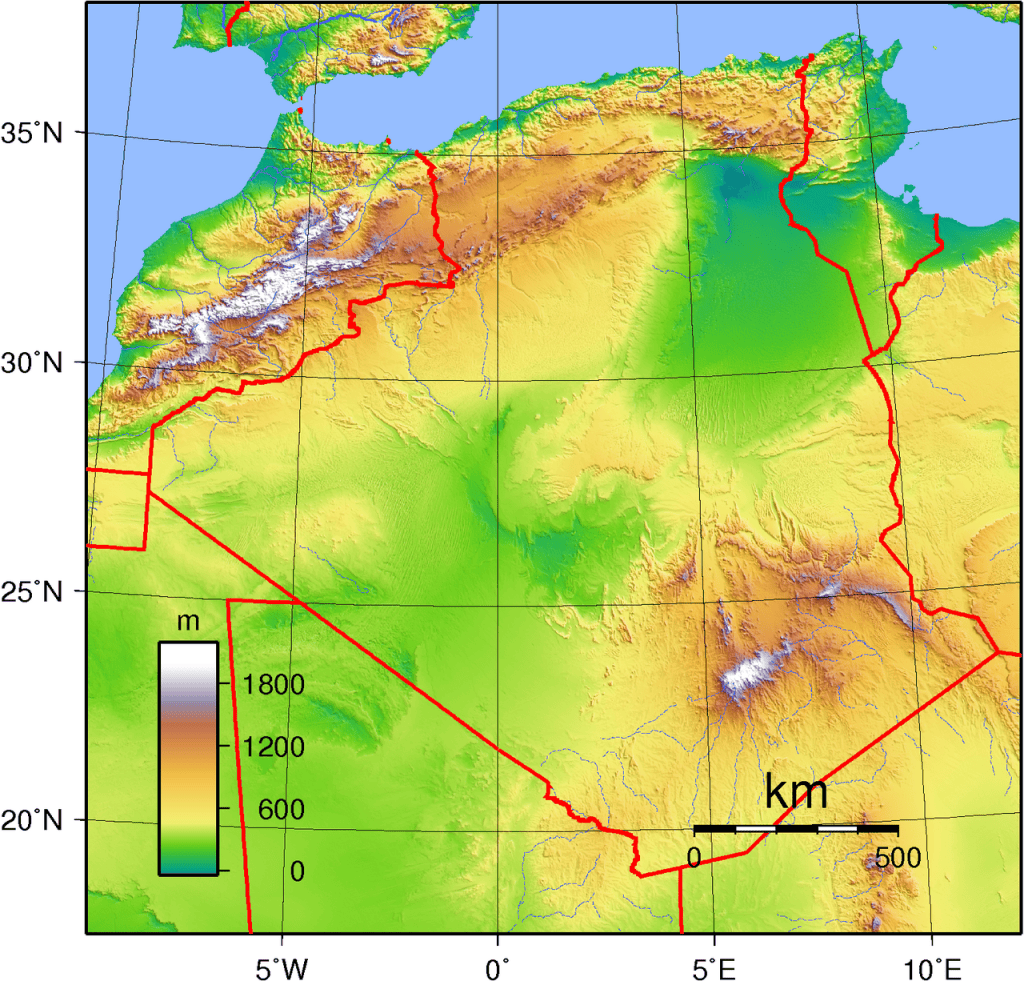
Algeria covers 2,381,741 square kilometres, roughly ten times the area of the United Kingdom, and its geography is best read as a series of bands running east to west. Along the Mediterranean lies the Tell, a narrow, fertile strip of coastal plains and hills where most Algerians live and where the great cities stand: Algiers, Oran, Constantine, Annaba, and Béjaïa. Behind it rise the Tell Atlas and, further inland, the Saharan Atlas, with the High Plateaus between them, a steppe of salt lakes and esparto grass that is neither coast nor desert. South of the Saharan Atlas begins the Sahara itself, which accounts for more than four fifths of the national territory.
The Sahara is not the uniform sea of dunes of popular imagination. It contains the sand seas of the Grand Erg Oriental and Occidental, but also the gravel plains of the regs, the hamada plateaus, and the volcanic massif of the Hoggar in the far south, where Mount Tahat rises to around 3,000 metres (surveys disagree on the exact figure). The Tassili n’Ajjer plateau holds one of the richest concentrations of prehistoric rock art in the world, a record of a greener Sahara that supported cattle herders and hunters thousands of years ago. The Algerian Sahara: Where Ancient Traditions Meet Endless Horizons is the magazine’s introduction to this landscape and the Tuareg, Mozabite, and oasis communities who have made it habitable.
That habitability was engineered. For centuries, oasis towns in the Touat, Gourara, and Tidikelt regions drew water through foggaras, underground channels that tap the water table and carry it by gravity to palm groves while limiting evaporation. In 2018, UNESCO recognised the specialised knowledge of foggara water measurers in Touat and Tidikelt as intangible heritage in need of urgent safeguarding. The irrigation system is explored in The Foggaras of Algeria. The date palms they sustain produce the Deglet Nour, the translucent “date of light” that is Algeria’s best-known agricultural export, the subject of Deglet Nour: Algeria’s Golden Queen of Dates. Further north, in the M’Zab Valley, the Ibadi communities who founded Ghardaïa in the eleventh century built five fortified hill towns whose urban design influenced Le Corbusier and which are now a World Heritage Site; Ghardaïa: The Ibadi Citadel of the Sahara tells their story.
Algeria’s administrative map now provides for 69 wilayas (provinces), up from 58. In November 2025 the government approved the creation of eleven additional wilayas, a change formalised by Law No. 26-06 of 4 April 2026, with the transfer of powers to the new wilayas scheduled for completion by 31 December 2026. The cities themselves are the subject of Algeria’s Urban Tapestry, while two of them have features of their own: Constantine, whose old town sits on a rock plateau sliced by a gorge and is held together by the bridges described in Constantine’s Bridges: How a City Learned to Cross Its Own Abyss, and Tébessa, close to the Tunisian border, where Numidian, Roman, Byzantine, and Islamic layers sit one on another in Tébessa and Ancient Theveste: A City Built in Layers.
Before Algeria: Numidia, Rome, and the Early Church
Human presence in Algeria is among the oldest documented anywhere outside East Africa. Stone tools excavated at Ain Boucherit, near Sétif, have been dated to around 2.4 million years ago, which places toolmakers in the Maghreb far earlier than was once assumed. The rock art of the Tassili n’Ajjer records the much later pastoral societies of the Holocene Sahara. By the first millennium BC, the Amazigh (Berber) peoples of the region, the indigenous population of North Africa, were organised into kingdoms whose names the Greeks and Romans recorded: Numidia in the east and centre, Mauretania in the west.
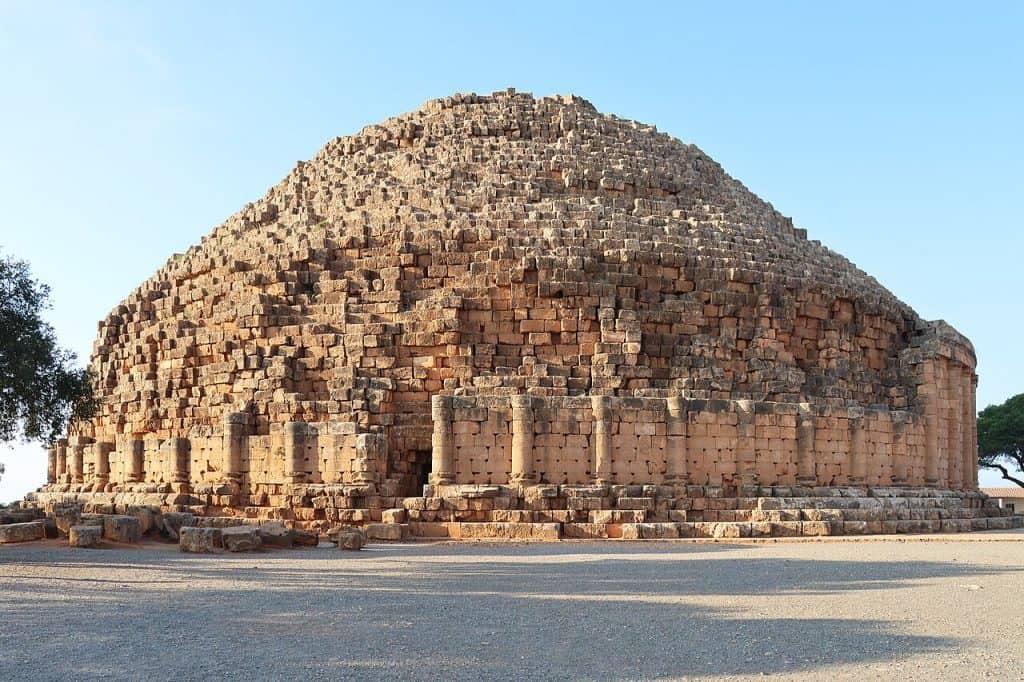
Numidia is the first political entity on Algerian soil that can be followed in some detail. Under Massinissa, who allied with Rome against Carthage and died in 148 BC, it became a unified kingdom with its capital at Cirta, modern Constantine. His grandson Jugurtha fought Rome for seven years before his capture in 105 BC, a war that the historian Sallust turned into a study of Roman corruption. The west produced a monument that still puzzles archaeologists: a circular stone tomb the size of a small stadium on a hill west of Algiers, examined in The Royal Mausoleum of Mauretania, where the evidence for who was buried there, and when, is weighed rather than assumed.
Under Rome, the provinces of Numidia and Mauretania Caesariensis became some of the empire’s most urbanised territory. Timgad, founded by Trajan around AD 100 as a colony for veterans, survives as one of the best-preserved Roman towns anywhere, its grid plan laid out on the plain below the Aurès; Djémila, Tipasa, and Hippo Regius (modern Annaba) are among the others. Algeria’s Roman Legacy surveys these sites. Two writers born in this province shaped Latin literature and Western thought. Apuleius of Madauros, born in the second century at what is now M’Daourouch, wrote The Golden Ass, the only Latin novel to survive complete, and described himself as “half Numidian, half Gaetulian”; Apuleius of Madauros follows the thread back to his hometown. Two centuries later, Augustine, born at Thagaste (Souk Ahras) in 354 and bishop of Hippo for more than thirty years, died in 430 as the Vandals besieged the city; Augustine of Hippo: The North African Bishop in Today’s Algeria considers what it means that the most influential theologian of the Latin West was a North African.
The Vandal kingdom (429–534) and the Byzantine reconquest that followed left fortresses and basilicas, Tébessa’s among them, but neither displaced the Amazigh population or its languages. That continuity matters for everything that came next.
Islam, Arabic, and the Making of the Maghreb
The Arab-Muslim armies reached what is now Algeria in the second half of the seventh century, and by 711 a commander named Tariq ibn Ziyad had crossed the strait that still bears his name (Jabal Tariq, Gibraltar) into Iberia. Tariq is often described as Algerian, but the surviving medieval sources do not establish his birthplace, as Was Tariq ibn Ziyad “Algerian”? explores. The question is a useful introduction to a larger point: the boundaries of modern states did not organise the Maghreb of the eighth century, and projecting them backwards produces confident answers to questions the evidence cannot settle.
Islamisation and Arabisation were separate processes, and the second was much slower than the first. The conversion of the Amazigh population to Islam was largely complete within a few centuries; the spread of Arabic as a spoken language took far longer and was never total. The decisive episode was the arrival from the 1050s of the Banu Hilal and Banu Sulaym, Arabic-speaking pastoral tribes who moved westwards from Egypt into Ifriqiya and then the central Maghreb. Their migration, explored in our account of the Banu Hilal migration, has been read in sharply different ways: Ibn Khaldun compared them to a swarm of locusts, French colonial historians made them the destroyers of a Roman-Berber order, and modern scholarship has emphasised negotiation, alliance, and gradual linguistic change over catastrophe.
Medieval Algeria was a land of dynasties rather than a single state. The Hammadids built their fortress capital at Al Qal’a of Beni Hammad in the eleventh century; the Zayyanids ruled from Tlemcen, whose Great Mosque is among the finest in the Maghreb, for three centuries from 1235. It was in a hilltop fortress in the west of the country, in 1377, that Ibn Khaldun completed the Muqaddimah, the introduction to his universal history and one of the founding works of sociology and historiography; our feature on Ibn Khaldun’s refuge visits the refuge where he wrote it. Across the sea, the slow collapse of al-Andalus sent waves of Muslim and Jewish refugees into the Maghreb over three centuries, culminating in the expulsion of the Moriscos between 1609 and 1614; their mark on Algerian cities, crafts, music, and family names is traced in When Al-Andalus Crossed the Sea. The mosques that anchor this whole inheritance, from village prayer halls to the Djamaa el-Djazaïr in Algiers, completed in 2019, inaugurated in 2024, and possessed of the world’s tallest minaret, are the subject of The Living Heart of Algeria.
The Regency of Algiers, 1516–1830
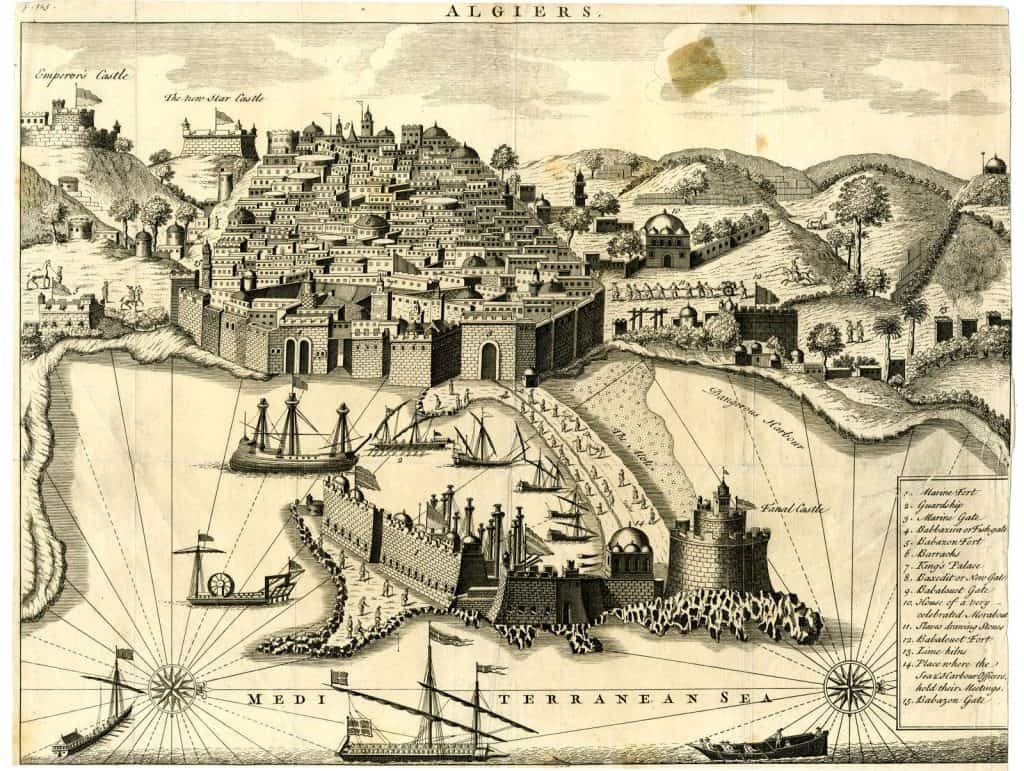
Algeria’s early modern history begins with the brothers Aruj and Khayr al-Din Barbarossa, corsair captains who took Algiers in 1516 and placed it under Ottoman protection. The Regency of Algiers that resulted was, for three centuries, a state unlike any other in the Mediterranean: formally part of the Ottoman Empire, in practice self-governing under a succession of pashas, aghas, and deys, and financed to a considerable degree by maritime raiding. Its fleet seized ships and coastal populations from Italy to Iceland; in 1631 it carried off almost the entire village of Baltimore in Ireland. When Algiers Ruled the Waves tells that story.
The captives were the Regency’s economy and its diplomacy. Tens of thousands of Europeans passed through the slave markets of Algiers; some were ransomed, some converted and rose high in the Regency’s service, some died there. Captives, Corsairs, and Converts sets out what the records show, including the petitions of English sailors’ wives preserved in the Parliamentary Archives. One captive became the most famous of all: Miguel de Cervantes spent five years in Algiers between 1575 and 1580, attempted escape four times, and carried the experience into Don Quixote. The Five Years That Made Cervantes, shortlisted for Editorial Content of the Year at the 2026 PPA Independent Publisher Awards, reconstructs those years.
The Regency also dealt with states as an equal. The young United States paid it tribute in the 1790s and threw in a warship, as our account of Algiers’ tribute diplomacy shows; England’s relations with Algiers go back to treaties of the early seventeenth century, the starting point of Algeria–UK Relations: Four Centuries of Partnership. Ottoman Algiers left its mark on the city too, in the Casbah’s houses and mosques and in a social institution that outlasted the Regency: the coffee house, whose four centuries of politics and sociability are followed in The Algerian Coffee Houses.
French Algeria, 1830–1962
A French expeditionary force landed at Sidi Fredj in June 1830 and took Algiers on 5 July. The pretext was a diplomatic insult; the motive was the political needs of Charles X, who lost his throne weeks later anyway. What began as a punitive expedition became, over the following decades, a settlement colony and, from 1848, legally part of France itself, divided into départements.
Conquest took far longer than capture. In the west, Emir Abdelkader, a scholar from a Sufi family proclaimed emir in 1832, built a state with its own administration, army, and moving capital, the zmala of tents and workshops that French forces finally captured in 1843; The Capital That Moved reconstructs it, and The Scholar-Warrior follows his later life, including his protection of Christians in Damascus in 1860. In Kabylia, resistance in the 1850s was led in part by a woman, Lalla Fatma N’Soumer, whose life and legend are examined in Lalla Fatma N’Soumer: The Defiant Saint of Djurdjura. The Mokrani revolt of 1871–72 was among the largest uprisings against colonial rule, but resistance continued, notably under Cheikh Bouamama from 1881.
The colonial order that followed rested on a legal paradox. Muslim Algerians were French subjects but not French citizens; they could acquire citizenship only by renouncing their personal status under Islamic law, which almost none did, and they lived under a separate penal regime, the indigénat. Unequal Frenchmen explains how that hierarchy was built and why it lasted until 1958. On the other side of the divide stood the European settlers, a community of French, Spanish, Italian, and Maltese origin that numbered around a million by the 1950s and left almost entirely in 1962; The Pieds-Noirs: History, Identity, and Legacy examines their experiences and place in Algeria’s colonial history. Colonial schooling served that community first, as Algeria’s Education Journey shows, and the response of Muslim Algerians was in part to build their own: the reformist scholar Abdelhamid Ben Badis founded a network of free schools and an association of ulama whose motto, “Islam is my religion, Arabic is my language, Algeria is my country”, became a founding statement of modern Algerian identity (Abdelhamid Ben Badis: The Scholar Who Defined Modern Algeria).
French Algeria also produced thinkers who could not be contained by either side. Albert Camus, born in 1913 to a poor settler family and raised in working-class Algiers, is read in Albert Camus: Algeria’s Witness, Not Its Champion as a writer formed by the country who nonetheless could not imagine its independence. Jacques Derrida, born in El Biar in 1930 and expelled from school at twelve under Vichy’s anti-Jewish laws, carried that experience of belonging and exclusion into his philosophy, as Jacques Derrida and Algeria argues. And Frantz Fanon, the Martinican psychiatrist who arrived at the Blida-Joinville hospital in 1953, became the century’s most influential theorist of decolonisation through what he saw there; The Blida Crucible makes the case that Algeria made Fanon as much as Fanon made the Algerian cause his own.
The War of Independence and the Birth of the Republic
On 1 November 1954 the newly formed National Liberation Front (FLN) launched coordinated attacks across the country. The war that followed lasted nearly eight years and is remembered in Algeria as a revolution. The war was marked by widespread violence, including the systematic use of torture by French forces, the forced relocation of rural Algerians into camps, and attacks on civilians. Independence brought an end to 132 years of French colonial rule, but also a period of considerable upheaval, including the departure of most of Algeria’s European settler population and reprisals against those accused of collaborating with the colonial authorities.
Among the founders of the FLN was Larbi Ben M’hidi, the strategist of the urban campaign that became the Battle of Algiers, captured and killed in French custody in 1957; Larbi Ben M’hidi: Strategist of Algeria’s Revolution tells his story. The revolution produced its own symbols. The anthem Kassaman, written in 1956 by Moufdi Zakaria in a French prison, is among the most openly revolutionary in the world and still names France in its verses (Kassaman: Algeria’s Revolutionary Anthem); the green-and-white flag with its red crescent and star, raised over an independent Algeria on 5 July 1962, has a longer history than is usually told (The Algerian Flag). The 92-metre concrete Maqam Echahid above Algiers, built in 1982 for the twentieth anniversary, is the war’s monument (Maqam Echahid: Symbol of Algerian Independence).
Independence came through the Évian Accords of March 1962 and a referendum on 1 July; the date Algeria celebrates is 5 July, chosen because it was the day Algiers had fallen in 1830. The new state immediately became a reference point for liberation movements everywhere. Through the 1960s and 1970s Algiers hosted the ANC, the PLO, the Black Panthers, and Amílcar Cabral, who called it the “Mecca of revolutionaries”; Algiers, “Mecca of Revolutionaries” examines both the solidarity and the state interests behind it.
Algeria Since 1962: State, Economy, and Society
The People’s Democratic Republic of Algeria is a presidential republic with a directly elected president serving five-year terms, a bicameral parliament (the National People’s Assembly and the Council of the Nation), and a constitution most recently revised by referendum in 2020. The army has been central to political life since the war. Understanding Algeria’s Government describes the institutions as they stand. The country’s post-independence history has three broad phases: a socialist, single-party state under Ahmed Ben Bella and Houari Boumediene, with nationalised hydrocarbons and ambitious industrialisation; a transition towards multi-party politics in 1989, followed by the devastating civil conflict of the 1990s, widely known as the “Black Decade”; and the long presidency of Abdelaziz Bouteflika from 1999, ended in 2019 by the Hirak, a sustained movement of largely peaceful weekly demonstrations whose legacy remains debated.
Algeria’s economy rests on oil and, above all, natural gas. Hydrocarbons account for around nine tenths of export earnings, and pipelines under the Mediterranean make Algeria a principal gas supplier to Italy and Spain. That dependence has shaped everything from the exchange rate, explained in practical terms in The Algerian Dinar in Your Pocket, to the fortunes of the domestic manufacturers and food brands that have survived nationalisation, liberalisation, and import restriction in turn (Algeria’s Enduring Brand Champions). The Sahara’s resources had a darker chapter: between 1960 and 1966 France conducted seventeen nuclear tests at Reggane and In Ekker, including one in 1962 that vented radioactive material over soldiers and inhabitants, and the question of clean-up and compensation is still open. Radioactive Sands examines the nuclear tests and their lasting consequences.
Society changed as fast as the state. Mass free education took literacy from a small minority at independence to near-universal among the young, a transformation with its own frustrations, among them an Arabisation policy that set the school language against the languages of home and work. Public life runs on networks as much as institutions; the everyday question ʿandek maârifa? (“do you have connections?”) is examined in It’s Who You Know: Maârifa, Connections, and Access in Algeria. For three decades a single state television channel, nicknamed al-Yatima, “the orphan”, shaped a shared national memory of serials, sketch shows, and dubbed Japanese cartoons (Iconic Television on Algerian State-Run Channels). And football became something close to a civic religion: the 1982 World Cup victory over West Germany, the Africa Cup of Nations wins of 1990 and 2019, and the chant “One, Two, Three, Viva l’Algérie” that unites the country and its diaspora are followed in The Beautiful Game’s Hold on Algeria, Lakhdar Belloumi: The Maestro Who Put Algerian Football on the World Map, and The Football Songs That Carry a Nation. The country’s two Olympic 1500-metre champions, Hassiba Boulmerka and Noureddine Morceli, each have a feature: Hassiba Boulmerka: The Runner Who Defied Convention and Noureddine Morceli: The Algerian Who Ruled Middle-Distance Running.
The People of Algeria: Identity Beyond Labels
Algeria’s population passed 47 million in 2025, nearly five times what it was at independence, and it is young: around three in ten Algerians are under fifteen. Almost all are Sunni Muslims of the Maliki school, with a long-established Ibadi community in the M’Zab and small Christian and, historically, Jewish minorities. Beyond that, the simple labels fail. Are Algerians Arabs? The honest answer, worked through in Are Algerians Arabs? History, Language, and the Question of Identity, is that Arabic language and culture are central to many Algerians’ identities, while the country’s indigenous Amazigh heritage remains fundamental to its history. The two are not mutually exclusive. For many people in Algeria, Arab identity expresses language and culture rather than any single line of ancestry.
The Amazigh dimension is not a minority footnote. Roughly a quarter to a third of Algerians speak a Tamazight language as their mother tongue, chiefly Kabyle in the mountains east of Algiers, Chaoui in the Aurès, Tumzabt in the M’Zab, and Tamasheq among the Tuareg of the deep south. Tamazight was recognised as a national language in 2002 and an official language in 2016, and since 2018 the Amazigh new year, Yennayer, on 12 January, has been a public holiday; Yennayer: Celebrating the Amazigh New Year in Algeria explains the festival and the politics of recognition behind it. The music of the Aurès, carried by the Chaoui language, has a feature of its own in Chaoui Music: The Sound of the Aurès Mountains.
Names carry this history. The prefix Bou- in surnames such as Bouali or Boumaza, the Ben and Ould of patronymics, the Turkish, Andalusi, and Kabyle elements, and the French colonial registrars who fixed spellings in the 1880s are all legible in an Algerian family name, as Why “Bou-” Is So Common in Algerian Surnames explains; readers can look up their own with the magazine’s Algerian Name Decoder. Even pronunciation tells a story: the rolled French r of the Algerian elite, examined in Why Do Algerian Elites Roll Their French R?, is a marker of class, region, and generation.
Languages

Algerians live in several languages at once. Modern Standard Arabic is the language of the state, the school, and the Friday sermon; Algerian Arabic, known as Darja, is the language of the street and the home, a variety whose vocabulary, pronunciation and grammar can differ considerably from Arabic varieties spoken in the Middle East; Tamazight varieties are spoken by millions; and French, despite having no official status, remains widely used in business, higher education and professional life. Meanwhile, English is gaining ground in schools and universities, with reforms introduced in 2026 making it the first foreign language taught in Algerian primary education, ahead of French. The regional varieties of Darja, from the Spanish-inflected speech of Oran to the clipped rhythms of Constantine, are mapped in The Voices of Algeria: A Journey Through the Country’s Linguistic Landscape. Readers who want to hear the language rather than read about it can take Algeria Connect’s free ten-lesson email course, Learn Algerian Arabic, built on Darja from eastern Algeria. For a fuller treatment of the languages and their place in Algerian life, see the Algerian Culture page.
Society and Everyday Life
The rhythm of the Algerian year is set by the Islamic calendar and by the family. Ramadan, spoken of as Sidna Ramadan, “Our Master Ramadan”, reorganises working hours, television schedules, and the national diet for a month, and its social dimension, the evening meals and night-time sociability, is as important as the fast itself (Ramadan in Algeria: Traditions, Practices, and Social Impact). Family rites mark the passage of life: the multi-day wedding with its regional dress and music (The Grand Tapestry: Algerian Wedding Traditions), the henna night that precedes it and that also marks births, circumcisions, and departures for the pilgrimage (Henna in Algeria: Beauty, Blessing, and the Art of Transition), the circumcision ceremony that confirms a boy’s place in the community (The Circumcision Ceremony in Algeria), and the trilling zagharid that announces joy at all of them (The Sound That Marks Life’s Big Moments).
Everyday life has its institutions. The coffee house, inherited from the Ottoman café maure, remains a male public space where politics, football, and dominoes are conducted with equal seriousness. The weekend couscous, the olive oil pressed each winter in Kabylia and the Mitidja (Algeria’s Liquid Gold: The Cultural Soul of Olive Oil), and the public garden, of which the Jardin d’Essai in Algiers is the grandest (Jardin d’Essai du Hamma), are familiar features of everyday life, reflecting Algeria’s deep-rooted Mediterranean traditions. Even the weather has its folklore: a sunshower is ʿers ed-dib, “the wolf’s wedding”, an expression that turns out to have cousins from Morocco to Japan (The Wolf’s Wedding: Algeria, Japan, and the World’s Strangest Weather Folklore).
Culture: An Introduction and a Doorway
Algerian culture rewards the attention this page cannot give it, which is why Algeria Connect maintains a separate Algerian Culture pillar covering literature, music, food, dress, craft, faith, and the figures Algeria gave the world. A few signposts belong here. The Casbah of Algiers, the Ottoman city climbing the hill above the bay, is both a World Heritage Site and a living, decaying neighbourhood (The Casbah of Algiers: A Living Medina Between Memory and Repair), and it gave birth to chaâbi, the urban art music of El Hadj M’Hamed El Anka (Chaâbi Music: The Sound of Algiers). Oran produced raï, the music of defiance that UNESCO inscribed in 2022 (The Voice of Rebellion: How Algerian Raï Music Became a Global Cultural Force). In literature, the generation that wrote in French during and after the war, Kateb Yacine, who called the language “spoils of war” (Kateb Yacine), Mohammed Dib (Mohammed Dib (1920–2003)), and Assia Djebar, who used it to recover the voices of Algerian women (Assia Djebar), remains the country’s best known abroad. In painting, the self-taught Baya Mahieddine astonished Breton and Picasso at sixteen (Baya Mahieddine); in cinema, The Battle of Algiers remains one of the country’s most internationally recognised films, while Algerian Cinema: From Colonial Images to a New Generation traces the evolution of Algerian filmmaking, from colonial-era representations to state-supported productions after independence and contemporary cinema. Regional dress, from the chedda of Tlemcen to the Kabyle robe, is surveyed in Threading Heritage, and the dish that stands for the country in Couscous: Algeria’s Golden Grains of Heritage.
The Diaspora: Algeria Beyond Its Borders
Several million people of Algerian origin live outside Algeria, the great majority in France, where emigration began under colonial rule, accelerated with post-war labour recruitment, and produced by the 1980s a generation born in France that the French language named beur, a term examined, alongside the discrimination experienced by many French people of Algerian descent, in Beur: France’s Algerian Generation and the Word That Named It. Smaller communities, each with a distinct character, exist elsewhere. The British one is modest, shaped by the upheavals of the 1990s and by students and professionals since, and little described until The Algerian Community in the UK; it has at least one landmark, the Algerian Coffee Stores in Soho, founded by an Algerian immigrant in 1887 and still trading (Algerian Coffee Stores: How One Immigrant’s Vision Became a London Institution). The American community is smaller still and shaped by education and professional migration (Algerians in America).
What unites them is the summer. Every year hundreds of thousands of emigrants and their children return for weeks at a time, filling ferries from Marseille and flights from Paris and London, in a homecoming that is part holiday, part family obligation, and part cultural maintenance (The Annual Homecoming). Algeria Connect is itself a product of that diaspora, published from Britain for readers in Algeria and beyond — whether the country is home, the place their families came from, or somewhere they are discovering for the first time.
Algeria and the World
Algeria’s foreign policy has been shaped by the war that created it: non-alignment, support for liberation movements, a doctrine of non-interference, and a jealously guarded sovereignty. Its oldest external relationships, with Britain and the United States, began in the age of the corsairs and have become partnerships in energy and security (Algeria–UK Relations; From Conflict to Cooperation: The Complex History of Algeria–US Relations). China recognised the provisional Algerian government in 1958, before independence, and the “revolutionary friendship” has become a strategic partnership built on construction, medical missions, and a Saharan railway (Algeria and China). With France the relationship remains the most intimate and the most difficult, bound by language, migration, and a colonial memory that neither state has finished with.
Outsiders have been describing Algerians for more than two thousand years, from Greek geographers to Roman historians, Ottoman chroniclers, French ethnographers, and modern journalists, and the record says as much about the describers as the described. Algerians in the World’s Imagination is Algeria Connect’s reckoning with that history of being watched; the Swiss-born Isabelle Eberhardt, who travelled the Sahara in men’s clothing and died there in 1904, is a case study in how the country has been both romanticised and genuinely understood (Isabelle Eberhardt and the Algeria That Made Her). Algeria Connect’s guiding idea is that the connections between Algeria and the wider world already exist; the task is to reveal them.
Frequently Asked Questions
Is Algeria the largest country in Africa? Yes. Since the partition of Sudan in 2011, Algeria’s 2,381,741 square kilometres make it the largest country in Africa and the tenth largest in the world.
What languages are spoken in Algeria? Arabic and Tamazight are the official languages. Most Algerians speak Algerian Arabic (Darja) in everyday life, while Tamazight varieties are spoken by millions. French remains widely used in business, higher education and the media despite having no official status, while English is gaining ground in schools and universities.
When did Algeria become independent? On 5 July 1962, after a war with France that began on 1 November 1954 and the Évian Accords of March 1962.
Are Algerians Arabs or Amazigh (Berbers)? Algerians may identify as Arab, Amazigh, or both. Arabic is widely spoken, Tamazight languages are spoken by millions, and indigenous Amazigh heritage is fundamental to the country’s history. These identities are not mutually exclusive. Are Algerians Arabs? works through the question.
How much of Algeria is desert? More than four fifths. The Sahara covers over 80 per cent of the territory, but almost all Algerians live in the coastal Tell.
What is Algeria known for? Natural gas and oil; the Roman cities of Timgad, Djémila, and Tipasa; the Casbah of Algiers; raï and chaâbi music; couscous and Deglet Nour dates; its war of independence; and a footballing culture second to none in Africa.
Explore Further
- Algerian Culture: the companion pillar on arts, food, music, dress, and faith
- Articles: every feature Algeria Connect has published
- Algerian Name Decoder: what an Algerian surname says about its origins
- Learn Algerian Arabic: a free ten-lesson email course in Darja
- About Algeria Connect: who publishes this magazine and why